Caso Nº 118Case No. 118·GreciaGreece
1990·Espacio aéreo griego — expediente Hellenic Air ForceGreek airspace — Hellenic Air Force file
GreciaGreece.Grecia · radar HAF, tres controladoresGreece · HAF radar, three controllers
El 14 de diciembre de 1990, tres controladores aéreos independientes en distintas ubicaciones detectaron en radar un objeto cigar-shaped que cruzaba el espacio aéreo griego a más de 3.000 mph, pintando un blanco duro en pantalla. La Hellenic Air Force abrió un expediente oficial del caso. Primer caso de Grecia en el corpus: multi-controlador + radar duro + archivo militar.On December 14, 1990, three independent air traffic controllers at different locations tracked on radar a cigar-shaped object crossing Greek airspace at over 3,000 mph, painting a hard target on screen. The Hellenic Air Force opened an official file on the case. Greece's first case in the corpus: multi-controller + hard radar + military file.
AñoYear
1990
TierTier
B
ProbabilidadProbability
45%
CategoríaCategory
IncidenteIncident
Evidencia limitada: testigo único, local o sin verificación primaria. Tres ejes independientes: el «tier» mide la fuerza de la evidencia; la «probabilidad» estima cuán genuinamente inexplicado está el caso —un fenómeno natural puede seguir sin explicación, así que no equivale a «no-prosaico»—; y la partición de explicaciones (abajo) dice qué fue más plausiblemente. Por eso un caso bien documentado puede tener como causa más plausible un posible fraude, y un Tier B no es, por eso, un fraude.Limited evidence: single-witness, local or without primary verification. Three independent axes: the «tier» measures the strength of the evidence; the «probability» estimates how genuinely unexplained the case is —a natural phenomenon can remain unexplained, so it does not equal «non-prosaic»—; and the partition of explanations (below) says what it most plausibly was. So a well-documented case can have a possible hoax as its most plausible cause, and a Tier B is not, for that reason, a hoax.
Documentos primarios · visorPrimary documents · viewer

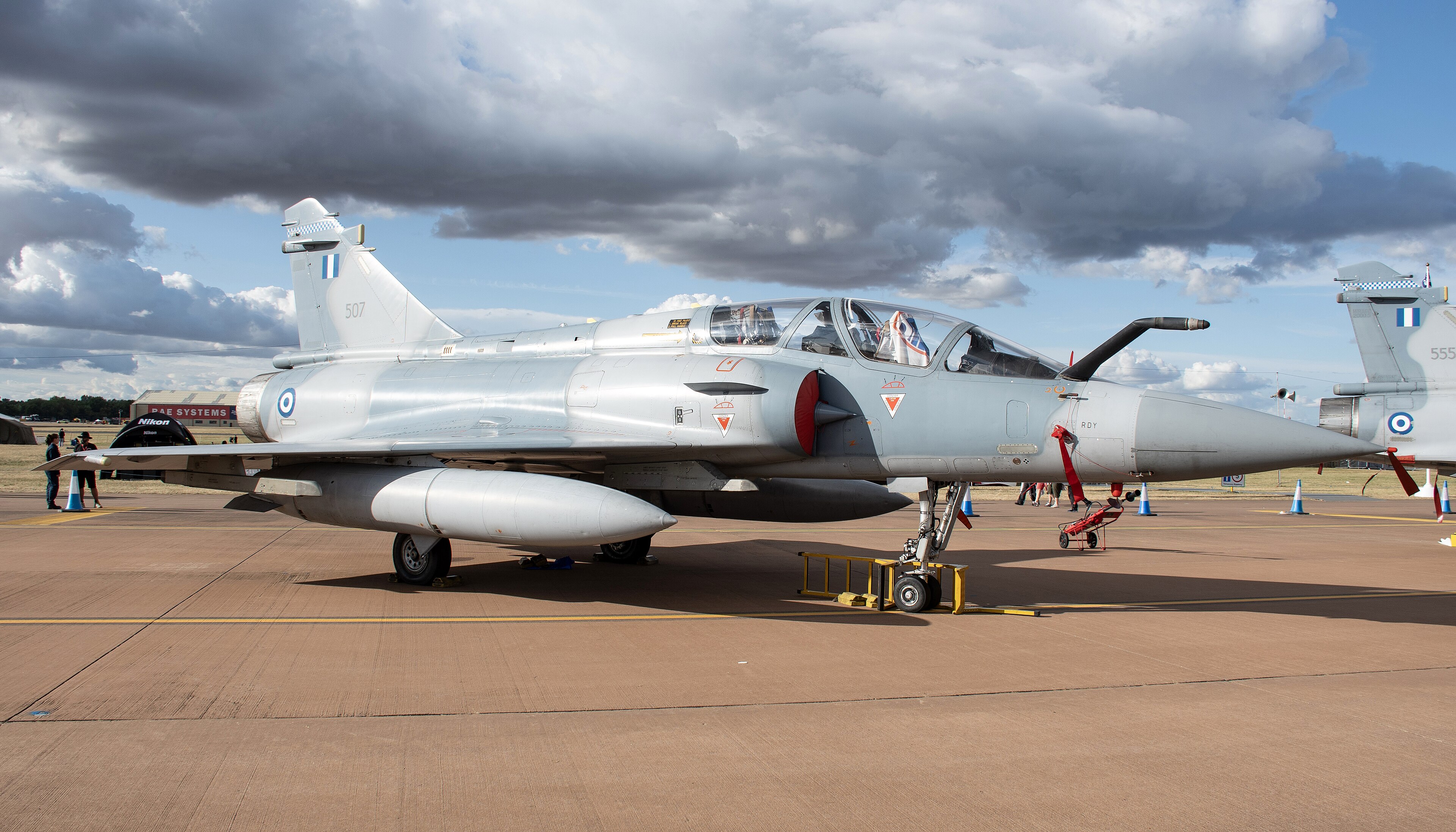
Contexto · la Fuerza Aérea Helénica, que abrió expediente por el avistamiento de 1990Context · the Hellenic Air Force, which opened a file on the 1990 sighting
Hellenic Air Force Mirage 2000.jpg · Wikimedia Commons · CC BY-SA 4.0 · abrir originalopen original
Parte 01Part 01
La noche en cuestiónThe night in question
El 14 de diciembre de 1990, tres controladores aéreos —operando de forma independiente en ubicaciones distintas— registraron en radar el mismo objeto cruzando el espacio aéreo griego. El blanco, descrito como de forma alargada (cigar-shaped), se desplazaba a una velocidad estimada de más de 3.000 mph (unos 4.800 km/h, cerca de Mach 4) y aparecía como un retorno de radar sólido ('hard target'), no como un eco fantasma ni como una interferencia atmosférica.
La coincidencia de tres registros independientes y la naturaleza física del retorno llevaron a la Hellenic Air Force (Fuerza Aérea Helénica) a abrir un expediente oficial del caso. El contexto importa: a comienzos de los años 90 el Egeo era uno de los espacios aéreos más vigilados y disputados de Europa, con intercepciones recurrentes entre cazas griegos y turcos, de modo que la red de radar militar y civil estaba en alerta permanente y los operadores eran profesionales habituados a discriminar tráfico real de espurios.
El encuadre del corpus es directo: lo sólido aquí es la cadena institucional —radar militar, multiplicidad de operadores independientes, expediente de la fuerza aérea—. No hay confirmación visual ni material recuperado, y la cifra de velocidad debe leerse con la cautela habitual de las estimaciones de radar de la época: las velocidades extremas en pantalla pueden originarse en artefactos de procesamiento, propagación anómala (ductos atmosféricos que 'doblan' el haz), correlación errónea de retornos sucesivos o ecos de origen instrumental. Que tres operadores independientes coincidieran reduce —sin eliminar— esas explicaciones, porque algunas anomalías de propagación pueden afectar a más de un radar a la vez. Como dato instrumental institucional, ancla a Grecia en el corpus con un caso de tier medio creíble pero no extraordinario.
On December 14, 1990, three air traffic controllers —operating independently at different locations— recorded on radar the same object crossing Greek airspace. The target, described as elongated (cigar-shaped), moved at an estimated speed of over 3,000 mph (about 4,800 km/h, near Mach 4) and appeared as a solid radar return ('hard target'), not a phantom echo or atmospheric interference.
The coincidence of three independent records and the physical nature of the return led the Hellenic Air Force to open an official file on the case. Context matters: in the early 1990s the Aegean was one of Europe's most heavily monitored and contested airspaces, with recurrent interceptions between Greek and Turkish fighters, so the military and civilian radar network was on permanent alert and the operators were professionals accustomed to discriminating real traffic from spurious returns.
The corpus framing is straightforward: what is solid here is the institutional chain —military radar, multiple independent operators, an air-force file. There is no visual confirmation or recovered material, and the speed figure should be read with the usual caution of period radar estimates: extreme on-screen speeds can arise from processing artifacts, anomalous propagation (atmospheric ducting that 'bends' the beam), mistaken correlation of successive returns, or echoes of instrumental origin. That three independent operators coincided reduces —without eliminating— those explanations, because some propagation anomalies can affect more than one radar at once. As an institutional instrumental datum, it anchors Greece in the corpus with a credible but not extraordinary mid-tier case.
Parte 02Part 02
Por qué este caso movió la agujaWhy this case moved the needle
Primer caso griego del corpus, y de buen perfil institucional: no un avistamiento anónimo sino tres controladores independientes y un expediente abierto por la Hellenic Air Force sobre un blanco duro de radar. Se prefirió este al 'Greek Roswell' de Megas Platanos (2 de septiembre de 1990, en Grecia central), cuyos testigos eran aldeanos que describieron luces y la caída en llamas de un objeto, y cuya explicación oficial —la reentrada de un satélite soviético, con la Fuerza Aérea recogiendo restos— es plausible y mundana. Esa elección editorial es deliberada: entre dos casos griegos del mismo año, el corpus privilegia el de mejor procedencia instrumental e institucional por encima del más espectacular pero peor sustentado.
El caso ilustra también por qué un retorno de radar, aun siendo el tipo de dato más codiciado, no es por sí solo concluyente. Un 'hard target' a Mach 4 sin confirmación visual ni recuperación de material deja abierta la pregunta de qué generó el eco; la fortaleza del registro está en la cadena de custodia institucional —operadores profesionales, multiplicidad, expediente formal—, no en una identificación cerrada del objeto. Por eso entra como tier medio: institucionalmente sólido, físicamente indeterminado.
Vale la pena recordar, además, cuál es el límite documental del caso: lo que llega al corpus es la síntesis de que tres controladores coincidieron y de que la Hellenic Air Force abrió un expediente, pero el contenido de ese expediente no es público y no se dispone de las cintas de radar primarias, los nombres de los operadores ni el informe de cierre. Sin esos primarios, la cifra de '+3.000 mph' y la forma 'cigar-shaped' deben tomarse como descripciones de prensa de un dato técnico que no podemos auditar directamente. Esa es la diferencia entre los casos griegos disponibles y un expediente del tipo del francés (GEIPAN), donde los datos crudos sí se publican. El caso, por tanto, cumple su función —anclar a Grecia con un episodio de buena procedencia institucional— sin que el corpus pretenda que conoce el detalle técnico que solo el archivo cerrado de la fuerza aérea contiene.
Greece's first corpus case, and one with a solid institutional profile: not an anonymous sighting but three independent controllers and a file opened by the Hellenic Air Force on a hard radar target. It was preferred over the Megaplatanos 'Greek Roswell' (September 2, 1990, in central Greece), whose witnesses were villagers who described lights and an object falling in flames, and whose official explanation —a Soviet satellite re-entry, with the Air Force collecting debris— is plausible and mundane. That editorial choice is deliberate: between two Greek cases from the same year, the corpus favors the one with better instrumental and institutional provenance over the more spectacular but more poorly supported one.
The case also illustrates why a radar return, while the most coveted kind of data, is not by itself conclusive. A 'hard target' at Mach 4 with no visual confirmation or recovered material leaves open the question of what generated the echo; the strength of the record lies in the institutional chain of custody —professional operators, multiplicity, a formal file— not in a closed identification of the object. That is why it enters as mid-tier: institutionally solid, physically undetermined.
It is also worth recalling the case's documentary limit: what reaches the corpus is the summary that three controllers coincided and that the Hellenic Air Force opened a file, but the contents of that file are not public, and the primary radar tapes, the operators' names and the closing report are unavailable. Without those primaries, the '3,000+ mph' figure and the 'cigar-shaped' description must be taken as press renderings of a technical datum we cannot directly audit. That is the difference between the available Greek cases and a file of the French type (GEIPAN), where the raw data are published. The case therefore fulfills its function —anchoring Greece with an episode of good institutional provenance— without the corpus pretending to know the technical detail that only the air force's closed archive contains.
Parte 03Part 03
Lo que queda en papelWhat's left on paper
Evidencia documentadaDocumented evidence
- Tres controladores aéreos independientes en distintas ubicaciones detectaron el mismo objeto en radar (14 dic 1990).Three independent air traffic controllers at different locations tracked the same object on radar (Dec 14, 1990).
- Blanco duro ('hard target'), forma alargada, velocidad estimada +3.000 mph.Hard radar target, elongated shape, estimated speed 3,000+ mph.
- La Hellenic Air Force abrió un expediente oficial del caso.The Hellenic Air Force opened an official file on the case.
- Sin confirmación visual ni material recuperado — dato puramente instrumental.No visual confirmation or recovered material — a purely instrumental datum.
Patrones que exhibe (1)Patterns it exhibits (1)
UbicaciónLocation
Espacio aéreo griego — expediente Hellenic Air ForceGreek airspace — Hellenic Air Force file · 37.98°, 23.73°
Distribución de explicacionesDistribution of explanations
Este caso se clasifica entre las hipótesis del modelo: la barra reparte el 100% según cuánto pesa cada explicación (la incertidumbre se reparte entre las hipótesis que el caso apoya). Sumadas en todo el corpus producen la partición comparable. Es una pregunta distinta de la Probabilidad de arriba: aquella estima qué tan probable es que el caso sea un fenómeno genuinamente no explicado; esta reparte cuál sería la explicación.This case is classified among the model's hypotheses: the bar splits 100% by how much each explanation weighs (the uncertainty is spread across the hypotheses the case supports). Summed across the corpus they produce the comparable partition. It is a different question from the Probability above: that one estimates how likely the case is a genuinely unexplained phenomenon; this one splits which the explanation would be.
Hipótesis modalModal hypothesis: MisidentificaciónMisidentification 56% · suma 100%sums to 100%
Se confundió conConfused with: Sin objeto único identificadoNo single object identified
Juicio analítico estructurado, no frecuencia calibrada. Clasificación forzada: la masa que la evidencia no permite asignar se reparte entre las hipótesis que el caso sí apoya.Structured analytical judgment, not a calibrated frequency. Forced classification: the mass the evidence cannot assign is spread across the hypotheses the case does support.
Casos relacionadosRelated cases