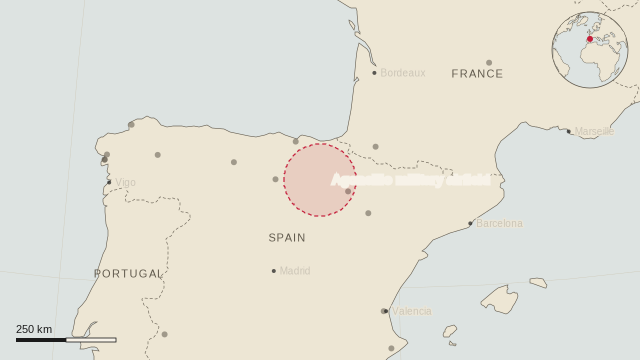
1978·Agoncillo military airfield, near Logroño (La Rioja)
Spain.Agoncillo · three airmen on duty see a diamond of lights
At about 1:20 a.m. on July 20, 1978, the soldier on guard at the gate of the Agoncillo military airfield (Logroño, Spain) saw a strange object in the air; a corporal and a second lieutenant came over and the three followed it for about five minutes as it flew slowly and silently from east to west. Two described it as a diamond and one as a triangle, with white lights at the corners and a brighter light flashing every second. The airfield commander reported it in writing that same day, without proposing an explanation.
Tier A · AcceptableWhat do they mean? →
Institutional evidence: several identified independent witnesses, or contemporary official documentation, without an instrumental record to corroborate them.
What it was
72%ordinary cause, unidentified
The most likely explanation.
- 72% ordinary cause, unidentified
- 6% other earthly causes
- 22% no known cause
See the split across the six explanations
Earthly origin (human or natural)78%
No known cause22%
Why no ordinary cause is identified
What happened
In the early hours of Thursday, July 20, 1978, at about 1:20 a.m. local time, the soldier standing guard at the main gate of the Agoncillo military airfield, about ten kilometers east of Logroño, saw "a strange object in the air." He alerted the corporal, and the corporal alerted the security duty officer, a second lieutenant. Both came to the guard post and, together with the soldier, followed the object for about five minutes as it flew from east to west, until they lost sight of it.
That same day, the lieutenant colonel acting as commander of the airfield signed a letter, number 681, addressed, according to the file's index, to the general commanding the Third Air Region, which the base belonged to. He sent it "in compliance with what was ordered in the reference letter," which the heading identifies as number 3483-CT, dated December 31, 1968. The letter records separately what each of the three witnesses said. Their names are blanked out in the published copy, and the page carries a partly illegible receipt stamp dated July 21.
According to the second lieutenant, the object "was diamond-shaped, with 4 white lights forming the corners, and a brighter white central light" that switched on and off "about every second." The corporal described it as triangular, with three white lights, one at each corner, and the same brighter, flashing central light. The soldier also saw a diamond, without saying how many lights it had, and a brighter light that flashed once a second; his statement does not say where on the object that light was.
All three agreed that the object made no noise at all and was flying at about 1,000 meters (some 3,300 ft), and they found it strange that, if it was an airplane, it made no noticeable noise. It seemed to them to be moving slowly. The letter ends with a sentence that matters for understanding the case: the object was watched until it was out of sight "without any strange movement being noticed." It mentions no check with air traffic control or with a radar, and the published file contains no other papers on the event: only that letter and the summary written when the file was declassified.
That summary was written in February 1995, at Torrejón, by the intelligence officer of the Air Operations Command (MOA, from its Spanish name), the unit that reviewed and declassified the Spanish Air Force's UFO archive between 1992 and 1999. It tells the case in two paragraphs and differs from the 1978 letter on three points. It says only that the soldier alerted "the guardhouse," the guard detail at the post. The letter gives a chain: he alerted the corporal, who then alerted the second lieutenant. It credits all three witnesses with a flashing central light, although the soldier did not place his. And it leaves out the sentence about the absence of strange movements and the comparison with an airplane.
Its only consideration was that nothing made it advisable to keep the case as "classified material." It proposed no explanation. The Air Staff declassified the file on February 15, 1995, with letter 684, and the Air Force Central Library logged it on February 28. Since September 2016 the file, with its cover, summary and letter, has been available in the Spanish Ministry of Defence's Virtual Library.
Where it happened
Why it matters
The Agoncillo case has what a 1970s sighting usually lacks: three military personnel on duty at a base, identified by name and rank in the original report (their names are blanked out in the published copy), and a written report made the same day by the base commander, with what each of them said separately. What it lacks is anything that would settle what they saw: no radar, no photograph, no known follow-up and no measurement. The altitude of 1,000 meters and the "slow" speed are naked-eye estimates, made at night, of lights whose size nobody knew.
All three statements mention a brighter light that flashed once a second, and all three witnesses agreed it made no noise; the letter adds that the object flew from east to west. The second lieutenant and the corporal also describe white lights at the corners. They differ on the shape, which for lights at night can depend on how many each observer makes out and how he connects them: the second lieutenant counted four and saw a diamond, the corporal counted three and saw a triangle. The witnesses considered that it might be an airplane and found it strange that, if so, it made no noticeable noise.
No document in the file suggests what the object was, and no analysis of the case has been published. The researcher Vicente-Juan Ballester Olmos, who worked with the Spanish Air Force on the declassification, lists it in his table of the process (two pages, one case, declassified February 15, 1995) without comment. In the same article he publishes an index of entries from the logbooks of Pegaso, the command center that ran the air defense radar stations, passed to him by General Ángel Bastida. It includes a sighting on the same date, July 20, 1978, in Albacete, about 390 km to the south, which Ballester marks as "additional," meaning a new sighting with no declassified report; he does not link it to Agoncillo, and the index gives neither the time nor the content.
The case also shows how the information traveled. In 1978 an airfield commander was still following a written order from 1968 and reporting to his air region the same day. Seventeen years later, the summary that came with the declassification simplified the account on three points and left out the witnesses' observation that weighs most in interpreting it: that the object did nothing strange while they watched it.
Documents and sources
Primary documents
Spanish Air Force file 780720 (without the cover, 2 pp.): the 1995 MOA summary and the Agoncillo airfield letter of July 20, 1978
The two pages of Spanish Air Force file 780720 on the Agoncillo sighting, declassified on February 15, 1995. The first is the summary by the intelligence officer of the Air Operations Command (Torrejón, February 1995), with the index of documents and the proposal to declassify.
Read more
The second is letter No. 681 from the lieutenant colonel acting as commander of the Agoncillo military airfield, dated July 20, 1978, with each witness's description; the names are blanked out. Grayscale copy, without the cover.
Source: Biblioteca Central del Ejército del Aire y del Espacio / Biblioteca Virtual de Defensa · CC BY 4.0 · open original
Documented evidence
- Letter No. 681 from the lieutenant colonel acting as commander of the Agoncillo military airfield (July 20, 1978), sent in compliance with letter 3483-CT of December 31, 1968: at about 1:20 a.m., a soldier on guard, a corporal and the security duty second lieutenant watched an object flying east to west for about five minutes
- Statements recorded in that letter: the second lieutenant, a diamond with four white lights at the corners and a brighter central light flashing every second; the corporal, a triangle with three white lights and the same central light; the soldier, a diamond without a count of lights, with a brighter light flashing every second
- All three witnesses agreed it made no noise and flew slowly at about 1,000 meters, and that if it was an airplane they found it strange not to hear it; it was watched until out of sight "without any strange movement being noticed"
- Summary by the intelligence officer of the Air Operations Command (Torrejón, February 1995): finds no reason to keep the case as classified material and proposes no explanation; it differs from the 1978 letter on who received the alert and on the soldier's central light, and leaves out that no strange movement was noticed
- Declassified by the Air Staff on February 15, 1995 (letter 684); logged at the Air Force Central Library on February 28, 1995
- Ballester Olmos (October 2016, with a December 2017 addendum and table) lists the file in his table of the declassification, without analysis, and records in an index of air defense logbook entries a sighting on the same date, July 20, 1978, in Albacete, which he marks as a new sighting, with no time or content
Sources
- Spanish Ministry of Defence, Defence Virtual Library, file 780720, "Sighting of strange phenomena at Agoncillo (Logroño): July 20, 1978," 3 pp. — Primary source: the Air Force Central Library cover, the MOA intelligence officer's summary (February 1995) and letter No. 681 from the acting commander of the Agoncillo airfield (July 20, 1978). CC BY 4.0 license.
- Vicente-Juan Ballester Olmos, "Los expedientes OVNI desclasificados" (The declassified UFO files), UFO FOTOCAT Blog (October 2016, with a December 2017 addendum), copy in the Defence Virtual Library — Table of the declassification process (Agoncillo: 2 pages, 1 case, declassified February 15, 1995) and an index of entries from the air defense command center's logbooks, including a sighting at Albacete on July 20, 1978, marked as a new sighting.
- All-domain Anomaly Resolution Office (AARO), Fiscal Year 2024 Consolidated Annual Report on Unidentified Anomalous Phenomena (Nov 14, 2024) — Base rate (p. 3): the 174 closed cases were resolved to prosaic objects; many others remain unresolved.