Case No. 186·United States
1968·University of Colorado, Boulder
United States.Condon Report · USAF–University of Colorado study
'Scientific Study of Unidentified Flying Objects' (1968), led by physicist Edward Condon at the University of Colorado with USAF funding. Its conclusion —that studying UFOs offers no scientific value— closed Project Blue Book in 1969. But its credibility was damaged: the 'Low memo' revealed a design bias, and roughly a third of cases remained unexplained despite the conclusion.
Year
1968
Tier
A
Probability
60%
Category
Document
Institutional evidence: multiple verifiable witnesses or official documentation. Three independent axes: the «tier» measures the strength of the evidence; the «probability» estimates how genuinely unexplained the case is —a natural phenomenon can remain unexplained, so it does not equal «non-prosaic»—; and the partition of explanations (below) says what it most plausibly was. So a well-documented case can have a possible hoax as its most plausible cause, and a Tier B is not, for that reason, a hoax.
Primary documents · viewer
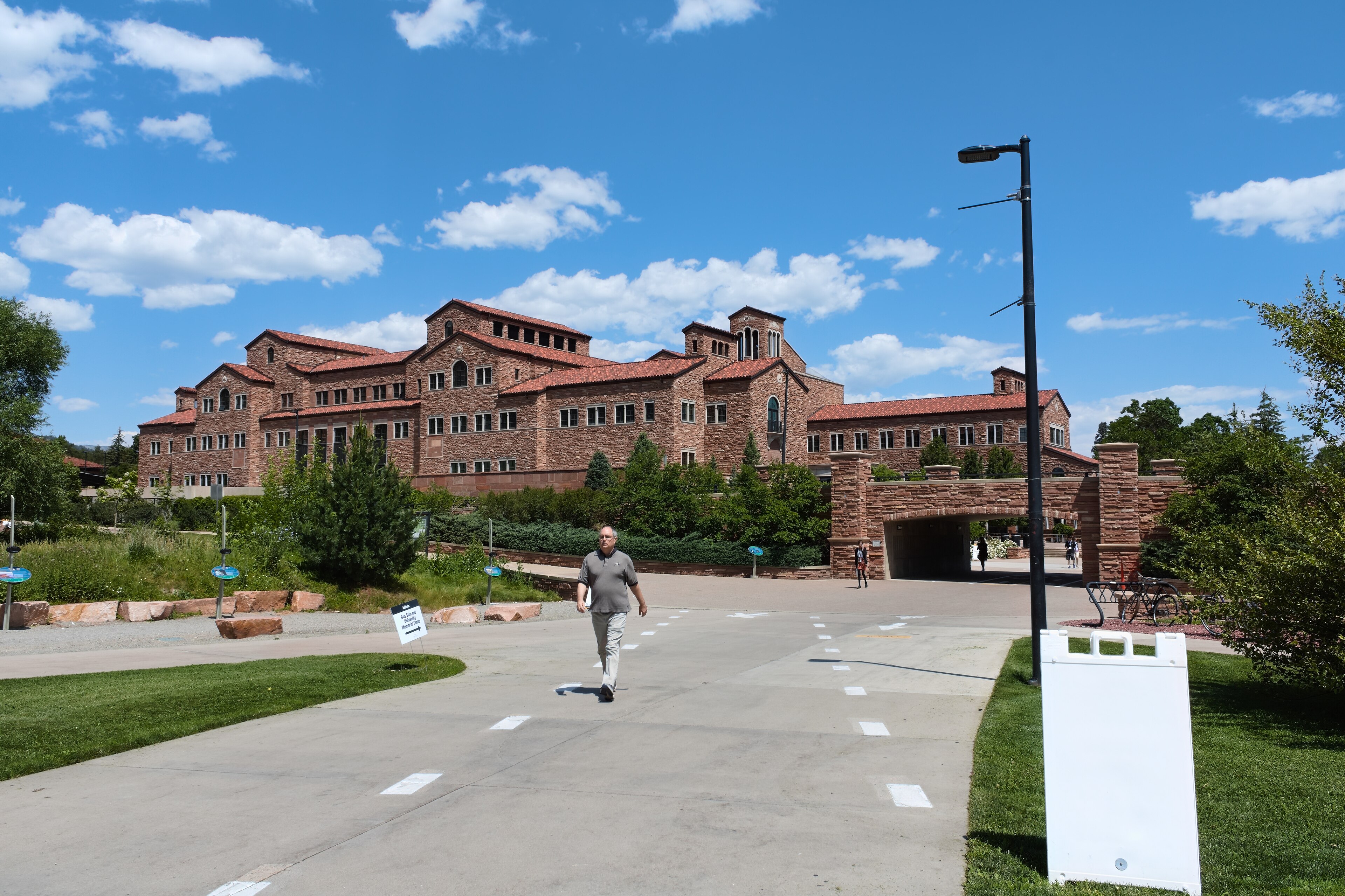
Context · the University of Colorado at Boulder, where the Condon Report was written
Center for Community, University of Colorado Boulder - 20250626111859.jpg · Wikimedia Commons · CC BY 4.0 · open original
Part 01
The file in question
By the mid-1960s, Project Blue Book —the USAF's official UFO record since 1952— faced a mounting erosion of credibility. The 1965-1966 sighting wave in Michigan, which Blue Book scientific consultant J. Allen Hynek tried to explain as 'swamp gas', triggered public ridicule and congressional pressure. To settle the matter with external scientific authority, the USAF contracted in October 1966 an independent study at the University of Colorado, under the direction of physicist Edward U. Condon, a prestigious figure in quantum physics and former director of the National Bureau of Standards. The study had a budget of several hundred thousand dollars and a multidisciplinary team.
Over nearly two years, the committee examined dozens of cases —about 91 in the final report—, commissioned analyses of photographs, radar and physical traces, and produced a volume of more than a thousand pages: 'Scientific Study of Unidentified Flying Objects', delivered in late 1968 and published by Bantam Books in January 1969. The conclusions and recommendations section, written personally by Condon and placed at the front of the report, held that two decades of UFO study had added nothing to scientific knowledge and that funding further investigation was not warranted. The National Academy of Sciences endorsed the report, and on that basis the USAF closed Project Blue Book in December 1969.
The report is famous, however, for its internal tension. In August 1966, even before the USAF contract was signed, project coordinator Robert Low —an assistant dean at the university— wrote an internal memo to reassure the administration: the 'trick', he wrote, would be to describe the project so that 'to the public it would appear a totally objective study' while presenting it to the scientific community as the work of 'non-believers' with 'almost zero expectation of finding a saucer'. The Low memo was leaked to Look magazine in 1968 by two committee researchers, David Saunders and Norman Levine, whom Condon fired over the leak; the episode prompted the resignation or departure of several members and public charges of a mandate bias. And, paradoxically, the report's own body left roughly a third of its cases classified as unexplained, despite a conclusion that asserted otherwise. The file enters the corpus as the U.S. founding skeptical institutional document and as a case study of how a conclusion can diverge from its own data.
Part 02
Why this case moved the needle
It is the document that institutionalized the closure of official UFO study in the U.S. for half a century — and, at the same time, the most cited example of a skeptical conclusion in tension with its own data. The Low memo's 'the trick would be...' line makes it a documented case of mandate bias: the expected conclusion was written before the investigation began. The ~33% of unexplained cases becomes an involuntary argument against that very conclusion, and left a lasting mark on the topic's historiography: astronomer James McDonald and the report's own congressional evaluators (House Committee on Science and Astronautics hearing, 1968) questioned whether Condon's section faithfully represented the study's technical body.
Hence its contribution is ambivalent. As an institutional act, the Condon Report anchors the skeptical pole: it provided academic cover to shut down official investigation. As evidence, its unexplained residue despite an avowedly hostile design weakly strains the 'it's all trivial' reading. Editorial honesty requires acknowledging both sides: neither does the residue prove anything exotic (an 'unexplained' case may be so for insufficient data, not real anomaly), nor does Condon's conclusion hold as a clean inference when its own apparatus undercuts it. Tier A for documentary solidity and verifiable historical impact (it closed Blue Book), not for the strength of a conclusion whose genesis was compromised by the Low memo.
Part 03
What's left on paper
Documented evidence
- 'Scientific Study of Unidentified Flying Objects' (University of Colorado, USAF-funded), delivered 1968, published Jan 1969
- Led by physicist Edward U. Condon; ~91 cases, over 1000 pages
- Conclusion: UFO study offers no scientific value; recommended discontinuation
- Basis for the closure of Project Blue Book (December 1969)
- Low memo (1967): the study designed to 'appear objective' with an expected negative result — mandate bias
- ~33% of the report's cases were classified as unexplained
Sources
- 'Scientific Study of Unidentified Flying Objects' (Condon Report) — texto completo (archive.org) — Primary document.
- University of Colorado / NCAR — registro del Condon Committee
- USAF (AFOSR/SAB) — reunión con el Dr. James McDonald y revisión de Blue Book (17 abr 1967, Pentágono) — Air Force process prior to the Colorado study, with the Scientific Advisory Board and NASA. AARO UAP Records, release 04 (DOWUAPD092).
Patterns it exhibits (2)
Location
University of Colorado, Boulder · 40.01°, -105.27°
Related cases