1956·Coppermine refuge, Robert Island, South Shetland Islands (Antarctica)
Antarctica · Robert Island (Chilean expedition).Robert Island · the two “cylinders” of the Chilean expedition
In January 1956, four Chileans of the 10th Antarctic Expedition, isolated in a refuge on Robert Island with a broken radio, said they saw for about 36 hours two metallic, cylinder-shaped objects standing vertical and still in the sky, which at times manoeuvred in zigzags. The account became known eleven years later, in a ufological bulletin using false names; the only published first-hand testimony is that of the assistant Abelardo Báez, who has told it since 2019. The sources disagree on the date, and one of the scientists' official report ends the stay before the day on which the account has them rescued.
Tier B · IndicativeWhat do they mean? →
Limited evidence: a single witness, testimony gathered years later, or an account without contemporary primary documentation.
What it was
56%natural or human cause
Most likely an ordinary cause that no one has identified
See the split across the six explanations
Natural or human cause
No known cause
Primary documents
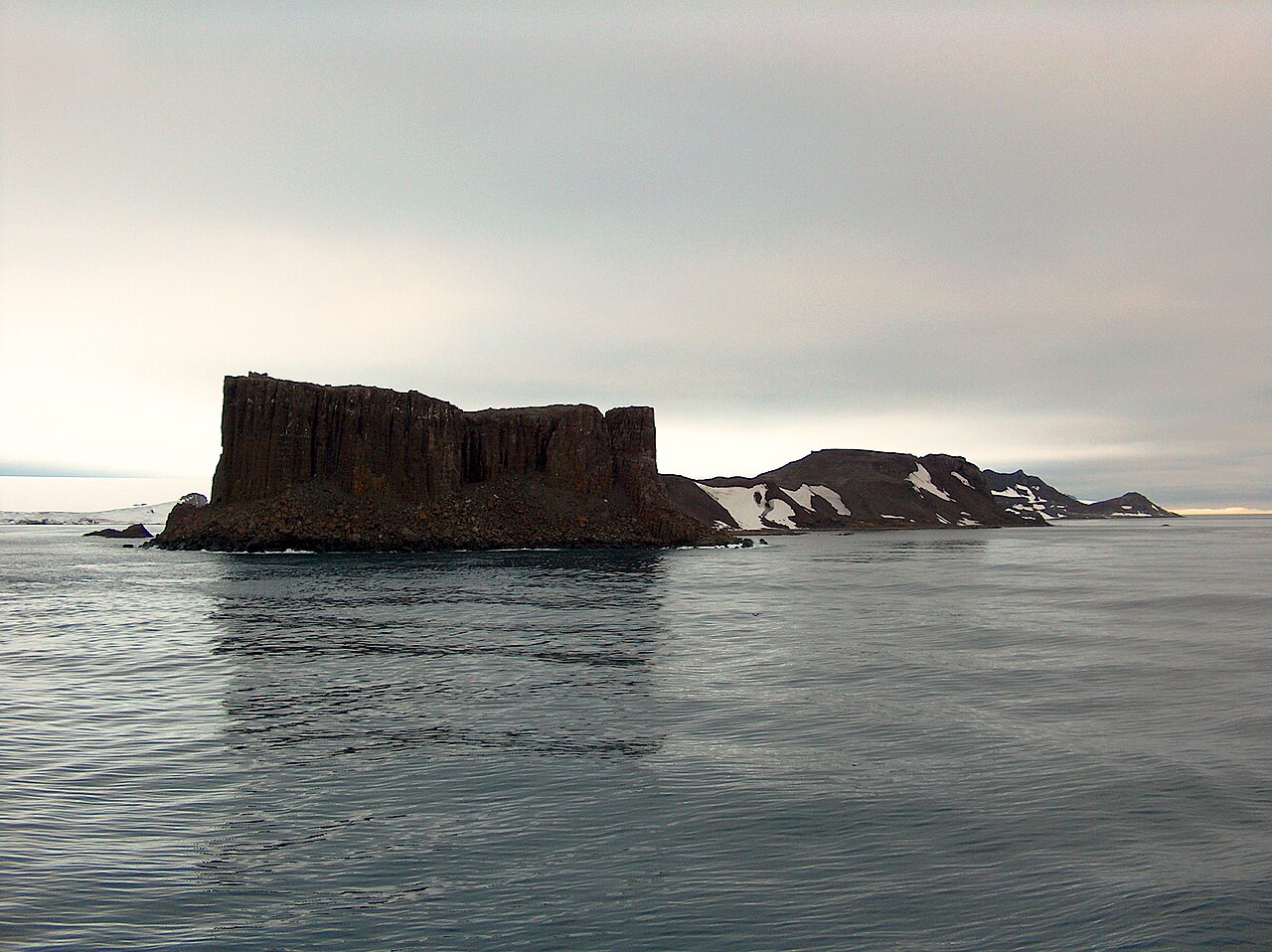
Context · the Coppermine Peninsula, on Robert Island, where the refuge stood
2005 photo of the Coppermine Peninsula, on Robert Island (South Shetland Islands). It is an image of the place, not of the phenomenon: no photo of the sighting has been published.
Coppermine-Peninsula.jpg (Apcbg) · Wikimedia Commons · CC BY-SA 3.0 · open original
UFO Chile no. 2, October 1967 · the first account of the case
Unsigned Chilean ufological bulletin that first published the case eleven years after the events, with false names and placing it on Robertson Island. It is the basis of the version CEFAA published in 2015. The facsimile and transcription are on Patrick Gross's site; the rights to the images are unclear.
UFO Chile (1967), vía ufologie.patrickgross.org · view source
The night in question
In the southern summer of 1955-1956, the 10th Chilean Antarctic Expedition left four men at the Coppermine refuge on Robert Island, in the South Shetlands, to carry out scientific work for a month: the glaciologist Jorge Moder Jorquera, of the Catholic University; the marine biologist Celestino Castro Alvarenga, of the University of Chile's marine biology station at Montemar; his assistant, Abelardo Báez, aged 18; and the Navy medical sergeant Héctor Juan Adofacci. According to Báez, the radio they used every afternoon to talk to the Arturo Prat base, on Greenwich Island, broke down after a few days and they were left isolated.
The account first appeared in October 1967, in issue 2 of the bulletin UFO Chile, under the headline “Scientists observe UFOs for two days over Antarctica (8 to 10 January 1956)”. The unsigned text used false names “at the request of the protagonists” and placed the events on Robertson Island, in the Weddell Sea. It said that on the morning of 8 January two of the expedition members saw two metallic, cigar-shaped objects, vertical and motionless, the apparent size of the full Moon, and that soon all four were watching them. At about nine, one of them supposedly turned horizontal and zigzagged for about five minutes, changing colour, before returning beside the other. A Geiger detector allegedly showed radioactivity forty times above normal; with a theodolite, using some cirrus clouds as a reference, one of the scientists supposedly calculated a height of about 8,000 metres, a length of about 150 metres and a speed of 40,000 kilometres per hour. When one of them pointed a polarizing lens at them, an object supposedly descended, and his companion, overcome by nerves, kicked the lens to pieces. The objects supposedly disappeared in the early hours, during a storm, and a helicopter rescued the men on 20 January. The bulletin added that they took many photos, that they told a senior Navy officer, and that the US Air Technical Intelligence Center (ATIC) sent them a questionnaire.
The official Chilean committee that studies these phenomena, CEFAA, published the account on its website in 2015 under the title “Caso Isla Robertson en la Antártica”, but it is a reissue of the 1967 text, with the same false names. The real names appeared in the second edition of Los ovnis de la Antártida (2018), by the Argentine Rubén Morales: those of the two scientists came from Pablo Petrowitsch, a friend of one of the witnesses and the origin of the CEFAA report, and he found the other two in documents of the time. Morales also placed the events on Robert Island, in the South Shetlands, not on Robertson Island. Later, the Chilean researcher Patricio Abusleme located and interviewed Abelardo Báez, the assistant, who in 2022 told his version on La Red's programme Así Somos. Another version of the account, in the book Alienígenas americanos (2022), dates the case to 1955.
In 2022, Abelardo Báez, then aged 85 and the only survivor, gave his version to the newspaper El Porteño. According to him, everything happened “on 4 January 1956”: Castro saw the objects first, then Moder and the sergeant came out, and he came last; they were “two zeppelins, like pencils”, vertical and static, changing colour, and they stayed “36 hours there, static”. Moder took measurements with an altimeter and a radioactivity meter, and when he signalled with a lens the objects came closer, until Castro, frightened, smashed the mirror with a stick. According to Báez, the objects were always oriented towards the Prat base, and in their manoeuvres they moved off in the direction of other bases. He said that, back on the ship, the commander confiscated their rolls of film and forbade them to talk; that, as he later learned from Moder, the documentation was sent to the United States by the Navy; that they were picked up “around 20 January”, and that they managed to stay “about three weeks” on the island. He attributes the figures —about 150 metres long and “almost forty-five thousand kilometres per hour”— to a document by Moder that he says he keeps. Báez also keeps the scientific reports that Moder and Castro handed to the commander-in-chief of the Tenth Antarctic Division, at Bahía Chile, on 13 February 1956; in his, Castro writes that the flag flew at the refuge “for 25 days, from 19 December 1955 to 12 January 1956”.
Why it matters
The case has in its favour four named witnesses, whose presence on the island is recorded in documents of the time, and one of them who told it in person. But everything that describes the phenomenon is late. The first text, from 1967, is anonymous, uses false names, sets the scene on another island and in another sea, and carries details that are hard to sustain: 21 degrees below zero in the middle of the Antarctic summer, a calculated speed of 40,000 kilometres per hour, a reference to theories of saucer propulsion and a “Second International Geophysical Year, 1956 to 1958” that never existed (the Geophysical Year was 1957-1958). But it is right about what could later be checked —two scientists, an assistant and a medical sergeant; a month's stay; the broken radio—, and its division of roles matches Báez's: the one who sees first and breaks the lens is one man, the one who measures and signals is the other. That points to a source close to the witnesses. No photo of the phenomenon has surfaced, the compilation of Chilean press coverage of the International Geophysical Year published in 2006 contains no mention, and no Navy or ATIC file has been found; no Antarctic case from 1956 appears in the digitized Blue Book collection.
The two versions agree on the essentials —two vertical cylinders, motionless for hours, that at times manoeuvre, the radioactivity, the lens that draws them in and the companion who breaks it, and material sent to the United States— but not on the date (8 January in the bulletin, the 4th in Báez's memory) nor on what happened afterwards: the bulletin speaks of a confidence to an officer who was not disturbed, and Báez of confiscated film and an order not to talk. And there is a contemporary record that clashes with both: the report Castro signed in February 1956 says the flag flew at the refuge until 12 January, whereas both accounts have the rescue arrive around the 20th. If the flag was lowered on leaving the refuge, the departure came about eight days earlier than the story says; Báez himself reckons they stayed “about three weeks”, closer to the report. Both sighting dates fall within that stay: the clash is only with the day of the rescue. Nor is it known whether the scientific reports mention the phenomenon, since they have only been cited for their dates and place; Castro's was published in the Chilean Navy's Anuario Hidrográfico in 1980. The figures Báez attributes to a document by Moder almost match those of the bulletin: either they corroborate it, or Báez's memory has gradually adjusted to the published version.
Under these conditions, the case is useful as an example of how an account settles over time. An anonymous text with pseudonyms becomes a page of an official body and then a book chapter, and each step gives it an appearance of backing that the previous one lacked. What remains verifiable is little and concrete: who was there, where and when according to Castro's report. The Canal 13 interview with Moder that Báez remembers, and that El Porteño dates to April 1968, would be the testimony closest to the events from one of the scientists, and it has not been located.
What's left on paper
Documented evidence
- UFO Chile bulletin no. 2 (October 1967), anonymous and with false names: two cigar-shaped objects seen from 8 to 10 January 1956, with radioactivity, theodolite measurements, photos and an ATIC questionnaire
- CEFAA page “Caso Isla Robertson en la Antártica” (29 July 2015), a reissue of the 1967 account with the same pseudonyms
- Rubén Morales, Los ovnis de la Antártida (2nd ed., 2018): real names of the four witnesses (the scientists', via Pablo Petrowitsch) and location on Robert Island
- Interview with Abelardo Báez in El Porteño (19 April 2022): the only published first-hand testimony, dated 4 January, with 36 hours of observation, confiscated film and a stay of “about three weeks”
- Report by Celestino Castro to the commander of the 10th Antarctic Division (13 February 1956), cited in El Porteño: the stay at the refuge ran from 19 December 1955 to 12 January 1956
- No published photos of the phenomenon, no mention in the 2006 compilation of Chilean press coverage of the International Geophysical Year, and no 1956 Antarctic case in the digitized Blue Book collection
Sources
- UFO Chile no. 2 (October 1967), facsimile and transcription at ufologie.patrickgross.org — First written version of the account, with false names; continues on pages 2 to 4 of the same issue.
- Guillermo Correa — “Avistamiento de OVNIS en la Antártida: conversando con Abelardo Báez Cortés” (El Porteño, 19 Apr 2022) — Báez's first-hand testimony and a quotation from Castro's February 1956 report.
- Rubén Morales — “Sorprendente novedad actualiza el caso de dos extraños cilindros que se vieron sobre la Antártida en 1956” (Antártida Enigmática, 13 Sep 2019) — The witnesses' real names, their origin in Pablo Petrowitsch and the correction from Robertson Island to Robert Island.
- CEFAA — “Caso Isla Robertson en la Antártica” (29 Jul 2015), English version at Project 1947 — Official reissue of the 1967 account, with the same pseudonyms. The English translation has errors in the figures; those in this entry are the bulletin's.
- AARO — Fiscal Year 2024 Consolidated Annual Report on UAP (14 Nov 2024), base rate — Base rate of resolved cases: the 174 cases closed in fiscal year 2024 were all resolved as prosaic objects.
- M. Consuelo León Wöppke et al. (eds.) — La Antártica y el Año Geofísico Internacional, 1954-1958. Percepciones desde fuentes chilenas (Valparaíso, 2006) — Compilation of Chilean press and documents of the time; it does not mention the sighting. Its bibliography lists Castro's report published in the Anuario Hidrográfico no. 40 (1980).