1957·Granada–Portalegre–Coruche route; the final approach, near Coruche (Portugal)
Portugal.Four F-84s from Ota air base · the light that followed Lemos Ferreira's flight (Spain and Portugal, 1957)
On the night of 4 September 1957, four Portuguese Air Force F-84s on a navigation exercise out of Ota air base watched for about forty minutes, from Granada to near Coruche, a light that changed colour and size, released four yellow circles and finally dived at the formation. The signed account of the flight leader, Captain José Lemos Ferreira, was published in 1958; an AFP dispatch of November 1957 dates it to 4 November. No official file has been published, and the magnetic variation that, according to AFP and the magazine, Coimbra logged coincides with a worldwide geomagnetic storm.
Tier B · IndicativeWhat do they mean? →
Limited evidence: a single witness, testimony gathered years later, or an account without contemporary primary documentation.
What it was
55%natural or human cause
Most likely an ordinary cause that no one has identified
See the split across the six explanations
Natural or human cause
No known cause
Read the full reasoning
Venus and Jupiter were low in the west-southwest at the start, but that is our own calculation and it does not explain the turn, the four circles or the dive. The absence of a published analysis is not evidence against an ordinary cause: AARO's FY2024 report finalized 'all 174 cases' as 'resolved to prosaic objects', while 'many other cases remain unresolved'.Context image (not a document from the case)
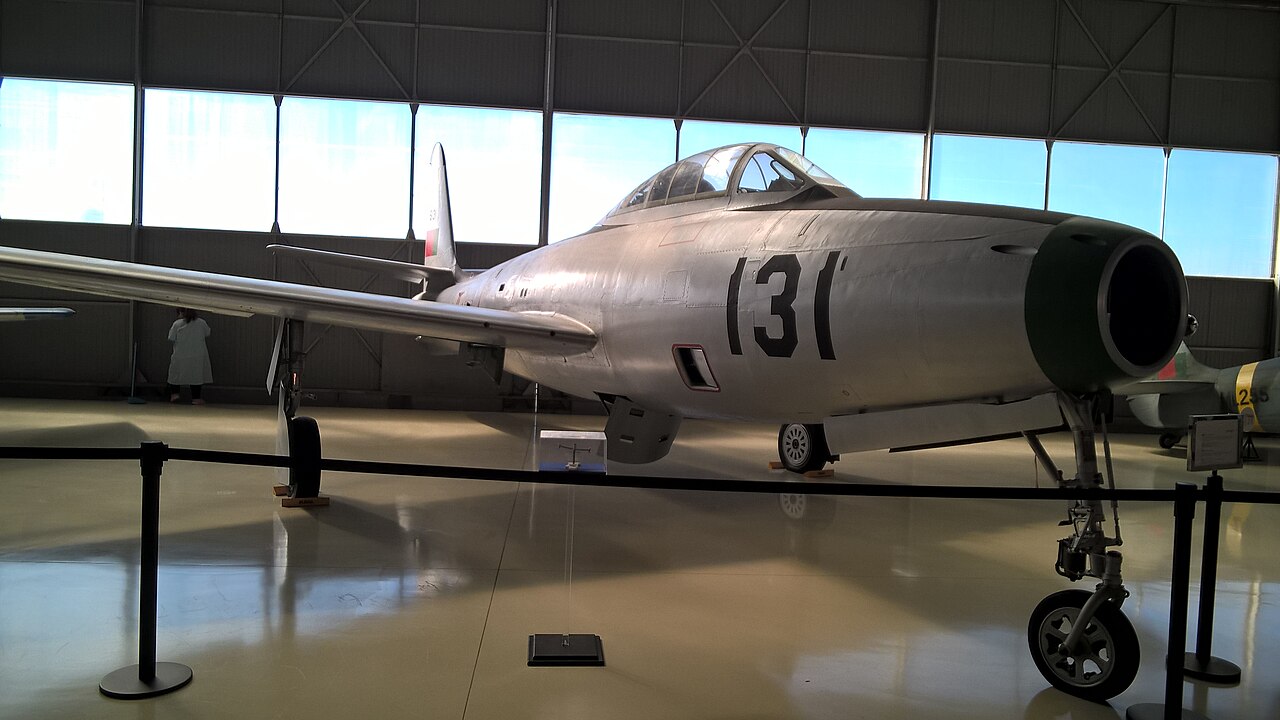
Context · a Portuguese Air Force F-84G at the Museu do Ar (Alverca), the type the flight was flying
F-84 no Museu do Ar.jpg · Wikimedia Commons (GualdimG, 2019) · CC BY-SA 4.0 · open original
The night in question
On the night of 4 September 1957, four F-84 fighter-bombers of the Portuguese Air Force took off from Ota air base, north of Lisbon, on a routine night navigation exercise over Portugal and Spain. The flight was led by Captain José Lemos Ferreira; the other three pilots were Sergeants Alberto Gomes Covas, Manuel Neves Marcelino and Salvador Alberto Oliveira. According to Lemos Ferreira's signed account, published by Flying Saucer Review in its May-June 1958 issue (and transcribed in English by Timothy Good in 1987), it was a clear night with an almost full moon and air-to-ground visibility of well over fifty miles. An ephemeris calculation gives that night a waxing Moon 83% illuminated, at mid-height in the south-southeast, which agrees with that description.
The account places the start at 20:06, when the flight reached Granada and began a port turn onto a heading for Portalegre. Lemos Ferreira saw on his left, above the horizon, "a very unusual source of light"; after three or four minutes he told the others, and the pilot on his right wing answered that he had already seen it, while the two on his left had not. He described it as "a very bright star unusually big and scintillating", with a nucleus that kept changing colour, from deep green to blue and through yellowish and reddish tints. According to Good, the pilots discussed several explanations over the radio and dismissed Venus or another planet, a star, a balloon or an aircraft. Then the light suddenly grew to five or six times its initial size and shrank back to a barely visible yellow point, several times and with no fixed period, always about 40° to the left. After seven or eight minutes it gradually sank below the horizon and moved to about 90° on their left.
At 20:38, Lemos Ferreira writes, he abandoned the exercise because nobody was paying attention to the navigation any more, and turned about 50° to port towards Coruche. The object, he says, stayed 90° to his left, which a stationary object could not do. By then it was well below their level of 25,000 feet, bright red and apparently near, shaped like a curved bean pod held at arm's length. A few minutes later they saw a small circle of yellow light come out of it, and soon three more identical ones on its right, moving around the larger object, which was ten to fifteen times bigger. Near Coruche the big object made what looked like a dive followed by a climb towards them; the formation almost broke up as it crossed over and ahead, and within seconds everything vanished. They landed without further incident. From first sighting to the end, he says, forty minutes passed, and he closed with a line the magazine repeated in its following issues: after this, "do not give us the old routine" of Venus, balloons and aircraft. Good's transcript adds, citing the same issue of the magazine, that the Coimbra meteorological observatory recorded at the same time "extraordinary localized variations in the earth's magnetic field, as proven by charts at that establishment".
The earliest published report located is an Agence France-Presse dispatch datelined Lisbon, 18 November 1957, reproduced by Patrick Gross with a reference to Vicente-Juan Ballester Olmos's catalogue of Iberian cases. According to the agency, the story had appeared in the Lisbon daily Diário Ilustrado, and the officer had only just been authorised to tell it. The dispatch agrees on the essentials (Captain Ferreira "at the head of a group of three jet fighters", the light over Granada turning from intense green to bright red, the forty-minute pursuit, the four luminous rings that separated from the object and the dive that threw the formation into panic), but differs on several points: it dates the incident to 4 November, gives the new heading as Córdoba and the Tagus, says the other pilots saw the phenomenon "at the same time" as their leader (the signed account says the two on the left had not yet seen it) and adds that the base lost radio contact with the four aircraft. It also describes the object holding a constant altitude "while oscillating", and repeats the Coimbra magnetic variation. It also says the newspaper published the testimonies of all four pilots; that issue of Diário Ilustrado could not be consulted.
Flying Saucer Review returned to the case several times. In July 1958 it cited it, without a date, as the article "in the last issue"; in January 1959 it recalled that on 4 September 1957 four jets left Ota and that the interview with the captain, with photographs of his three wingmen and himself, had appeared in May-June 1958; its 1961 chronology repeats the date and sums it up as forty minutes at 25,000 feet with an object that released four small lights. In 1969 the editor of that period explained that the scoop came from the magazine's Lisbon correspondent, D. Alves, who interviewed the captain at Ota air base and sent in the signed story with pictures of the pilots. No official file has been located: Project Blue Book's collection on archive.org holds no Portuguese case from September or November 1957, although the researcher Joaquim Fernandes states in Correio da Manhã that the testimony was incorporated into Blue Book, and the joint report Lemos Ferreira said was written has not been published.
Half a century later, in 2007, Lemos Ferreira, by then a retired general, told the story again to the Lusa news agency with variations. He spoke of about 35 minutes, of a flight of four F-84Gs between Ota and the cities of Córdoba and Cáceres, and said they first saw the object over Córdoba at about nine thousand metres, "slightly above the horizon line", as "a kind of yellowish sphere"; he added that it was "almost 22:00" when, the sphere having turned red, four small spheres separated from it, and that they never actually overflew Cáceres. He said a joint report was written "which the Air Force must have sent to NATO", that some officers out hunting near Coruche saw "a dance of lights" that night, and that he heard about Coimbra from an officer who was studying there; linking it all, he concluded, "would be speculation". That same year a former operator of the Montejunto radar, who says he started at the radar towers that very day, told Correio da Manhã that he heard the captain ask whether the radar had picked anything up, and that it had; no known document backs this. When he died in January 2020, the obituary Sábado published from Lusa repeated the Cáceres version, with an object that passed below and behind the formation. Lemos Ferreira had been Chief of Staff of the Air Force from 1977 to 1984 and Chief of the General Staff of the Armed Forces from 1984 to 1989.
Why it matters
Four identified military pilots, in four aircraft, described for forty minutes a light that changed size and colour, split into five and ended by diving at the formation. The main witness later rose to head Portugal's armed forces and stood by the story all his life without assigning it a cause. But the evidence is thinner than that biography suggests: no official file has been published, the account reached the press in November 1957 and through a newspaper, the signed text was published by a flying-saucer magazine, and the three sergeants saw the same thing at the same time and discussed it over the radio, so they count as one shared testimony rather than four independent ones. What survives from the period is the flight leader's version.
The later versions disagree on place and time. The 1957 and 1958 sources put the start over Granada at 20:06 and the end near Coruche some forty minutes later; the 2007 Lusa interview and the 2020 obituary move it to Córdoba and Cáceres and to almost 22:00, and the Correio da Manhã piece of that same 2007 keeps the return leg from Granada but places the first sighting over Portalegre. The date of 4 September is better established than the AFP dispatch's 4 November: the signed account, the magazine and its 1961 chronology and the general himself all give it, and the agency text says the officer had only just been allowed to speak, which fits a September event told in November. There is also a physical datum. The Kp index of the GFZ geophysical centre in Potsdam records a severe geomagnetic storm on 4 September 1957, with Kp between 8 and 9 from 12 UTC and a value of 8 between 18 and 21 UTC, exactly while the flight was airborne; the geophysical literature studies it as "the geomagnetic storm of September 4, 1957". The 4th of November, by contrast, was magnetically quiet. The sources speak of a "localized" variation, but that of 4 September was a worldwide storm: if Coimbra logged an extraordinary variation that night, it most likely recorded that storm, which affected the whole planet, rather than a local disturbance caused by the object. A storm of that size can produce red aurorae at low latitudes, but none has been found observed in the peninsula that night, and an aurora would have appeared to the north, on the formation's right, not its left.
An ephemeris calculation of our own shows what was in the sky at the start. At 20:06 local time (19:06 UTC), seen from Granada, Venus (magnitude −3.9) stood in the west-southwest about 12° high and Jupiter (magnitude −1.5) in the west at about 6°; on the heading of roughly 306° towards Portalegre, both lay between 40° and 55° to the left, where Lemos Ferreira placed the light. At that hour the Sun was 6° below the horizon, at the end of civil twilight. The account does not say whether its times are local or Greenwich, the usual reference in military aviation. If local, Venus stayed more than 10° above the visible horizon for the whole half hour and never set. If Greenwich, at 20:06 it stood about 3° above the horizon and some 45° to the left, and sank until it set around 20:38, when the account places the object already below flight level and red; that second reading also fits the "almost 22:00" the general gave in 2007. A low planet can twinkle and change colour through the atmosphere, and a first sighting "slightly above the horizon line", as he described it in 2007, is where a low celestial body sits. The calculation does not, however, explain the rest of the account: the pilots said they had ruled out Venus, and after the 50° turn towards Coruche a planet would have ended up almost dead ahead under either reading of the times (Venus was then between azimuth 254° and 263°, and the new heading about 249°), whereas the account keeps the object 90° to the left and below; nor does it account for the four circles or the dive. None of the sources consulted proposes an ordinary cause for the whole. The absence of a published analysis is not evidence against an ordinary cause: in its 2024 report AARO resolved 174 cases, all to prosaic objects, though many others remain unresolved.
What's left on paper
Documented evidence
- Signed account by Captain José Lemos Ferreira, Flying Saucer Review, vol. 4, no. 3 (May-June 1958), pp. 2-3, taken down at Ota air base by the Lisbon correspondent D. Alves: four F-84s out of Ota, light seen from 20:06 while turning over Granada, turn towards Coruche at 20:38, forty minutes in all
- The same account names the other three pilots, Sergeants Alberto Gomes Covas, Manuel Neves Marcelino and Salvador Alberto Oliveira, and describes the light at 40° and then 90° to the left, its repeated growing and shrinking, the four yellow circles and the dive near Coruche
- AFP dispatch datelined Lisbon, 18 November 1957, citing Diário Ilustrado: Granada, light from green to red, forty minutes, four luminous rings, loss of radio contact with the base and a magnetic variation at Coimbra; it dates the event to 4 November
- Flying Saucer Review of January 1959 gives the date of 4 September 1957 and the departure from Ota, and its July 1961 chronology repeats the date; the July 1958 issue refers to the article "in the last issue"; the September 1969 issue credits the interview to the correspondent D. Alves
- Lemos Ferreira's interview with Lusa (2007): about 35 minutes, F-84Gs, Córdoba and Cáceres, almost 22:00, a joint report he believes was sent to NATO, and the link to Coimbra described by himself as speculation
Show 2 more items
- GFZ Potsdam Kp index: severe geomagnetic storm on 4 September 1957 (Kp 8 between 18 and 21 UTC, 9 between 15 and 18 UTC); on 4 November 1957, Kp at most 1.7
- No Portuguese case from September or November 1957 in the Project Blue Book collection on archive.org; the flight's joint report has not been published
Sources
- Flying Saucer Review, January-February 1959 (archive.org, complete run of the magazine, file 31) — Period magazine: "On September 4, 1957, four jet planes of the Portuguese Air Force left Ota Base"; refers to the interview with Captain Lemos Ferreira published in May-June 1958 with photographs of the four pilots.
- Flying Saucer Review, July-August 1958 (archive.org, file 29) — Cites the article "Air Force Pilots Spend 40 Minutes with Saucers" as published in the previous issue (May-June 1958), which is not in the digitised collection.
- Flying Saucer Review, July-August 1961, chronology (archive.org, file 43) — Summarises the case: 4 September 1957, Captain Lemos Ferreira and three sergeant pilots, four F-84s at 25,000 ft, forty minutes, an object that released four small lights; refers to vol. 4, no. 3.
- Flying Saucer Review, September-October 1969 (archive.org, file 89) — The former editor explains that the May-June 1958 scoop came from the Lisbon correspondent D. Alves, who interviewed Captain Ferreira at Ota air base and sent the signed story and pictures of the pilots.
- NICAP · transcript of Lemos Ferreira's account from Timothy Good, "Above Top Secret" (1987), pp. 147-148 (secondary source) — English text of the signed account published in Flying Saucer Review, vol. 4, no. 3: times, headings, the three sergeants' names, the four circles and the dive near Coruche. It is the only accessible full version of the 1958 account.
- Patrick Gross · AFP dispatch, Lisbon, 18 November 1957 (secondary transcript) — Translation of the dispatch citing Diário Ilustrado; it dates the event to 4 November and adds the loss of radio contact and the magnetic variation at Coimbra. Refers to Ballester Olmos's Iberian catalogue (CUFOS, 1976).
- RTP / Lusa · "General Lemos Ferreira recorda encontro nos céus 50 anos depois" (2007) — Interview with the witness fifty years later: Córdoba and Cáceres, about 35 minutes, almost 22:00, a joint report, lights seen by hunters near Coruche and the Coimbra claim, which he himself calls speculation.
- Correio da Manhã · "Os caçadores de OVNIs" (29 April 2007) — Interview with the general (return leg from Granada, Portalegre, Coruche) and testimony of the former Montejunto radar operator Heitor Morais, who claims the radar recorded the object; no document backs it.
- Sábado · "Morreu José Lemos Ferreira, o general que jurou ter visto um OVNI" (23 January 2020) — Lusa obituary: 4 September 1957, four F-84s from Ota, joint exercise with Spain, object over Cáceres turning from green to orange and red; the general's career (Air Force chief 1977-1984, Armed Forces chief 1984-1989).
- GFZ Potsdam · Kp, ap and Ap indices since 1932 — Definitive data: on 4 September 1957 Kp rises to 8.3 at 12 UTC, reaches 9 between 15 and 18 UTC and is 8 between 18 and 21 UTC; on 4 November 1957 it does not exceed 1.7.
- Antsilevich and Sofienko, "Ionospheric current system of the initial phase of the geomagnetic storm of September 4, 1957", Geomagnetism and Aeronomy 6 (1966) (OSTI record) — Geophysical paper on the worldwide geomagnetic storm of that same day.
- Project Blue Book · archive.org collection, September 1957 files — The 52 files for September 1957 include none from Portugal or Spain.
- Correio da Manhã · «Ovnis: as novas descobertas sobre um velho tema» (Joaquim Fernandes) — The researcher Joaquim Fernandes states that Lemos Ferreira's testimony "was incorporated into Project Blue Book" of the US Air Force; the Blue Book collection on archive.org holds no Portuguese case from 1957.
- EarthSky — article on AARO's 2024 annual report — Base rate: AARO finalized 174 cases, all resolved to prosaic objects, and leaves many others unresolved.