1958·Off the coast of Taichung, Taiwan
Taiwan.Taichung · fishermen pull an unknown device from the sea
Sometime before March 11, 1958, fishermen pulled a 20-inch object of plastic, rubber and metal out of the sea off Taichung, Taiwan, and handed it to the Chinese Nationalist Air Force. The U.S. air attaché in Taipei received it on loan and on March 11 sent it to the U.S. Air Force with seven photos and a drawing. In April, the Air Force's technical intelligence center concluded that no one could say for certain what it was, though several details strongly indicated a float that worked a valve.
Tier A · AcceptableWhat do they mean? →
Institutional evidence: several identified independent witnesses, or contemporary official documentation, without an instrumental record to corroborate them.
What it was
90%human light or activity
The most likely explanation.
- 90% human light or activity
- 6% other earthly causes
- 4% no known cause
See the split across the six explanations
Earthly origin (human or natural)96%
No known cause4%
Ordinary cause the sources propose: human light or activity
What happened
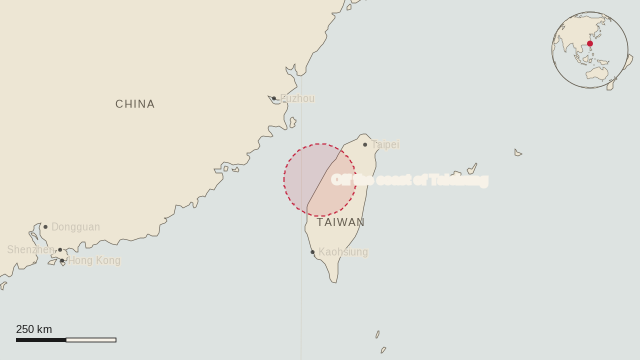
Sometime before March 11, 1958, fishermen pulled an object floating in the water out of the sea off the coast of Taichung, in western Taiwan. They handed it to the Chinese Nationalist Air Force, the air force of the government on Taiwan. The case survives in Project Blue Book, the U.S. Air Force program that studied UFO reports, and none of the eight pages in its file names the fishermen or gives the day or the exact spot of the find.
The Blue Book record card lists the time as "unknown" and, in the date box, gives the date of the report, March 11, 1958. The same card sums up the case: fishermen picked up "an obj made of plastic, rubber & metal floating in the water."
The air attaché's office at the U.S. Embassy in Taipei received the object on loan to identify it, promising to return both the item and the findings to the Chinese Air Force. On March 11, 1958, it described the object in intelligence report IR-159-58, prepared, according to the later evaluation, by the air attaché, Col. Donald H. Frank, and shipped the item separately as Inclosure No. 2, the military spelling of "enclosure."
The cover letter, addressed to the Assistant Chief of Staff for Intelligence at Air Force headquarters in Washington, survives copied in full on three Air Force summary cards, separate from the Blue Book record card. It called the item "an unidentified object" and said its purpose and use were unknown. It also gave a reason for the loan: helping the Chinese Air Force in this matter could lead it to release other material that might come into its hands in the future.
Report IR-159-58 came with seven photos and a drawing. The drawing, copied on the third summary card, dated May 13, 1958, shows a 20-inch (about 51 cm) device: a cylindrical bottle, a cone-shaped neck and a long rod with a collar near the tip. A key lettered A through O gives the materials: soft black rubber on the end of the bottle, an alloy, milk-white plastic, transparent plastic, aluminum alloy on the rod and the collars, and black rubber in two inner parts. The photos are not among the eight scanned pages; an annotation refers to them by control number 23246-A.
On April 8, 1958, Capt. George T. Gregory, the UFO project officer in the Air Science Division of the Air Technical Intelligence Center (ATIC), at Wright-Patterson Air Force Base in Ohio, wrote an internal note by hand to Clarence L. Arnold, in another office of the same center. He said he had received the object, sent to him as a UFO and with a security classification. Without the time, place, circumstances and the names of the sources, Gregory wrote, no alleged UFO could be analyzed or identified, and he asked for whoever had turned in the object to fill out the official UFO questionnaire.
Once the parts were taken apart, Gregory added, the object seemed meant to hold and bleed off some liquid, but it had no outlet for it and the rod was solid. And if it was a shock absorber, whatever it supported was never designed "for high-velocity entry or application." Over the previous nine months, he went on, the Air Force had received a number of similar objects, with photos attached. ATIC had found them to be "hoaxes and attempted frauds," and because of the waste of money and manpower, action had been started to prosecute those responsible where warranted. The note also summarized "substantially" what it presented as a federal law punishing anyone who interfered with the workings of the government with fines and prison.
Gregory asked to be told if whoever turned in the object seemed to be attempting a hoax, and for a statement on why the object fell into the "flying" or "aerial" category. An unidentified object on the ground, he noted, was the responsibility of the Army or local authorities, and one in the water belonged to the Navy or the Coast Guard. The note does not say that the Taichung object was a hoax.
Two days later, on April 10, analyst Francis G. Jacocks signed ATIC's evaluation of report IR-159-58, which Arnold also signed off on. No one at the center who had examined the object, it said, could state conclusively what it was. Several details strongly indicated a float controlling a valve or some other control attached to the end of the metal rod. The sealed polyethylene bottle made a corrosion-resistant, almost unbreakable float. One section bore markings and indentations that could connect it to a mechanism, such as a valve, triggered by the float's motion.
Jacocks then described two more parts. The sponge-rubber hemisphere on the end of the bottle cushioned the float against shocks as it moved in its channel, and a black rubber ring on the lower metal collar sealed the rod's passage airtight. What the inner plastic channel was for was not known: perhaps a way to adjust the length of the rod, perhaps a mechanism that tripped and then reset itself. The evaluation warned that it was not meant to be complete: since no supporting information of value had been received, no further analysis or identification was possible, and the center might help more if details about the object's origin turned up.
The record card, which bears no date of its own, closed the case under "Other" with the entry "Possibly some kind of valve" and the comment that the object was believed to be a valve. The eight pages do not record whether the item went back to the Chinese Air Force.
Where it happened
Why it matters
The case papers record no sighting: what reached the Air Force UFO program was a piece of hardware, not an account. Instead, they show how the system worked in 1958. An ally handed an odd object to the U.S. attaché, the attaché forwarded it as unidentified in the hope of receiving more material later, and ATIC examined it part by part without knowing where or when it had turned up.
ATIC's two responses differ in tone. Gregory's note treated the shipment as a possible hoax, complete with a threat of prosecution, and asked why an object found in the water counted as a flying one. The Jacocks evaluation, two days later, treated it as a mechanism, most likely a float with a valve, and left the identification open for lack of data.
The identification stopped at "possibly," and ATIC itself gave the reason: with no date, no exact place and no fishermen, it had nothing to trace the device's origin with. Because the photos are missing from the scanned copy, the object is known today only from the drawing and from the descriptions by Gregory and Jacocks.
The UFOScans website reproduces the file online alongside an AI-generated summary, which differs from the documents on four points. It dates the find to March 1958, while the file only shows that it came before March 11, the date of the report. It attributes the complaints about hoaxes to Arnold, who received the note, when Gregory wrote them. It calls the attaché "Donald D. Frank," where the evaluation reads "Donald H. Frank." And it gives as the official conclusion that the object was considered water-borne rather than flying, a statement that does not appear in the file: Gregory only asks why it was being treated as a flying object.
Documents and sources
Primary documents
Blue Book file on the Taichung object (1958): record card, embassy letter, drawing, Gregory's note and the ATIC evaluation, 8 pp.
The eight pages of the Blue Book file on the object picked up in the sea off Taichung. Page 1 is the record card, with the conclusion "Possibly some kind of valve."
Read more
Pages 2 to 4 are three Air Force summary cards that copy the cover letter from the U.S. Embassy in Taipei (report IR-159-58, March 11, 1958) and the drawing of the object with its materials key. Pages 5 and 6 are Capt. George T. Gregory's handwritten note (April 8, 1958), and pages 7 and 8 the ATIC evaluation signed by Francis G. Jacocks (April 10, 1958). Grayscale copy, recompressed; the report's seven photos are not in the scanned file.
Project Blue Book (NARA), via archive.org · Public domain · US Government work · open original
Documented evidence
- Blue Book record card (no date of its own; report date March 11, 1958): fishermen picked up an object of plastic, rubber and metal floating in the water; time unknown; the photos box is checked "No" with "Physical Specimen" typed beside it, though the report came with seven; conclusion under "Other": "Possibly some kind of valve."
- Cover letter from the U.S. Embassy in Taipei, copied in full on summary cards: the object, Inclosure No. 2 to report IR-159-58, was lent for identification on condition that it be returned to the Chinese Air Force. The letter's subject line reads "BLITZ EVALUATION," a request for a rapid assessment.
- Drawing from report IR-159-58 (card dated May 13, 1958): a 20-inch device with a materials key lettered A through O; seven photos cited that are not in the scanned copy.
- Handwritten note by Capt. George T. Gregory, ATIC's UFO project officer (April 8, 1958): asks for time, place and sources, describes the device after taking it apart and mentions similar objects that turned out to be hoaxes. It forwards the object, listed with an Air Force stock number, along with photos and a report labeled "Rocket Hoax" (the abbreviation before it appears to read "Calif").
- ATIC evaluation signed by Francis G. Jacocks (April 10, 1958): no one could say for certain what it was; several details strongly indicated a float working a valve; without supporting data, no further analysis was possible.
Sources
- Project Blue Book, file "1958-03-6964008, In the sea off coast of Taichung, Taiwan," 8 pp. (record card, summary cards of the embassy letter, Gregory's note and the ATIC evaluation), NARA, archive.org mirror — Primary source. The scan's text layer is poor and pages 5 and 6 are handwritten: quotations were read from the page images.
- UFOScans, "BLITZ EVALUATION: Unidentified Object Recovered off the Coast of Taichung, Taiwan" (AI-generated summary and copy of the PDF) — An online version of the case; cited for where it departs from the file (date of the find, authorship of the note, the attaché's middle initial and a conclusion that does not appear in the documents).