1561·Núremberg, Sacro Imperio Romano Germánico
Alemania.Fenómeno celeste · Núremberg
El 14 de abril de 1561, al amanecer, numerosos habitantes de Núremberg dijeron ver en el cielo un despliegue de esferas, cilindros, cruces y dos grandes crecientes que parecían combatir entre sí, seguido de la caída de objetos humeantes y la aparición de una gran forma oscura. El impresor Hans Glaser publicó una hoja volante con un grabado y un texto describiendo el suceso.
Tier B · Indiciario¿Qué significan? →
Evidencia limitada: un solo testigo, un testimonio recogido años después o un relato sin documentación primaria de la época.
Qué fue
67%causa natural o humana
Explicación más probable: relato folclórico o literario
Ver el reparto entre las seis explicaciones
Causa natural o humana
Sin causa conocida
Cita en el idioma original
«Einblattdrucke nun berichten nicht tatsächliche Ereignisse, ihnen geht es vor allem um die Botschaft»; «Ob damals etwas über Nürnberg gesehen wurde, das wissen wir nicht und können wir nicht wissen»Documentos primarios
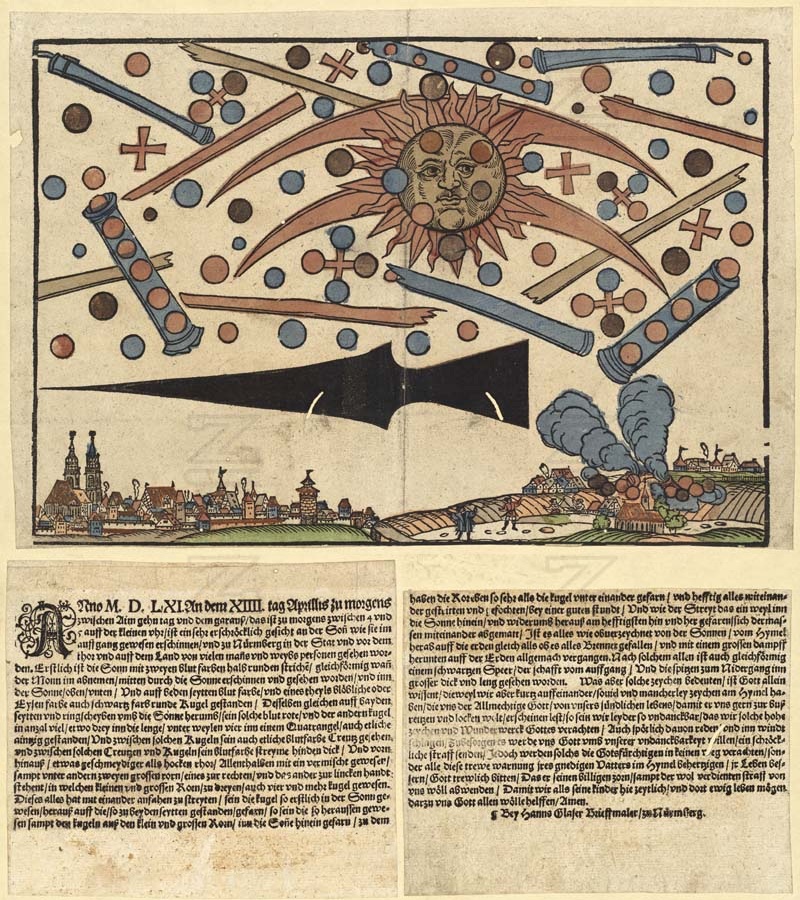
El grabado de Hans Glaser sobre el fenómeno celeste de Núremberg, 14 de abril de 1561
Himmelserscheinung über Nürnberg vom 14. April 1561.jpg · Wikimedia Commons · Dominio público · abrir original
La noche en cuestión
El relato procede de una hoja volante (Flugblatt) impresa en Núremberg por Hans Glaser, grabador, impresor y editor de la ciudad, en 1561. El documento, que mide unos 26 por 38 centímetros y combina un grabado en madera con un texto explicativo, se conserva hoy en la colección de estampas y dibujos de la Zentralbibliothek de Zúrich. Según el texto, el suceso ocurrió alrededor del amanecer del 14 de abril de 1561, entre las cuatro y las cinco de la mañana, y fue presenciado por 'muchos hombres y mujeres' de la ciudad.
“Un mito moderno de cosas que se ven en el cielo”
La descripción es vívida y concreta. Sobre el sol naciente aparecieron numerosos objetos de formas diversas: esferas o globos de color rojo sangre, azulado y negro; cilindros largos de los que, a su vez, parecían salir esferas más pequeñas; cruces, algunas con globos en los brazos; y dos grandes 'medias lunas' o crecientes. Según el texto, todo «empezó a luchar entre sí»: las esferas salían del sol hacia las de los lados y volvían a entrar, y combatieron con violencia «durante más de una hora», hasta que, «fatigadas», cayeron del sol a la tierra «como si todo ardiera» y se consumieron en el suelo con un gran humo. Después se vio algo «como una lanza negra, muy larga y gruesa», con el asta hacia el este y la punta hacia el oeste. «Qué significan tales señales, solo Dios lo sabe», escribe Glaser. Glaser interpretó todo el espectáculo en clave providencial: como una advertencia divina que llamaba a la población al arrepentimiento.
El documento de Núremberg no es un caso aislado en su época. Apenas cinco años después, en 1566, otra hoja volante describió un fenómeno parecido sobre Basilea (Suiza), con grandes esferas negras que cruzaban el cielo frente al sol. Estas hojas formaban parte de un género editorial floreciente tras la imprenta: noticias ilustradas de prodigios celestes, cometas, eclipses y 'señales' que se vendían en ferias y se leían como augurios en un clima de intensa ansiedad religiosa, en plena Reforma y Contrarreforma.
La fuente, conviene subrayarlo, es un único documento de naturaleza popular y propagandística, no un registro instrumental ni un parte oficial. El grabado fue redescubierto por el público moderno cuando Carl Jung lo reprodujo y comentó en su libro de 1958 'Un mito moderno de cosas que se ven en el cielo', donde lo trató no como prueba de naves sino como material psicológico: la proyección de imaginería bélica y religiosa de la época sobre un fenómeno atmosférico real. Esa es, hasta hoy, la lectura dominante entre los historiadores.
Por qué importa
Núremberg 1561 importa por una razón distinta de la mayoría de los casos: no como evidencia de un objeto, sino como el documento histórico que ancla la profundidad temporal del fenómeno-relato. Mucho antes de la era de los radares y las cámaras, comunidades enteras describían y publicaban observaciones de luces y formas en el cielo organizadas como un 'evento' significativo. El caso es, en este sentido, un control historiográfico: muestra que la percepción de prodigios aéreos y su transformación en narrativa de advertencia es muy anterior a la cultura ovni del siglo XX, lo que debilita cualquier tesis de que el fenómeno sea un mero artefacto de la imaginación moderna.
Pero su antigüedad y el hecho de que descanse en un único documento popular pesan en contra de leerlo como observación literal. La lectura del historiador Ulrich Magin es que la hoja pertenece al género de las «batallas celestes»: las hojas volantes de la época no informaban de sucesos reales, sino que copiaban un formato fijo (en este caso, con cañones y balas en lugar de jinetes) para transmitir una advertencia religiosa, y si aquel día se vio algo sobre Núremberg no se puede saber. Magin muestra el modelo: una hoja de 1554 sobre Plech, cerca de Núremberg, en la que el párroco y toda la comunidad vieron poco después de salir el sol esferas azules y jinetes que lucharon dos horas y cayeron a tierra; en la de Glaser, dice, los jinetes se han cambiado por cañones («Rohr» significaba entonces cañón) y sus balas, y el grabado ni siquiera muestra el castillo y hace caer las bolas junto a una iglesia destruida desde 1508. Además, dos meses antes un impresor de Núremberg, Georg Kreydlein, había publicado una hoja sobre una aurora boreal vista el 27 de febrero de 1561 cerca de Eisleben, con dos columnas de humo, una vara y un crucifijo, elementos que reaparecen en la de Glaser. También se han propuesto ópticas atmosféricas (parhelios, halos solares), que producen arcos, cruces y 'soles' múltiples, pero ninguna fuente académica localizada las sostiene; a ello se suma el incentivo comercial de una hoja volante que se vendía mejor cuanto más portentosa. La lectura de Jung (proyección psicológica sobre un fenómeno real) es la otra opción prosaica. No podemos auditar a testigos de hace casi cinco siglos, y nada en la hoja da base para inferir tecnología. Su lugar es el de testigo de la longue durée, no el de prueba.
Lo que queda en papel
Evidencia documentada
- Hoja volante (Flugblatt) de Hans Glaser, Núremberg, 1561, con grabado en madera y texto descriptivo (~26 × 38 cm)
- Original conservado en la colección de estampas y dibujos de la Zentralbibliothek de Zúrich
- Texto que data el suceso al amanecer del 14 de abril de 1561, entre las 4 y las 5, cita a 'muchos hombres y mujeres' como testigos y describe un combate de más de una hora
- Caso paralelo de Basilea (1566), otra hoja volante con fenómeno aéreo similar cinco años después
- Reproducción y análisis por Carl Jung en 'Un mito moderno de cosas que se ven en el cielo' (1958)
- Modelo del género: hoja de 1554 sobre Plech, cerca de Núremberg, con esferas y jinetes que lucharon dos horas y cayeron a tierra (Magin)
Fuentes
- Wikipedia — 1561 celestial phenomenon over Nuremberg — Fuente secundaria: síntesis del caso.
- The Public Domain Review — 'Celestial Phenomenon Over Nuremberg, April 14th, 1561' — Reproduce la hoja de Glaser con una traducción inglesa completa de su texto.
- C. G. Jung — 'Flying Saucers: A Modern Myth of Things Seen in the Skies' (1958) — Reproduce y comenta el grabado como proyección psicológica sobre un fenómeno natural.
- Magin, U. — «Ein Ufo im Jahr 1561?» (ufo-information.de) — Cita el texto original de la hoja y lo compara con la hoja de 1554 sobre Plech.