1959·Benghazi, Cyrenaica, Libya
Libya.Benghazi · a soldier sees a domed object with green lights
In Benghazi, on the eastern coast of Libya, a British soldier walking to the troops' canteen on a cold February night in 1959 saw a round object in the sky, with a dome and green lights, that kept changing color. His account, written months later on a questionnaire that ended up with the U.S. Air Force's Project Blue Book, is the only known record of the event, and it shows why testimony like this is hard to evaluate.
Tier B · IndicativeWhat do they mean? →
Limited evidence: it falls short of what Tier A requires. Any one of these is enough: a single testimony (or several witnesses who saw it together), testimony gathered years later, or an account without contemporary primary documentation.
What it was
74%ordinary cause, unidentified
The most likely explanation.
- 74% ordinary cause, unidentified
- 5% other earthly causes
- 21% no known cause
See the split across the six explanations
Earthly origin (human or natural)79%
No known cause21%
Why no ordinary cause is identified
What happened
The night of Monday, February 16, 1959, was cold, dry and windless in Benghazi, the large city on the eastern coast of Libya, where British troops were stationed. At about 9:30 p.m., a 20-year-old British soldier was walking outdoors, in open country, to the NAAFI, the British armed forces canteen. "I looked up into the sky and I saw it," he wrote later. The sky was clear, with many stars and bright moonlight, and he was not wearing glasses or using binoculars. Someone was with him, but by his own account that person did not see the object.
What he saw was a round, solid object with a sharp outline and a dome on top. He drew it from above as two rings, one inside the other, and from the side as a flattened disc with the dome, next to which he wrote "vents of green light." Its color shifted from silvery blue to a reddish shade and back to blue, and the rim gave off a glow. It made "no sound at all." It was brighter than the sky, like a car's headlights a block away, and its brightness changed, though its shape did not, and it did not flicker.
According to his drawing of its path, the object moved in a straight line, rose, dropped diagonally to a point he marked "stopped here," and from there climbed straight up to another point marked "vanished here." He estimated that its speed ranged from zero to 500 mph. At the end, he wrote, "they just disappeared, leaving nothing at all visible." He used the plural, although the rest of the questionnaire speaks of a single object. He watched it for about 15 minutes and said he was fairly certain of that duration.
His directions for where the object was do not fully agree with one another. He marked that he was looking northwest when he first saw it, and for the end he circled both north and northwest. The figures in degrees he gave later ("25" and "10" from north) do not quite match that northwest, depending on which way they are counted. He gave its height above the horizon as 30 or 50 degrees at first, since the digit is smudged, and 40 at the end, but on the drawing of the arc of the sky he placed the last point much higher, at about 75 degrees.
The soldier estimated that the object was about 100 feet across, that it was 10,000 feet away and that, at arm's length, it looked the size of a baseball. Those three figures do not fit together: according to a calculation from the figures in his own questionnaire, a 100-foot object 10,000 feet away would look about eleven times smaller than that baseball. If he had to build it, he wrote, he would make it of an alloy and in the shape of a disc, and he added that nothing on Earth could give the same appearance. Asked what he thought it was, he answered: "It was a flying object."
It was not, he said, the first time: he had seen objects like it "in England from my bedroom window," "about fifty times at least." Where the form asked when he had reported it to an official, he drew dashes instead of a date.
All of this comes from a questionnaire the soldier dated September 13, 1959, almost seven months after that night. It is not an original U.S. Air Force form: it is pages 255 to 262 of an unidentified book that reprinted, as its Appendix III, the questionnaire the Air Force used with UFO witnesses; the soldier filled it in on those pages, torn out or copied. In the archived copy, the name and address are blacked out. Before the name is written "L/Cpl," short for lance corporal, the lowest corporal rank in the British Army, and as the place he wrote "B.M.H. Benghazi," the abbreviation that army used for a British Military Hospital.
An unsigned handwritten note on the questionnaire says it was received on October 1, 1959. The questionnaire ended up with Project Blue Book, the U.S. Air Force program that studied sightings, and its record card sums up the account and classifies the case as having insufficient data for evaluation. The nine pages of the file do not say who gave the soldier the questionnaire or how it reached the Air Force.
Where it happened
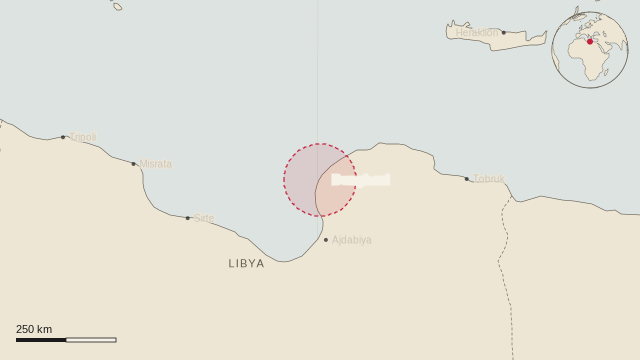
Why it matters
The whole case rests on a single witness, who wrote his account almost seven months later and whose companion, by his own account, saw nothing. The questionnaire also leaves the object's direction, height and size at odds with one another, and its author said he had seen similar things about fifty times in England. The Blue Book file holds only the card and the questionnaire, with no follow-up questions to the soldier and no inquiry to his unit, and nobody in it proposes a cause or rules one out. That is why Blue Book left it at "insufficient data."
Some causes can be checked against the date and time. According to a calculation from Benghazi's coordinates and the time on the card, the Moon, one day past first quarter, stood high in the west-southwest, outside the directions the soldier gave, which fits the bright moonlight he marked on the questionnaire. There was no planet toward the north or northwest: Venus and Mercury had already set, Jupiter and Saturn had not yet risen, and Mars was in the west. The brightest star in that part of the sky was Capella, high in the northwest.
Very few satellites were in orbit in February 1959. According to the GCAT catalog kept by astronomer Jonathan McDowell, which records launches and satellites, they were Explorer 1, Vanguard 1, Explorer 4 and Sputnik 3, plus the last stage of Vanguard 1's rocket and two small parts; Vanguard 2 was launched the next day. Besides, the Sun had long set by then, and in the directions the soldier gave, anything less than about 1,000 km up was in Earth's shadow, with no sunlight to reflect. Sputnik 3, the only large one, flew mostly below that height, and the others were much smaller. A satellite also crosses the sky in a few minutes without stopping, while the account describes a quarter of an hour with stops.
An online list of cases goes further than the file. The 1959 chronology of NICAP, the National Investigations Committee on Aerial Phenomena, a U.S. civilian group, lists the case as "BBU," a Blue Book unknown, citing a re-evaluation by the Center for UFO Studies (CUFOS) and researcher Jan Aldrich. Its summary includes the dome, the green lights, the colors and the 15 minutes, but it does not say that the companion saw nothing, that the account was written seven months later or that the witness said he had seen such objects about fifty times. The Blue Book card classified it as a case with insufficient data, a different category from unidentified.
It remains to be seen whether British Army records hold any report of that night in Benghazi, or the name of whoever sent the questionnaire to the U.S. Air Force.
Documents and sources
Primary documents
Blue Book file on Benghazi (February 1959), 8-page extract: record card and the witness's questionnaire
The Air Force record card and the questionnaire in which a British soldier described what he saw in Benghazi on the night of February 16, 1959.
Read more
The card, an ATIC Form 329, sums up the case and classifies it as having insufficient data. The questionnaire is pages 255 to 262 of a book's Appendix III, filled in by hand on September 13, 1959, and received on October 1; it includes his drawings of the object, its path and its height. This is a grayscale extract of pages 1 to 8 of the file; the last page, with the blacked-out personal details, is in the full original at archive.org.
Project Blue Book (NARA), via archive.org · Public domain · US Government work · open original
Documented evidence
- Blue Book record card, ATIC Form 329 (p. 1 of the archive PDF): date "16 Feb 59"; local time "2130," GMT "16/1930Z"; location "Benghazi, Libya"; ground-visual observation; no photos; source "British Military"; 15 minutes; one object; course "NNW," a word the questionnaire does not use; comment "Report classified as insufficient data" and the box "Insufficient Data for Evaluation" checked
- Questionnaire (pp. 2 to 9): pp. 255 to 262 of a book's Appendix III, either copied or torn out (the edge on the spine side looks torn), with the "U.S. Air Force Technical Information Sheet," "Form A"; handwritten note "Received 1 Oct 59" (p. 2); completion date "13 Sept 1959" (p. 9); name and address blacked out, "L/Cpl" before the name, "Soldier," age 20, male; place "B.M.H. Benghazi," with the remark "Cold night"
- Questionnaire, conditions (pp. 2, 3, 6 and 8): February 16, 1959, 9:30 p.m.; no trace of daylight, many stars, bright moonlight; clear sky, no wind, dry and cold; outdoors in open countryside; "I was just walking to the NAAFI. I looked up into the sky and I saw it"; no glasses or binoculars; someone was with him, but that person did not see the object
- Questionnaire, description (pp. 3 to 5): "no sound at all"; "silvery blue changing to a reddish colour then back again"; drawing from above and from the side, with "vents of green light"; "sharply outlined" and "the rim gave off a glowing effect"; solid; brighter than the sky, like a car headlight a block away; it stood still and sped up; it changed brightness, not shape; it did not flicker
- Questionnaire, path and position (pp. 5 to 7): drawing of the path with "stopped here" and "vanished here"; "they just disappeared, leaving nothing at all visible"; speed from 0 to 500 mph; looking northwest at first and north and northwest at the end (both circled); 25° and 10° "from true North"; elevation 30 or 50° (smudged digit) and 40°; on the arc of the sky, point A sits at about 35° and the last point near 75°, measured on the drawing
Show 3 more facts
- Questionnaire, estimates and background (pp. 5, 8 and 9): 100 feet in size, 10,000 feet away, like a baseball at arm's length; "alloy," "disc shaped," "nothing on earth could give the same appearance"; "It was a flying object"; earlier, "in England from my bedroom window. About fifty times at least"; dashes on the question about when he reported it to an official. Calculation from those figures: 100 feet at 10,000 feet spans about 0.6°, and a 7.4 cm ball at about 65 cm spans about 6.5°
- Ephemeris computed with PyEphem for 19:30 GMT on February 16, 1959, at 32.10° N, 20.07° E: Moon at 58° elevation and azimuth 250°, 60% illuminated (first quarter on the 15th at 19:20 GMT); Mars at 55° and azimuth 264°, magnitude 0.5; Venus, Mercury, Jupiter and Saturn below the horizon; Capella at 69° and azimuth 317°; Sun 39° below the horizon. Libya used GMT+2 in 1959 (time zone database), so 19:30 GMT is the card's 21:30
- Jonathan McDowell's GCAT catalog (satcat.tsv): in orbit on February 16, 1959, Explorer 1, Vanguard 1 and pieces of its launcher, Explorer 4 and Sputnik 3 (207 km perigee and 1,247 km apogee in its reference orbit, 1.7 m across); Vanguard 2 was launched on February 17. Earth-shadow calculation from the Sun's position: toward the north and northwest, between 30° and 50° elevation, anything below about 1,000 km was in darkness
Sources
- Project Blue Book (NARA), file "1959-02-9079081, Benghazi, Libya," 9 pp., copy at archive.org — Primary source. PDF p. 1: record card (ATIC Form 329); pp. 2 to 9: the witness's questionnaire, printed on pp. 255 to 262 of a book's Appendix III, with the note "Received 1 Oct 59" and dated September 13, 1959.
- NICAP, 1959 chronology ("1959 Full Report") — Secondary version, created in 2006 on the NICAP website coordinated by Francis Ridge: lists the case as "BBU," a Blue Book unknown, based on a CUFOS re-evaluation and Jan Aldrich; it leaves out that the companion did not see the object, the seven-month gap and the fifty earlier sightings the witness reported.
- Jonathan McDowell, General Catalog of Artificial Space Objects (GCAT), satcat.tsv — Satellites in orbit on February 16, 1959, and their reference orbits (Explorer 1, Vanguard 1, Explorer 4, Sputnik 3); Vanguard 2, launched on the 17th.
- All-domain Anomaly Resolution Office (AARO), Fiscal Year 2024 Consolidated Annual Report on Unidentified Anomalous Phenomena (Nov 14, 2024) — Base rate (p. 3): the 174 closed cases were resolved to prosaic objects; many others remain unresolved.