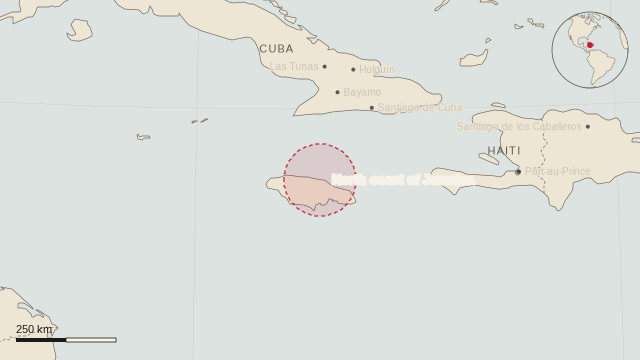
1959·North coast of Jamaica, east of Ocho Rios
Jamaica.Ocho Rios · a haloed light seen by airline pilots and three ships
On the night of Thursday, July 9, 1959, at about 8:07 p.m., a Trans-Canada Air Lines captain staying at a hotel east of Ocho Rios, Jamaica, then a British colony, watched with his first officer and others as a light with a halo crossed the northern sky for about seven minutes. At the same time, three ships in the Atlantic reported a rocket. Blue Book called it a missile without having the launch data; the GCAT catalog lists a Jupiter missile launched from Cape Canaveral six minutes earlier.
Tier A · AcceptableWhat do they mean? →
Institutional evidence: several identified independent witnesses, or contemporary official documentation, without an instrumental record to corroborate them.
What it was
94%rocket or missile
The most likely explanation.
- 94% rocket or missile
- 3% other earthly causes
- 3% no known cause
See the split across the six explanations
Earthly origin (human or natural)97%
No known cause3%
Ordinary cause the sources propose: rocket or missile
What happened
On Thursday, July 9, 1959, shortly after eight in the evening, a group was chatting on the terrace of a hotel on the north coast of Jamaica, east of Ocho Rios, facing the open sea. Jamaica was then a British colony. The group included a Trans-Canada Air Lines captain, 47, trained in navigating by the stars, and his first officer. The sky was clear, moonless and full of stars.
At about 8:06 p.m. Eastern time, another member of the group saw what at first looked like a shooting star. The tail vanished within seconds, leaving a point of light like a star. After about a minute, that person pointed it out to the captain.
According to the letter the captain wrote the next day, the light was slightly east of the North Star, about 30° above the horizon, and was heading slightly east of south. As he watched, it took the shape of an elongated halo, like a cigar, with the bright point at its northern end. He thought of an airplane's landing light seen through haze and listened for engines. Within a minute he ruled out an airplane.
The light then moved southeast. At 0112 Greenwich time, 8:12 p.m. in Jamaica, it turned northeast, and by 0115 it was too faint to make out. In that time it shifted about 30° to the right with almost no change in height. According to his letter, it shone like a second-magnitude star and dimmed only as it vanished in the east. In the questionnaire, however, he noted that the brightness changed as it approached and receded, and in a postscript that it had been much brighter, like a planet.
The person who first spotted it wrote a separate account on July 10, on hotel letterhead. In that account, the light sometimes looked like an oval glow, as if strong lights had been switched on at the sides and rear of a central point. At other times it looked like three stars: a brighter one in the middle and two trailing lights that showed only now and then. At first it moved almost due south; over about seven minutes it traced a large crescent, turning through almost 180°, and went off to the north until it disappeared. It seemed to be at a tremendous height, twinkled, and made no sound. That letter says four others in the party saw it. The captain, by contrast, saw it vanish to the northeast.
The light was also seen from elsewhere on the island. The Kingston Daily Gleaner of July 10, whose clipping the captain enclosed with his letter, carried two reports. A resident of Red Hills, on the outskirts of Kingston, saw a bright object "looking like a Sputnik or a Flying Saucer," with a long tail, cross from northwest to south-southeast. Dr. E. C. Melville, president of the Jamaica Astronomical Society, watched it through his telescope and saw three bright, star-like objects in formation; he said they might have been three jet planes or guided missiles. From Buff Bay, on the northeast coast, the paper's correspondent wrote that many people saw an object they took for a satellite at about 8:20 p.m., moving northeast for just over a minute. That time is about five minutes later than the end the captain gave.
At the same time, three ships reported a rocket. The Esso Stockholm, in the Atlantic north of Hispaniola, reported that at 0110 a large rocket passed overhead on a course of about 120°, with a heavy trail and lights that went out after it passed. The Caltex Auckland and the Allobrogia, east of the Bahamas, saw a rocket-like body with three lights heading east at 0110 Greenwich time; according to its message, the Caltex Auckland kept it in sight for about ten minutes. The Coast Guard in Miami passed the three reports to Air Defense Command, two Navy commands and the Air Force Chief of Staff, whose headquarters forwarded them early on July 10 to the Air Force's technical intelligence center (ATIC) in Ohio.
The captain sent his July 10 letter to the "U.F.O. Division" at the Pentagon. On July 31, Major Lawrence J. Tacker of the Air Force information office replied that the letter lacked enough data and sent him a questionnaire. The captain filled it out on August 4. He placed the light, meaning the point in the sky where he saw it, first almost due north and last toward the northeast, both times at the same height, and gave a duration of seven minutes. He added that he had used the North Star as a reference. He did not think it was a tanker refueling, a possibility he had raised himself in his letter, and he did not know enough about intercontinental missiles to have an opinion. If no reasonable explanation could be found, he wrote, he had seen "the most unusual" and had left "the ranks of the sceptics."
The undated Project Blue Book record card sums up the four reports. It places them at "Ocho Rios, Bahamas, SE of Florida," although Ocho Rios is in Jamaica. It gives 8:10 p.m. local time and two Greenwich times, 0100 and 0110, and the conclusion "Other: Missile." Its comments concede "Missile data for 59 not available," but state that the sighting has all the characteristics of subsequent missile sightings: the area is where Cape Canaveral shots can be seen on their way down the Atlantic range, and the duration matches. The card gives eight minutes for the Jamaica witness and three for the Caltex Auckland, whose message said ten.
Where it happened
Why it matters
The card's conclusion was written without the fact that supports it, and that fact exists. The GCAT catalog compiled by astronomer Jonathan McDowell, which also covers test missiles, lists a Jupiter intermediate-range missile launched from Pad 26B at Cape Canaveral on July 10 at 0101 Greenwich time. That was six minutes before the hotel group saw the light and nine before the ships' reports. According to the catalog, the flight reached a height of 500 km and a range of 2,411 km. By a calculation made for this case from the Esso Stockholm's coordinates, the ship was 1,466 km from the pad, exactly on a bearing of 120°, the same course it gave for the rocket.
The geometry also fits what the captain measured. By a calculation made for this case from the catalog's height and range and a straight track toward the Esso Stockholm's position, the missile, seen from Ocho Rios, would have appeared in the north, climbed to about 27° above the horizon and then moved northeast at almost the same height. That resembles what the captain recorded, although he gave 25° to 30° for both the first and the last position. In that calculation, the track first approaches the hotel and then recedes, and from the ground that looks like a change of course.
The same calculation, using the time and the hotel's position, puts the Sun about 17° below Jamaica's horizon. Several hundred kilometers up, the missile and its trail were still in sunlight. That explains a bright halo in an already dark sky.
The case shows what a missile at night can look like to a trained observer. The captain measured against the North Star, ruled out an airplane within a minute, and thought of a missile himself, yet the steady brightness still puzzled him. The witnesses on land did not describe it the same way: the person who first spotted it saw three lights and a turn of almost 180° toward the north, the captain an exit to the northeast, and Melville three objects in formation. The three ships, much closer to the track, spoke of a rocket.
It remains to be seen what the three lights seen by Melville, the person who first spotted it and two of the ships were: the catalog records the launch, but not which parts separated in flight. And the card places in the Bahamas a case whose main witness was in Jamaica, so anyone reading it alone cannot tell where it happened.
Documents and sources
Primary documents
Blue Book file on Ocho Rios (July 1959): record card, the witnesses' letters and three ships' reports, 10 pp.
Ten of the eighteen sheets of Project Blue Book file 1959-07-8407212, with the Jamaica accounts, the ships' reports and the Air Force's conclusion.
Read more
The first is the record card (ATIC Form 329, undated), which misplaces the sighting in the Bahamas and concludes "Other: Missile." The second and third are the Trans-Canada Air Lines captain's letter of July 10, with that day's Daily Gleaner clipping; the fourth is the letter from the person who first spotted the light; the fifth is Major Tacker's reply of July 31. The sixth and seventh are the first sheet of the August 4 questionnaire and the drawing of the path, marked 20.07 and 20.14. The last three are the Coast Guard messages with the reports from the Esso Stockholm, the Caltex Auckland and the Allobrogia. The names of the witnesses and of the hotel are blacked out on almost every sheet of the original; this copy also covers those the original leaves visible on the third and fourth. Grayscale scan of the archive.org original.
Project Blue Book (NARA), via archive.org · Public domain · US Government work · open original
Documented evidence
- Blue Book record card (ATIC Form 329, undated): "9 Jul 59," "Ocho Rios, Bahamas SE of Florida," 8:10 p.m. local time, "10/0100Z" and "10/0110Z," four reports summarized and the conclusion "Other: Missile," with the comment "Missile data for 59 not available."
- The Trans-Canada Air Lines captain's letter of July 10, 1959, on hotel letterhead and co-signed by his first officer: the light from 0107 Greenwich time, about 30° up and slightly east of the North Star; a turn to the northeast at 0112; too faint by 0115; the brightness of a second-magnitude star.
- Letter of July 10 from the person who first spotted the light, on the same hotel's letterhead: at about 8:06 p.m., a shooting star that turned into an oval glow or three stars, a crescent of almost 180° over about seven minutes, no sound, seen by four others in the party.
- Three Coast Guard messages (7th District, Miami) relayed to ATIC on July 10: the Esso Stockholm, at 21°13' N 68°24' W, saw a large rocket at 0110, first to the northwest (300°) and 10° up, pass overhead on a course of 120° with a heavy trail; the Caltex Auckland, at 26.05° N 73.05° W at 0130, and the Allobrogia, at 26°49' N 73°39' W, saw a rocket-like body with three lights heading east at 0110 Greenwich time, passing over the Allobrogia.
- Daily Gleaner clipping of July 10, 1959, enclosed with the captain's letter: the Red Hills resident who saw an object with a long tail moving from northwest to south-southeast, the three objects in formation E. C. Melville saw through his telescope, and the object seen at Buff Bay at about 8:20 p.m., heading northeast.
Show 2 more facts
- Major Lawrence J. Tacker's reply of July 31 and the captain's questionnaire of August 4: 8:07 p.m. Eastern time; seven minutes; first position 5° east of north and last between 30° and 40°, both 25° to 30° above the horizon; a change in brightness "as it approached then receded"; and, in a postscript, a light much brighter than his first letter said, "more similar to one of the planets."
- J. McDowell's GCAT catalog (launch.tsv): a Jupiter missile (AM-15) launched from Pad 26B at Cape Canaveral on July 10, 1959, at 0101 Greenwich time, with a maximum height of 500 km and a range of 2,411 km.
Sources
- Project Blue Book (NARA), file "1959-07-8407212, Ocho Rios, Bahamas SE of Florida," 18 pp., copy at archive.org — Primary source; ten of its pages are in this case's viewer. P. 1: record card; pp. 2 to 8 and 18: the captain's questionnaire of August 4 (p. 18 is its first sheet); pp. 9 and 10: the questionnaire's summary sheet, on which he wrote a letter on August 4; pp. 11 to 13: Coast Guard messages; pp. 14 and 15: the captain's letter of July 10 with the Daily Gleaner clipping; p. 16: letter from the person who first spotted the light; p. 17: Major Tacker's reply of July 31. The title places Ocho Rios in the Bahamas; it is in Jamaica, as the questionnaire and the captain's letter say.
- Jonathan McDowell, General Catalog of Artificial Space Objects (GCAT), launch.tsv — Entry 1959-S106: Jupiter missile AM-15, Pad LC-26B at Cape Canaveral, July 10, 1959, at 0101 Greenwich time, 500 km maximum height, 2,411 km range; a test flight carrying an ionosphere experiment. There is no other launch from Cape Canaveral on July 9 or 10.
Related cases
Cases with the same likely cause.
Rocket or missile · Within 10 years
Chali · missionaries see a silvery cloud cross the sky
1962 · Tier B
Rocket or missile · Within 10 years
Kenema · light with a big halo seen in Sierra Leone and Liberia
1963 · Tier B
Rocket or missile · Within 10 years
Big Sur · a lieutenant says a disc fired at a test warhead
1964 · Tier B
Rocket or missile
Northern Spain · a fan of light seen from air, land and sea
1971 · Tier A