1963·Kenema, Sierra Leone
Sierra Leone.Kenema · light with a big halo seen in Sierra Leone and Liberia
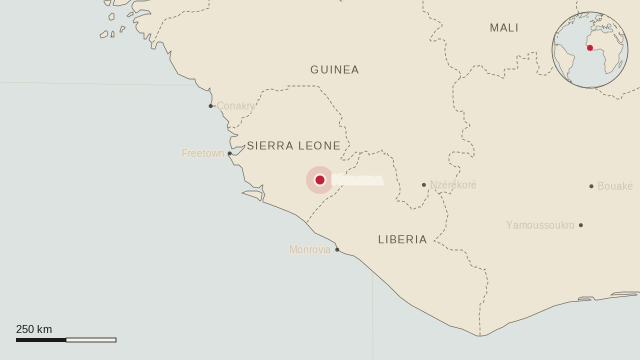
On the night of November 27, 1963, at around 19:25 Greenwich time, a British teacher in Kenema, Sierra Leone, saw a light with a large bright halo come in from the west and pass over the town. About 180 km away, in Monrovia, the capital of Liberia, the U.S. attaché received many reports of a light with a spiral tail. The teacher wrote to NASA the next day. The U.S. Air Force put both sightings down to the Atlas-Centaur rocket that NASA had launched from Florida 22 minutes earlier, and told him so in a letter.
Tier B · IndicativeWhat do they mean? →
Limited evidence: it falls short of what Tier A requires. Any one of these is enough: a single testimony (or several witnesses who saw it together), testimony gathered years later, or an account without contemporary primary documentation.
What it was
94%rocket or missile
The most likely explanation.
- 94% rocket or missile
- 2% other earthly causes
- 4% no known cause
See the split across the six explanations
Earthly origin (human or natural)96%
No known cause4%
Ordinary cause the sources propose: rocket or missile
What happened
On November 27, 1963, at 19:03 Greenwich Mean Time (GMT), NASA launched the second test flight of the Atlas-Centaur rocket, known as AC-2, from Cape Canaveral, Florida. According to NASA, it was the first successful launch of the Centaur upper stage and the first in-flight firing of a liquid hydrogen and liquid oxygen engine. It carried no payload: what reached orbit was the Centaur stage itself, with a ring of instruments. According to astrophysicist Jonathan McDowell's catalog of space objects, its orbit ran from about 490 to about 1,770 km in altitude and was tilted 30 degrees to the equator.
Twenty-two minutes after liftoff, at 19:25 GMT by his own account, a British science teacher working as a volunteer in Kenema, a town in eastern Sierra Leone, saw something in the sky. The next day, November 28, he wrote a letter by hand to NASA's satellite tracking department in Washington. He said the object had passed over Kenema from the west, at the speed one associates with a low-flying aircraft, and seemed to give off light at regular intervals.
The final effect, he wrote, was "very supernatural," with a large bright halo, bigger than the one sometimes seen around the moon. The thin cloud cover scattered the light and gave the impression of ripples, "as from a stone in a pond." According to the letter, it caused havoc in the town: many people spent the night sleeping in the mosque or dancing until dawn. The teacher closed by hoping someone could satisfy the curiosity of many people. His name is blacked out in the released copy; under his signature he described himself as a graduate volunteer science teacher from the United Kingdom.
About 180 km to the south, in Monrovia, the capital of Liberia, the U.S. attaché received "many reports" of an unidentified flying object seen at around 19:25 GMT on November 27. His message, which survives as an undated typed copy, sums up what most of them agreed on: a bright light with a luminous spiral tail or exhaust that seemed to hover or to travel at great speed toward the southeast, 15 to 40 degrees above the horizon. The sky was clear, with a bright three-quarter moon. The message names no witnesses.
Both sightings reached Project Blue Book, the U.S. Air Force office that studied UFO reports, and each has its own record card. The Monrovia card lists 19:25 GMT, multiple sources, one object and a southeasterly course. It concludes "Missile," with the comment "Atlas/Centaur-2 Missile." The Kenema card summarizes the letter and says the object matches the Atlas/Centaur-2 launch and its later passage over Sierra Leone; its conclusion is handwritten as "Atlas Centaur." That card's time does not match the letter it summarizes: it gives 19:03 GMT, the moment of liftoff in Florida, not the teacher's 19:25. It lists the course as "W" (west). If that box means where the object was heading, it also clashes with the letter, since the teacher says it came from the west.
The teacher's letter bears a receiving stamp dated December 9, 1963. On December 13, the Air Force's Foreign Technology Division at Wright-Patterson Air Force Base, Ohio, which Blue Book reported to, forwarded it to the Air Force public information office in Washington with its explanation. What the teacher saw coming from the west had been produced by the launch of an Atlas/Centaur-2 from Cape Canaveral at 1903 GMT, "to place a satellite in orbit," and the same object had been seen as it passed over Monrovia. The note is in a colonel's name, but the handwritten signature is that of a captain named Quintanilla.
On December 19, Major Maston M. Jacks of the Air Force Public Information Division wrote back to the teacher. He thanked him for the report and told him he had seen an Atlas/Centaur-2 launched from "Cape Kennedy," as the letter calls Cape Canaveral, "at 7:03 GMT," without saying it was in the evening. The rocket, he added, had also been seen as it passed over Monrovia, and he regretted any "undue consternation" it might have caused.
Where it happened
Why it matters
Both Blue Book cards and both Air Force letters put the light down to the Atlas-Centaur, but no sheet in either file shows how the match was checked. What does fit is the time: both accounts place the light at around 19:25 GMT, 22 minutes after liftoff, and McDowell's catalog records the AC-2 launch at 19:03:23 GMT that day. The direction also fits the Centaur stage's orbit, which crossed the Atlantic toward the southeast and passed off the coast of West Africa: the teacher saw the light come in from the west, and in Monrovia people saw it moving toward the southeast.
The Smithsonian Astrophysical Observatory tracked the stage with its cameras and published its first orbit in 1964. By an approximate calculation made for this case from that orbit, the stage rose in the west of both cities at around 19:22. It climbed over the sea to just over 30 degrees in the southern sky at around 19:29 and set in the southeast at around 19:37. That fits both accounts: from the west in Kenema, and toward the southeast at 15 to 40 degrees in Monrovia. On the ground it was already night, but at 700 to 1,000 km up the stage was still in sunlight. The letter, however, says the object passed over Kenema, while by the calculation it never came within about 1,150 km of the town.
None of the papers explains the halo, the ripples or the light at regular intervals. Neither the letter nor the Monrovia message makes it possible to tell whether people saw the stage itself or a cloud of gas around it lit by the sun, like the "jellyfish" effect that accompanies other launches seen at night from far away (↗ Kirov and Perm).
The case shows how a test launch seen at night, thousands of kilometers from Florida, could alarm one town and bring a flood of reports in another, in two countries. In Kenema, according to the teacher, some people spent the night in the mosque, and in Monrovia the attaché received many reports. The explanation came three weeks later, by mail, to the teacher who had written. And the two Blue Book cards, filed as separate cases, do not record the event the same way: the Kenema card puts the liftoff time in the box for the time of the sighting.
Documents and sources
Primary documents
Blue Book files on Kenema and Monrovia (November and December 1963): the witness's letter, two record cards, the attaché's message and the Air Force replies, 7 pp.
All seven sheets of the two Blue Book files on the light of November 27, 1963, in grayscale. Pages 1 to 5, the Kenema file (1963-11-9737436): the record card, with the liftoff time (19:03 GMT) and the conclusion "Atlas Centaur"; the teacher's handwritten letter of November 28, with the time of the sighting (19:25 GMT), the halo and the uproar in the town, and the back of the air letter, addressed to NASA's satellite tracking department; the Foreign Technology Division note of December 13; and Major Maston M. Jacks's reply of December 19. Pages 6 and 7, the Monrovia file (1963-11-9737453): the record card, with the conclusion "Missile," and the copy of the attaché's message.
Project Blue Book (NARA), via archive.org · Public domain · US Government work · open original
Documented evidence
- Handwritten letter dated Kenema, November 28, 1963, on an air letter addressed to "Satellite Tracking Dept, National Aeronautics & Space Administration, Washington D.C.": it reports "an object in the sky at 19-25 G.M.T. on 27th Nov. 1963" that passed over Kenema from the west at the speed of a low-flying aircraft, gave off light at regular intervals and had "a large bright halo"; the sender's name and address are blacked out, and he signs as "Graduate Volunteer Science teacher from U.K."; receiving stamp "DEC 9 1963."
- Blue Book record card (ATIC Form 329), file 1963-11-9737436: November 27, 1963, "Kenema, Sierra Leone, Africa"; time "GMT 27/1903Z"; ground-visual, civilian source, no photos, length "N/A," one object, course "W"; summary: "Object observed coming from West passing at speed of a/c. Gave off light at regular intervals. Had large bright halo. Trail had ripples"; comment: "Object conforms with ATLAS/CENTAUR-2 Missile launch and subsequent passage over Sierra Leone"; conclusion handwritten next to "Other": "Atlas Centaur."
- Blue Book record card (ATIC Form 329), file 1963-11-9737453: November 27, 1963, "Monrovia, Liberia, Africa"; time "GMT 27/1925Z"; ground-visual, source "Multi," no photos, one object, course "SE"; summary: "Luminous spiral tail or exhaust hovering and great speed reported. Sky clear bright 3/4 moon. Elev estimated 15-40 deg above horizon"; comment: "Atlas/Centaur-2 Missile"; conclusion "Other: Missile."
- Undated typed copy ("TRUE COPY") of the message "FROM: ATTACHE - MONROVIA," in the Monrovia file: "Many reports received of unidentified flying object sighted approximately 1925Z/27 Nov."; "Concensus of sightings indicate bright light with luminous spiral tail or exhaust signals by hovering and/or traveling at great speed towards southeast 15 to 40 degrees above horizon. Sky condition clear and cloudless with bright three quarter moon."
- Note from the Air Force Foreign Technology Division (office TDEW), Wright-Patterson Air Force Base, December 13, 1963, to office SAF-OIPB at Air Force headquarters in Washington: it forwards the letter of November 28 and says the sighting "was generated by the launching of an Atlas/Centaur-2 missile from Cape Canaveral, to place a satellite in orbit. The launch time was 1903Z," and that the object was also seen as it passed over Monrovia; issued in the name of Colonel Eric T. de Jonckheere, with the handwritten signature "Quintanilla, Capt."
Show 2 more facts
- Letter of December 19, 1963, from Major Maston M. Jacks, Public Information Division, Air Force Office of Information, to the Kenema witness (name blacked out): "What you saw was an Atlas/Centaur-2 missile which was launched from Cape Kennedy at 7:03 GMT, to place a satellite in orbit. This missile was also observed as it passed over Monrovia, Liberia."
- Jonathan McDowell's GCAT catalog: launch 1963-047, Atlas Centaur AC-2, from complex LC-36A at Cape Canaveral on November 27, 1963, at 19:03:23 GMT; the "Centaur AC-2" stage (A00422) went into an orbit of 485 by 1,774 km with an inclination of 30.39 degrees, per the elements of December 31, 1963.
Sources
- Project Blue Book — file 1963-11-9737436, "Kenema, Sierra Leone, Africa" (record card, the witness's letter of November 28, 1963, the Foreign Technology Division note of December 13 and the reply of December 19), NARA, archive.org mirror — Primary document, embedded in this case's viewer: all five sheets in the file. The card refers to the launch data in the Monrovia case, which are not among the two sheets of that file.
- Project Blue Book — file 1963-11-9737453, "Monrovia, Liberia, Africa" (record card and copy of the attaché's message from Monrovia), NARA, archive.org mirror — Primary document, embedded in this case's viewer: both sheets in the file.
- Jonathan McDowell — General Catalog of Artificial Space Objects (GCAT), launch list: 1963-047 (Atlas Centaur AC-2)
- Jonathan McDowell — GCAT, auxiliary catalog: A00422 (Centaur AC-2 stage), with its orbit
- NASA — Robert S. Arrighi, "Centaur: America's Workhorse in Space" (December 12, 2012) — First successful launch of the Centaur stage and first in-flight firing of a liquid hydrogen/liquid oxygen engine; no payload.
- Smithsonian Astrophysical Observatory — L. H. Solomon, "Tracking of Centaur (AC-2)," Special Report 156 (June 25, 1964) — The stage's first orbit, measured with the Baker-Nunn cameras (PDF p. 23); basis of the trajectory calculation.
Related cases
Cases this case cites and cases with the same likely cause.
Cited in this case
Kirov and Perm · residents film a glowing "jellyfish" in the sky
2026 · Tier A
Rocket or missile · Within 10 years
Big Sur · a lieutenant says a disc fired at a test warhead
1964 · Tier B
Rocket or missile · Within 10 years
Chali · missionaries see a silvery cloud cross the sky
1962 · Tier B
Rocket or missile · Within 10 years
Ocho Rios · a haloed light seen by airline pilots and three ships
1959 · Tier A