1964·Big Sur optical tracking station, California
United States.Big Sur · the UFO and the test warhead (Vandenberg, 1964)
In September 1964, according to the testimony of then lieutenant Robert Jacobs, an optical tracking station at Big Sur (California) filmed the test flight of an Atlas missile launched from Vandenberg with a dummy warhead.
Read the rest of the summary
Jacobs says the film showed a disc-shaped object approaching the warhead and firing four beams of light at it from different angles, after which the warhead became destabilized, and that his superior, Major Florenze Mansmann, ordered him to keep silent and confiscated the material. Jacobs went public in 1982. The case rests on a single witness, with no surviving film and disputed technical details.
Tier B · IndicativeWhat do they mean? →
Limited evidence: a single witness, testimony gathered years later, or an account without contemporary primary documentation.
What it was
50%natural or human cause
Most likely explanation: rocket or missile
See the split across the six explanations
Natural or human cause
No known cause
Primary documents
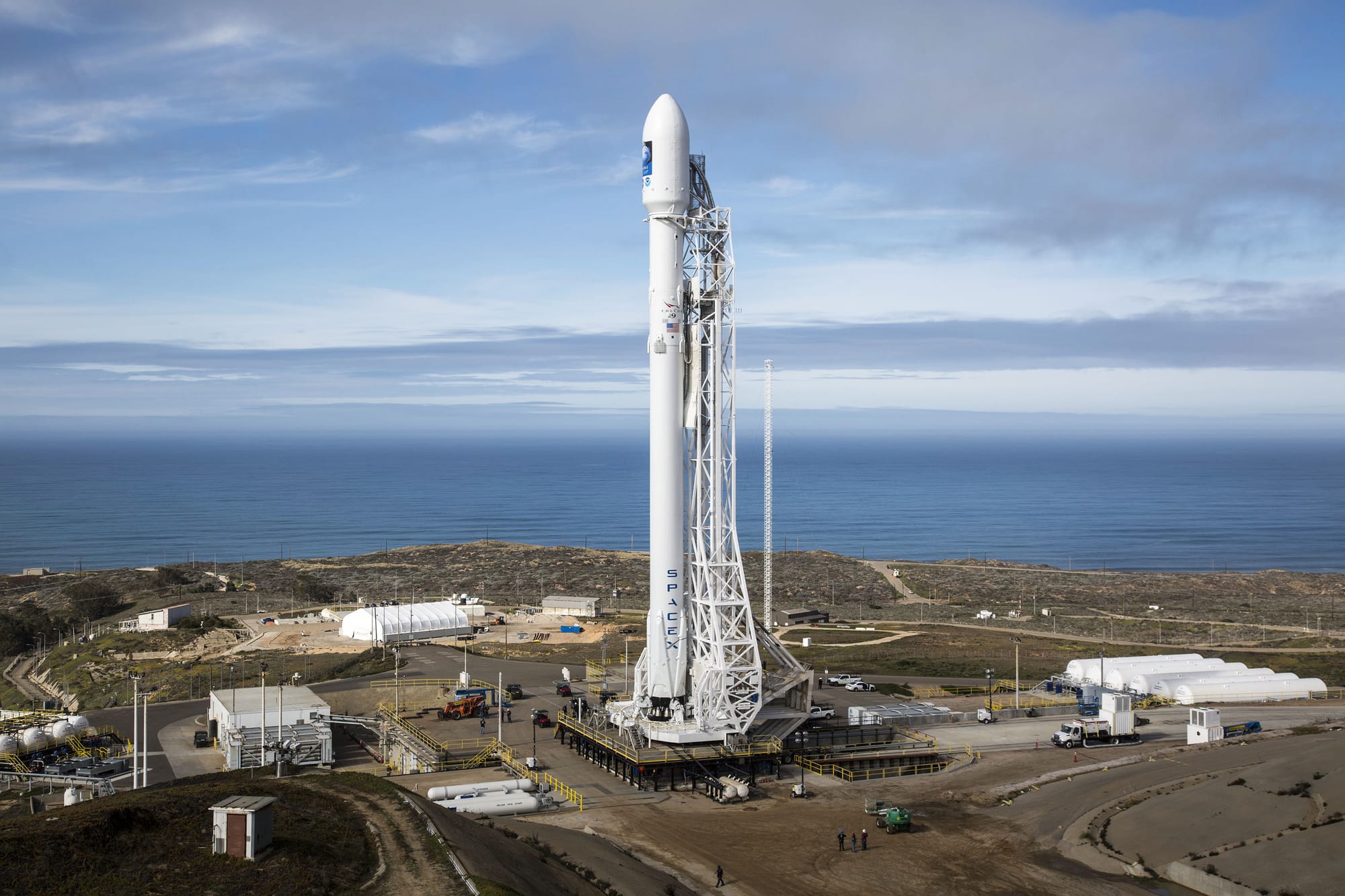
Context · Vandenberg Air Force Base (California), origin of the test warhead launch
2016 Falcon 9 at Vandenberg Air Force Base.jpg · Wikimedia Commons · CC0 · open original
Kingston A. George, project engineer · 'The Big Sur "UFO": An Identified Flying Object' (1993)
Article published in Skeptical Inquirer (vol. 17, Winter 1993) by Kingston A. George, who identifies himself as project engineer for the Big Sur telescope. He recounts that before dawn on 22 September 1964 the telescope filmed the Atlas launch 'Buzzing Bee': the warhead separation and the release of two decoys trailing packing debris that gave them away. He says nothing 'circled' the images, that the Atlas did not miss its target, that the film was classified Top Secret and destroyed before the planned twelve years, and answers Robert Jacobs's six conclusions one by one. He cites his preliminary report of 13 October 1964 for the 1st Strategic Aerospace Division.
Skeptical Inquirer, vol. 17 (invierno de 1993), pp. 180-187 · Center for Inquiry · view source
The night in question
The so-called Big Sur incident belongs to the subgenre of UAP cases associated with strategic weaponry, and is known almost entirely through the testimony of a single man: Robert Jacobs. In September 1964, Jacobs was a lieutenant in the U.S. Air Force and, according to his account, was in charge of the photo-optical instrumentation of the 1369th Photographic Squadron, operating a tracking-telescope station located at Big Sur, on the California coast. The mission, before dawn on September 22, 1964 according to the project engineer (a launch nicknamed 'Buzzing Bee'), was to film, with a 24-inch telescope set at about 4,000 feet and a highly light-sensitive television camera, the flight of an Atlas ballistic missile launched from the nearby Vandenberg air base, carrying a dummy warhead on a suborbital test trajectory.
Jacobs maintains that the launch and the filming proceeded normally, and that the drama came days later, during the screening of the developed film. On the screen, he says, the warhead's nose cone was seen advancing through space when a disc-shaped object (described as two plates facing each other with a dome) entered the frame, flew alongside the warhead, emitted four flashes or beams of light directed at it from different positions, and withdrew. After the apparent hits, the warhead reportedly left its trajectory and fell destabilized before reaching the target. Jacobs claims that his commander, Major Florenze J. Mansmann, present at the screening with two men in civilian clothes, ordered him never to mention the matter again and kept the film.
Jacobs remained silent for almost two decades and only made the episode public in 1982, in a National Enquirer piece, and in 1989 in the MUFON UFO Journal ('Deliberate Deception: The Big Sur UFO Filming'); later he told it in interviews within the work on UAP and nuclear installations, including that of Robert Hastings, who compiles veterans' testimonies about incidents at silos and missile fields. Mansmann, by then retired, partially corroborated some elements of the account in later letters, though with nuances, before his death.
The case is, however, fragile in its evidentiary basis, and that must be said. No accessible film exists: according to the project engineer, the film was classified Top Secret and, since its usefulness ended after a few months, it was 'destroyed long before the 12 years were up'. The account comes from a single direct witness, which prevents independent corroboration. And the account has a firsthand contradictor: Kingston A. George, the telescope project engineer, wrote in Skeptical Inquirer in 1993 that what was filmed was the release of the Atlas's own decoys. According to George, two decoys (simulated warheads meant to confuse a missile defense) were fired off by small rocket charges on schedule, but some of the packing material trailed along and formed 'a little cloud of debris around each decoy warhead' that gave away their false status; the charges were seen as short flashes, 'nothing circled' any of the images, and an energy beam would be invisible in vacuum. George adds that the Atlas, suborbital like every ballistic missile, 'did not miss the target'; that the warhead's image spanned 'between two and three scan lines', so it could not be resolved and only the specular reflection of sunlight was seen; and that the footage was shown to the top brass at Vandenberg and a copy flown to Strategic Air Command. His account confirms, for a different reason, the secrecy Jacobs describes: everyone who had been at the telescope or seen the film was identified, questioned by civilian intelligence experts and cautioned not to discuss it; according to George, the reason was that the film showed that the Atlas decoys could be told apart from a ground telescope. George also says Jacobs 'was technically not authorized to view the pictures' and that he does not think Jacobs ever gained the required clearance. Space journalist James Oberg added objections about the tracking geometry and the telescope's resolution. The episode thus oscillates between a possibly genuine sighting degraded by time and the absence of evidence, and the decoy release the project engineer describes.
Why it matters
Big Sur matters as a limiting case of the value of long-delayed military testimony in the UAP-nuclear-weapons narrative. Its appeal is obvious: an Air Force officer, with a precise technical role, describes an object actively interfering with a warhead during a strategic test: the archetype of the catastrophic-risk-source monitoring pattern (8f), alongside Malmstrom, Minot, or Loring. If the account were verifiable, it would be a very strong case. But it is not, and the project engineer gives a firsthand explanation: the release of the missile's own decoys.
That prudent calibration is precisely its lesson. The case gathers all the factors that compel discounting: a single witness, the absence of the film that would be the central proof, almost two decades between the event and the public account, and serious technical objections about what a ground telescope could have resolved. Mansmann's partial corroboration raises the case above an anonymous rumor, but does not close it: two concordant memories decades apart are not equivalent to physical evidence.
The methodological value lies in the contrast with the cases of its same pattern that do have documentation. Malmstrom 1967 or Minot 1968 rest on contemporary records, multiple witnesses and, in some cases, declassified documentation; Big Sur rests on an account. Including it (but classifying it as evidentially weak) shows the gradient within the UAP-nukes narrative: from the well-documented incident to the late, unverifiable testimony. It remains to be seen whether the film or a second independent witness ever appears. Until then: an emblematic case with a fragile evidentiary basis.
What's left on paper
Documented evidence
- Testimony of Robert Jacobs, USAF lieutenant in charge of photo-optical instrumentation of the 1369th Photographic Squadron at Big Sur (September 1964)
- Verifiable context: Atlas missile test launches from Vandenberg base with dummy warheads on suborbital trajectories
- Partial corroboration by Major Florenze J. Mansmann in later correspondence, with nuances
- Absence of the film: according to the project engineer, the film, classified Top Secret, was destroyed long before the 12 years set for its declassification were up
- Firsthand contradictor: Kingston A. George, the project engineer, identifies what was filmed as the release of the Atlas's decoys and their debris cloud (Skeptical Inquirer, 1993); James Oberg also objects to the geometry and resolution
- George (1993): 'Buzzing Bee' launch, 22 Sep 1964; the Atlas did not miss the target; the warhead spanned two or three scan lines; everyone who saw the film was questioned and cautioned to keep silent because it revealed the decoys' vulnerability
Sources
- Robert Jacobs — declaraciones públicas sobre el incidente de Big Sur (desde 1982) — Primary source of the account of the filmed sighting.
- Robert Hastings — recopilación de testimonios sobre UAP e instalaciones nucleares — Frames the case within the UAP-nuclear-weapons narrative.
- James Oberg — análisis crítico del caso Big Sur — Source of the technical objections to the sighting's interpretation.
- Kingston A. George — 'The Big Sur UFO: An Identified Flying Object', Skeptical Inquirer 17 (invierno 1993) — The project engineer's account: what was filmed was the release of the Atlas's decoys and the packing material that trailed them.
Related cases
same explanation · same country · same period
Gemini 7 · Borman & Lovell
1965 · Tier A
same explanation · same country · same period
Gemini 4 · McDivitt
1965 · Tier A
same explanation · same country · same period
Glenn's Fireflies · Friendship 7
1962 · Tier A
same object · same period
Chali · the "cloud" the missionaries saw on the night Mars 1 was launched (1962)
1962 · Tier B
Associated actors (1)