1962·Low Earth orbit · Mercury-Atlas 6 / Friendship 7 mission (NASA)
United States.Glenn's Fireflies · Friendship 7
On 20 February 1962, during the first U.S. crewed orbital flight (Friendship 7), John Glenn described thousands of light yellowish-green luminous particles floating around the capsule, 'as if the spacecraft were moving through a field of fireflies'. In May 1962 Glenn himself still considered it an open question; NASA's analyses and an experiment by Scott Carpenter on the next flight attributed them to particles shed by the craft itself, mostly frost from the life-support system's steam.
Tier A · AcceptableWhat do they mean? →
Institutional evidence: several identified independent witnesses, or contemporary official documentation, without an instrumental record to corroborate them.
What it was
82%natural or human cause
Most likely explanation: space object
See the split across the six explanations
Natural or human cause
No known cause
Read the full reasoning
Walter Schirra traces them to hydrogen peroxide gas and the water coolers: 'this is where I feel our firefly, frost particles come from'. On MA-7, Carpenter 'performed the decisive experiment of hitting the capsule walls with his hand. The blows promptly resulted in the liberation of large numbers of particles.'Primary documents
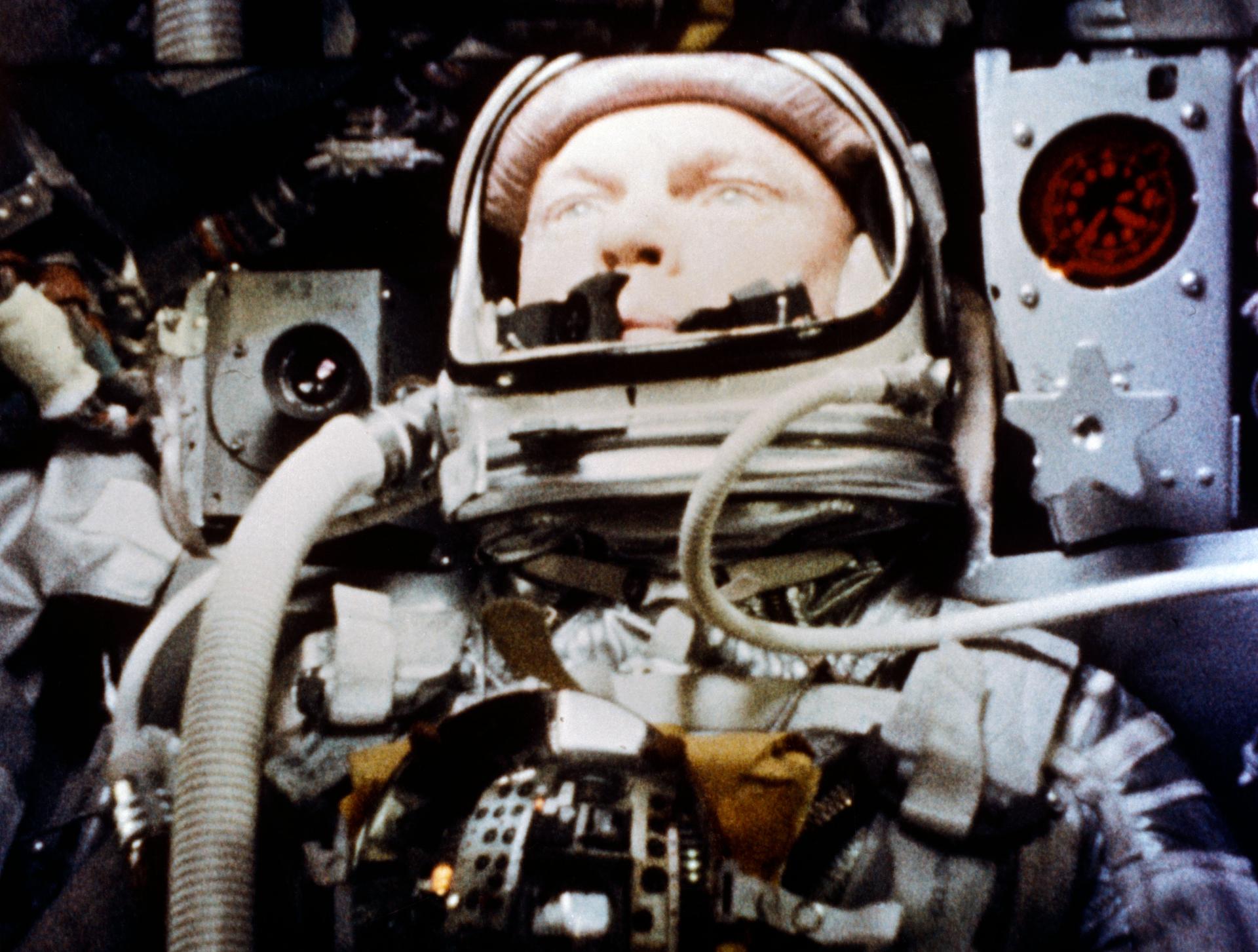
Friendship 7 · onboard camera, John Glenn (Mercury-Atlas 6, February 1962)
NASA · imagen s62-00303 (dominio público) · Public domain · NASA, US Government work · open original
NASA-UAP-D015 — Astronaut Scientific Debriefings (Mercury era, 1962-1963)
Eight NASA documents published in the third PURSUE release on June 12, 2026: the crew and technical debriefings of the Gemini 4, 5, 7 and 9 missions (1965-1966) and the Mercury-era Astronaut Scientific Debriefings (1962-1963). They are the primary source for the cylindrical object James McDivitt described and photographed on Gemini 4, the 'bogey' and 'fireflies' Frank Borman and Jim Lovell reported on Gemini 7, and John Glenn's 'fireflies' report. Most of the material is routine technical debriefing. NASA attributed the bogey to the Titan booster stage and the fireflies to ice and debris shed by the spacecraft; McDivitt's object was never securely identified.
NASA (PURSUE Release 03) · Public domain · US Government work · open original
The night in question
On 20 February 1962, John Glenn became the first American to orbit the Earth aboard the Friendship 7 capsule, on the Mercury-Atlas 6 mission. During one of his orbital sunrises, as the Sun rose after a period of darkness, Glenn radioed an unexpected observation: the capsule was surrounded by a cloud of small luminous particles. In his paper for the COSPAR symposium of May 1962 he described them thus: they were 'a light yellowish green color', 'as if the spacecraft were moving through a field of fireflies', about 'the brightness of a first magnitude star', varying in size from a pinhead up to possibly 3/8 inch, about 8 to 10 feet apart and 'evenly distributed' around the craft; occasionally one or two would move slowly up and across the window. He saw them for a few minutes at each orbital sunrise. A NASA memorandum of 21 February spoke of 'thousands of luminous particles' that seemed to travel with the spacecraft.
The phenomenon puzzled both Glenn and mission control, on a flight that was already the riskiest leap of the U.S. space program to date. Glenn, in his paper, did not lean towards a local origin: at the third sunrise he turned the craft to face forward, saw only about 10 percent as many particles and felt they 'seemed to be coming towards me from some distance so that they appeared not to be coming from the spacecraft'; he added that what they were 'is still subject to debate' and that, like the luminous layer above the horizon, they were for him 'still open items for speculation'. NASA, by contrast, pointed to the craft itself from the start: a draft memorandum after the 27 February interview with Glenn concluded, from the velocity field alone (all moved at the same speed and in the same direction, alike on all three orbits), that they 'were not extraterrestrial particles but were particles associated with the spacecraft', and that this consistency 'would require' them to come from the capsule itself.
The next flight provided the proof. On MA-7 in May 1962, Scott Carpenter saw and photographed snowflake-like particles at all three sunrises, but also 7 and 43 minutes after sunrise, so they were not tied to sunrise except perhaps in being most easily visible then; and shortly before reentry he performed what NASA's report calls 'the decisive experiment' of hitting the capsule walls with his hand, and the blows 'promptly resulted in the liberation of large numbers of particles'. The analysis concluded that they were most likely snowflakes formed inside the capsule, between the cabin bulkhead and the heat shield, by the steam exhaust from the life-support system, with a share of dust, bits of insulation and other loose material. On MA-9 in 1963 Gordon Cooper described 'tremendous streams of luminous particles of fireflies' coming out of the craft whenever he fired a thruster.
Why it matters
Glenn's 'fireflies' matter as the seed case of the astronaut-sighting category and, at the same time, as its canonical explanation: the episode that established, as early as 1962, that a trained astronaut can observe a genuinely puzzling phenomenon in orbit that turns out to have a local, mundane cause. Together with Gemini 4 (McDivitt) and Gemini 7 (Borman), it forms a triad of early space observations and sets the frame for interpreting them: not every anomaly reported by an astronaut points outward; many point at the craft itself.
The explanation of frost and debris shed by the craft rests on three documented supports: the kinematics Glenn himself described, Carpenter's experiment, and the repetition of the effect on later flights. What the file also shows is that the witness did not share it in 1962: Glenn thought the particles came from a distance and invited hypotheses from the scientists. The case thus teaches both things at once: that a trained observer's direct impression can be wrong about the origin of what he sees, and that the way to settle it was an in-flight experiment rather than an argument from authority. Glenn is the anchor on the luminous side of spaceflight: the proof that the most exotic conceivable scenario (thousands of lights surrounding a human in orbit) can have, and did have, the most domestic possible explanation.
What's left on paper
Documented evidence
- Friendship 7 air-to-ground transcripts (20 Feb 1962) with Glenn's description of 'thousands' of firefly-like particles
- Glenn's description (COSPAR paper, May 1962): light yellowish-green particles, about the brightness of a first-magnitude star, from a pinhead up to about 3/8 inch, 8 to 10 feet apart and spread around the craft
- Glenn, facing forward at the third sunrise, saw about 10 percent as many and felt they came 'from some distance'; in May 1962 he considered them 'still open items for speculation'
- NASA draft memorandum after the 27 February interview: same speed and direction on all three orbits, hence particles 'associated with the spacecraft', not extraterrestrial
- Carpenter's experiment on MA-7: hitting the capsule walls released large numbers of particles; NASA attributed them mostly to snow formed by life-support steam
- Phenomenon repeated on later flights: Carpenter (MA-7) and Cooper (MA-9), who saw streams of 'luminous particles of fireflies' when firing the thrusters
Sources
- Wikipedia — Mercury-Atlas 6 (Friendship 7) — Secondary source: mission synthesis.
- ExplorersWeb — 'Exploration Mysteries: John Glenn and the Fireflies in Space'
- AmericaSpace — 'Americans in Orbit: The Flight of John Glenn (Part 2)'
- J. H. Glenn, «Summary Results of the First United States Manned Orbital Space Flight» (NASA, COSPAR, mayo de 1962; NTRS 19620007576) — Glenn's own description of the particles and his view that they remained an open question.
- NASA — «Astronaut Scientific Debriefings 1962-1963» (NASA-UAP-D015, PURSUE) — Memoranda on Glenn's particles, Carpenter's experiment (MA-7) and Cooper's debriefing (MA-9).
Related cases
same explanation · same country · same period
Big Sur · the UFO and the test warhead (Vandenberg, 1964)
1964 · Tier B
same explanation · same country · same period
Gemini 7 · Borman & Lovell
1965 · Tier A
same explanation · same country · same period
Gemini 4 · McDivitt
1965 · Tier A
same explanation · same country · same period
Apollo 11 · Technical Crew Debriefing observations (NASA, PURSUE)
1969 · Tier B