1896–1897·Sacramento, California (start of the wave), and across the U.S.
United States.Great Airship Wave · U.S.
Between November 1896 and spring 1897, over a thousand press accounts described large cigar-shaped 'airships' with searchlights and propellers crossing the U.S. sky, years before any aircraft could do such a thing. The wave began in Sacramento and spread east; in Aurora (Texas) a newspaper even reported the 'crash' of one with a pilot 'not of this world'.
Tier B · IndicativeWhat do they mean? →
Limited evidence: a single witness, testimony gathered years later, or an account without contemporary primary documentation.
What it was
68%natural or human cause
Most likely explanation: planet or star
See the split across the six explanations
Natural or human cause
No known cause
Read the full reasoning
Hough 'was certain people were looking at Alpha Orionis (Betelgeuse)', and other astronomers, that witnesses mistook Jupiter, Venus and Mars for it. Fireflies, meteors and proven pranks with 'balloons or kites with lanterns or candles attached' are also proposed. The class covers the lights; crewed stories such as Aurora fall on the hoax side.Primary documents
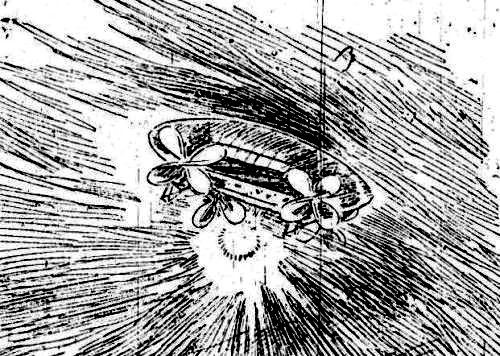
Press illustration of the 1896-97 mystery airship wave
Mystery airship 1896.jpg · Wikimedia Commons · Public domain · open original
The years in question
The great airship wave of 1896-1897 is the first wave of mass aerial-object sightings documented in the American press, nearly a decade before the Wright brothers' first flight. The first major episode occurred on 17 November 1896 over Sacramento, California. According to the next day's Record-Union, "several persons" saw between six and seven in the evening "a big ball of fire, like an electric light", which crossed the city slowly toward the southwest for more than half an hour; some said they heard voices and singing, but no one made out the outline of a balloon, and the paper suggested it might have been an illuminated balloon or a meteor. The San Francisco Call added that the sky was covered by heavy clouds and that the object's shape and size could not be made out. The cigar-shaped machine appeared two days later, from a witness who described it as driven by four men pedalling, while the Record-Union wrote that "ninety-nine out of 100 men" in the city regarded the matter as a huge hoax. In the following days and weeks the sightings multiplied across northern California (San Francisco, Oakland) with recurring descriptions: a large cigar- or spindle-shaped craft, often fitted with a powerful searchlight and propellers or wings, advancing with a control impossible for the technology of the time.
After a winter pause, a second phase began in Nebraska on 2 February 1897 and swept the Midwest eastward: Kansas, Texas, Iowa, Illinois, Missouri, Nebraska, and by April the phenomenon was reaching New York State. Each area's local press competed to publish the most spectacular sighting, and alongside the light descriptions came accounts of landings, conversations with 'pilots' and notes from anonymous inventors who claimed to be flying the machine. The most famous and outlandish episode was published in April 1897 in Aurora, Texas: a dispatch signed by S. E. Haydon in the Dallas Morning News of 19 April reported that an airship had crashed into Judge Proctor's windmill, that the body of a pilot who "was not an inhabitant of this world" had been found among the wreckage and that his funeral would take place the next day; the grave in the town cemetery is a later addition to the legend. The sources consulted record no physical remains to support it.
The wave's balance sheet is telling: over a thousand distinct accounts gathered in newspapers coast to coast, and, according to the sources consulted, no debris recovered, no pilot coming forward and no reliable photograph. Most historians interpret it as a complex blend of misidentifications of bright celestial bodies (above all Venus and stars), deliberate newspaper hoaxes amid a circulation war, social anticipation of the 'imminent' triumph of aeronautics (very present in turn-of-the-century popular culture) and the contagion effect once the first story caught on in the press.
Why it matters
The 1896-1897 wave matters as the founding case of the modern phenomenon-as-account in its mass, media form: half a century before Kenneth Arnold and the term 'flying saucer', entire U.S. communities were already describing, debating and printing sightings of aerial craft impossible for their time, organized as a national event. Its value is historiographic and methodological: it shows that the social machinery that produces a wave (technological expectation, eager press, contagion, misidentification of the sky) was fully operational before the space age, which compels caution toward any reading that presents 20th-century waves as something unprecedented.
The strongest explanation is not a single object but a compound: Venus and bright stars seen through suggestion, newspaper hoaxes amid a circulation war (Aurora, with its pilot "a native of the planet Mars", its announced funeral and not a single verifiable remnant, is the paradigmatic example of fabrication) and the collective desire to see the machine everyone was waiting for take flight. As Mike Dash sums it up, among over a thousand heterogeneous accounts and with no way to audit witnesses from 130 years ago, a small residue remains perplexing; nothing in it indicates there were craft. The great wave is the 19th-century mirror in which all later dynamics are recognized: the reminder that a phenomenon can be perfectly real as a social fact without anything physically anomalous in the sky.
What's left on paper
Documented evidence
- Over a thousand press accounts coast to coast between November 1896 and spring 1897
- First major episode: Sacramento, California, 17 November 1896 ("several persons" saw a ball of light under a cloudy sky; the cigar shape appears in accounts from days later)
- Second phase from Nebraska (2 Feb 1897) spreading across Kansas, Texas, Iowa, Illinois, Missouri and to New York
- The Aurora, Texas 'crash' account (April 1897) with a pilot 'not of this world'; the sources consulted record no physical remains
- According to the sources consulted, no recovered debris, identified pilot or reliable photograph across the entire wave
- Context: cultural anticipation of aeronautics and a circulation war among newspapers
Sources
- Wikipedia — Mystery airship
- Readex — 'UFO Fever in America's Historical Newspapers: The Mysterious Airships of 1896-97'
- HowStuffWorks — 'Airships in America'
- «What Was It? An Apparition Wandering Through the Atmosphere», Sacramento Daily Record-Union, 18 nov 1896, p. 4 (Chronicling America) — Primary source: first local report of 17 November; «several persons» and a ball of light, perhaps an illuminated balloon or a meteor.
- «Claim They Saw a Flying Airship», The San Francisco Call, 18 nov 1896, p. 3 (Chronicling America) — Primary source: the sky was overcast and shape and size could not be made out; voices and singing according to streetcar employees.
- «That Mysterious Light. Was It an Air-Ship or a Will-o'-the-wisp?», Sacramento Daily Record-Union, 19 nov 1896, p. 8 (Chronicling America) — Primary source: first accounts of a cigar-shaped machine and the paper's view that nearly everyone took it for a hoax.
- S. E. Haydon, «A Windmill Demolishes It», Dallas Morning News, 19 abr 1897, transcrito en Magonia 20 (agosto 1985) — Transcript of the original Aurora dispatch: Judge Proctor's windmill, a pilot who «was not an inhabitant of this world» and an announced funeral.
Entity form (1)
Related cases