1953·Ellsworth AFB, Rapid City, South Dakota
United States.Ellsworth AFB · Blue Book's 'best report'
On the night of August 5, 1953, a Ground Observer Corps volunteer at Blackhawk, South Dakota, reported a light; the Ellsworth AFB radar showed echoes and vectored two F-84s toward them. The first pilot saw only a silver light; the second chased a light that changed from white to green for about five minutes, to some 80 miles north, while ground radar showed an echo ahead. Ruppelt's report carried it as 'Unsolved', but in January 1954 Hynek and the radar squadron commander discounted it, and the record card was corrected by hand to Capella (visual) and anomalous propagation (radar).
Tier S · SolidWhat do they mean? →
Strong evidence: a contemporary instrumental record (radar, sensor, film or photo of known provenance) that corroborates several independent witnesses.
What it was
63%natural or human cause
Most likely explanation: planet or star
See the split across the six explanations
Natural or human cause
No known cause
Primary documents
Blue Book file on Rapid City–Blackhawk (August 1953): record card, report T53-11156 and the Atwell and Hynek letters, 8 pp.
Extract of the Blue Book file. The record card says the ATIC representative was unable to determine the identity of the object, and a handwritten correction in the conclusion box reads "Astro (Capella)" for the visual and "anomalous propagation" for the radar. Pages 20 to 23 of report T53-11156 record the interviews with the GCI controller and the two F-84 pilots: the five-minute chase to 80 miles north with the blip 5-10 miles ahead, the radar gunsight that gave no range, the camera that malfunctioned, and the conclusion "Unsolved". They are followed by Maj. Allen L. Atwell's letter to Hynek (19 January 1954), who believes the pilot would admit he was chasing a large star, and Hynek's reply of 2 February.
Proyecto Blue Book (NARA), vía archive.org · Public domain · US Government work · open original
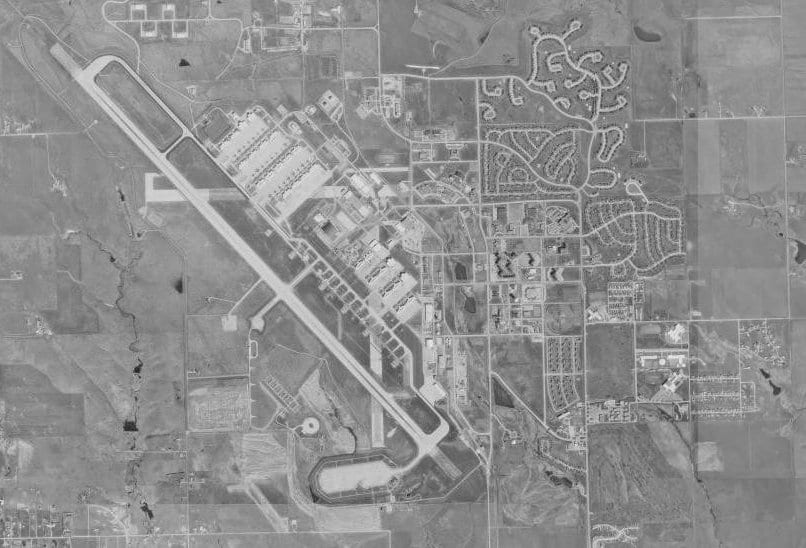
Context · Ellsworth Air Force Base (South Dakota)
Ellsworth Air Force Base - 3Apr1997.jpg · Wikimedia Commons · Public domain · open original
The night in question
The sequence began on the ground, at 8:05 p.m. Mountain time on August 5, 1953, 45 minutes after sunset. A Ground Observer Corps volunteer (the Cold War civilian air-watch network) whose name is blacked out in the file called from her post at Blackhawk to report a light to the northeast that was first stationary and then moved south, toward Rapid City. The filter center passed the alert to the duty controller of the ground-controlled intercept (GCI) radar of the 740th Aircraft Control and Warning Squadron at Ellsworth AFB, who sent three airmen outside: they saw a light crossing from north to south at high speed. Two echoes moving south appeared on the scope, although the controller could not get a distinct track because of ground clutter. A few minutes later the Blackhawk post reported that the light was back in nearly its original position.
According to the controller, an F-84 on patrol was vectored toward an echo that remained stationary about 15 miles northeast of Blackhawk; once the pilot saw it, the target began moving on a heading of about 320 degrees magnetic, gave "four good blips", and the last was at 70 miles. An attempt was made to photograph the scope, but the camera malfunctioned. The pilot, however, told Ruppelt that he searched for 20 minutes without seeing anything and only on returning to land saw a silver light to the northwest, "brighter than the brightest star I've ever seen", which held for 30 seconds, disappeared, reappeared for another 30 and faded; the report itself says he "only got a glimpse of a light". A second F-84 took off and, flying north at 15,000 feet (4,500 m), saw a light 30-40 degrees to his right and level; he thought it was a star or planet, but it seemed to "jump" 15-20 degrees in elevation and to change from white to green. He climbed to 26,000 feet (7,900 m) while the controller carried on the scope both the aircraft's echo and the object's, the latter 5 to 10 miles ahead. When he switched on his radar gunsight the warning light came on, but it gave no range, because the sight starts measuring at about 4,000 yards; on the way home the light blinked on and off several times, which the report notes as a possible malfunction, and the sight was never checked. The chase lasted about five minutes, to some 80 miles (130 km) north of the base, and the pilot maintained that the light moved relative to the stars. On the way back he saw another red and white light near the ground, and the height-finder radar gave an echo at 8,000 feet in that direction. The Bismarck, North Dakota filter center was alerted, and observers there saw lights for about three hours from just after midnight.
Ruppelt's report (T53-11156) is far more cautious than the legend. It notes that the controller "left the impression that he was trying to prove the existence of an unidentified flying object", although "he saw targets on the scope, there is no doubt about it"; that the airmen's description, a "streak", fits a meteor; that the 8:00 p.m. weather balloon went south, but two Lowry research balloons were lost and could have been in the area; that inversion data were not available; and that the star Capella was visible low on the northern horizon and the pilot could have seen it. It concludes: "Pending further study, this incident is carried as Unsolved." The Blue Book office called it in its weekly report "one of the best reports ever received". In January 1954 Hynek and Captain Charles Hardin went back to Rapid City and Bismarck. The radar squadron commander, Major Allen Atwell, wrote to Hynek that the second pilot was "willing to admit that he was chasing a large star", that the controller was known to exaggerate, and that he had "totally discounted" the incident as a series of coincidences; Hynek replied that they would probably proceed by "discounting the Rapid City incident altogether" and concentrate on Bismarck, whose lights had for him "no ready explanation". The card says the ATIC investigator "was unable to determine the identity of object", but a handwritten correction on it replaces this with "astro (Capella)" for the visual and "anomalous prop." for the radar. Computing the positions confirms the visual part: between 9:00 and 10:00 p.m. Capella (magnitude 0.1) stood 1-4 degrees high at an azimuth of 9 to 19 degrees, just to the right of the jet's northerly heading, on a moonless night. The pilot, however, put the light 30-40 degrees to his right on a magnetic heading of 360, a discrepancy the report puts down to uncertain positions ('All positions are subject to some error').
Why it matters
Ellsworth holds a central place in the history of the subject because Blue Book's own chief canonized it: in his 1956 book Ruppelt called it "the best UFO report in the Air Force files". But the file shows that this version grew over the years. The book dates the event to the night of August 12, puts the target at 16,000 feet, and describes a constant 3-mile separation, a 120-mile chase and a radar lock indicating "something real and solid"; his own 1953 report says August 5, a 5-to-10-mile separation on radar, about 80 miles, a pilot who only glimpsed the light, and a sight that gave no range and later blinked as if faulty. It is a textbook case of the embellishment that accumulates with each retelling, which is why this entry relies on the report and not on the book.
What remains unexplained is not trivial either, and it deserves to be stated just as plainly. The controller saw echoes that, by Ruppelt's own account, were there; the first stayed stationary and then moved away on a definite heading, and the second stayed ahead of the jet during the chase. The card's "anomalous propagation" was never demonstrated: the inversion data were not obtained and the correction cites no new analysis. Capella explains the second pilot's light well, low in the north, twinkling and changing color, but does not by itself explain a radar echo accompanying it. And at Bismarck, 220 miles away, filter-center observers watched for hours lights that Hynek could not identify. In short, the file downgrades the case from 'best report' to an episode with a strong prosaic explanation for the visual part and a poorly documented radar residue, without the camera or the data that would have closed it. The classification therefore gives the greatest weight to astronomical misidentification combined with spurious echoes, and keeps an indeterminate share for the echoes nobody explained.
What's left on paper
Documented evidence
- Report by a Ground Observer Corps volunteer at Blackhawk at 8:05 p.m.: a light to the northeast, stationary and then moving south
- Three radar-site airmen saw a fast light moving north to south; Ruppelt's report says their 'streak' fits a meteor
- Echoes on the Ellsworth GCI radar: one stationary 15 miles northeast of Blackhawk that then moved away on heading 320; the radar camera failed
- First F-84: saw only a silver light for about 60 seconds while returning to base
- Second F-84: white and green light to his right, a chase of about five minutes to 80 miles north with the object's echo 5 to 10 miles ahead
Show 3 more items
- Second jet's radar gunsight: warning light on without measuring range, which later blinked as if faulty; never checked
- Ruppelt's report: 'Unsolved'; January 1954: Atwell and Hynek discount the Rapid City part; card corrected by hand to Capella and anomalous propagation
- Position computation: Capella 1-4 degrees above the northern horizon between 9:00 and 10:00 p.m., on a moonless night
Sources
- Project Blue Book — file "5 August 53, Rapid City, Blackhawk, South Dakota Area" (record card and file, 36 pp.), NARA, archive.org mirror — Primary source: card corrected by hand (Capella / anomalous propagation), Ruppelt's report T53-11156 ('Unsolved'), ATIC weekly reports, Hynek and Hardin's Bismarck report, and the January 1954 Atwell and Hynek letters
- Edward J. Ruppelt — The Report on Unidentified Flying Objects (1956), Project Gutenberg — Later memoir by the Blue Book chief, not a contemporaneous record: calls it "the best UFO report in the Air Force files", with a date and figures that do not match his own 1953 report
Referenced by 1 case
Related cases