1965·Edwards AFB, Mojave Desert, California
United States.Edwards AFB · The 1965 Tapes
In the early hours of October 7, 1965, the Edwards AFB tower operator and three other servicemen watched for hours between seven and twelve star-sized lights flashing red, green and white, low in the east-northeast. Several radars picked up brief returns in the area, and at one point the tower and radar nearly agreed on three objects; an F-106 scrambled at 5:09 a.m. and found nothing. The Blue Book card puts the lights down to stars and planets and the returns to the atmosphere; the radar analyst attributed both to atmospheric variations. Jupiter, Capella, Castor and Pollux were in that part of the sky.
Tier A · AcceptableWhat do they mean? →
Institutional evidence: several identified independent witnesses, or contemporary official documentation, without an instrumental record to corroborate them.
What it was
71%natural or human cause
Most likely explanation: planet or star
See the split across the six explanations
Natural or human cause
No known cause
Read the full reasoning
Against it, from the same file: the witnesses called what that officer saw not representative, and the brightest object did not follow a single star, although it ended where Bellatrix and Betelgeuse stood, as the report itself anticipates. The FTD analyst proposed another natural cause for the lights, atmospheric variations; the radar, a separate layer, is put down to the atmosphere by both the card and the FTD.Primary documents
Project Blue Book · record card, Flight Test Center report and radar evaluation (extract)
Eleven pages of the Blue Book file on Edwards (NARA). The record card concludes: visual, astro (stars/planets) with "balloon" added by hand; radar, returns due to atmospheric conditions. The Flight Test Center report of 21 December 1965 describes 7 to 12 objects with "the general shape and appearance of stars" flashing red, green and white, identifies one as a weather balloon and says that at one point tower and radar operators nearly agreed on three objects. The Foreign Technology Division evaluation signed by Vincent D. Bryant attributes the scope photos to radical variations in the atmosphere. One of those photographs is included.
Project Blue Book, expediente «7 Oct 65, Edwards AFB, California» (NARA), espejo en archive.org · pp. 1, 2, 16–23 y 32 · Public domain · US Government work · open original
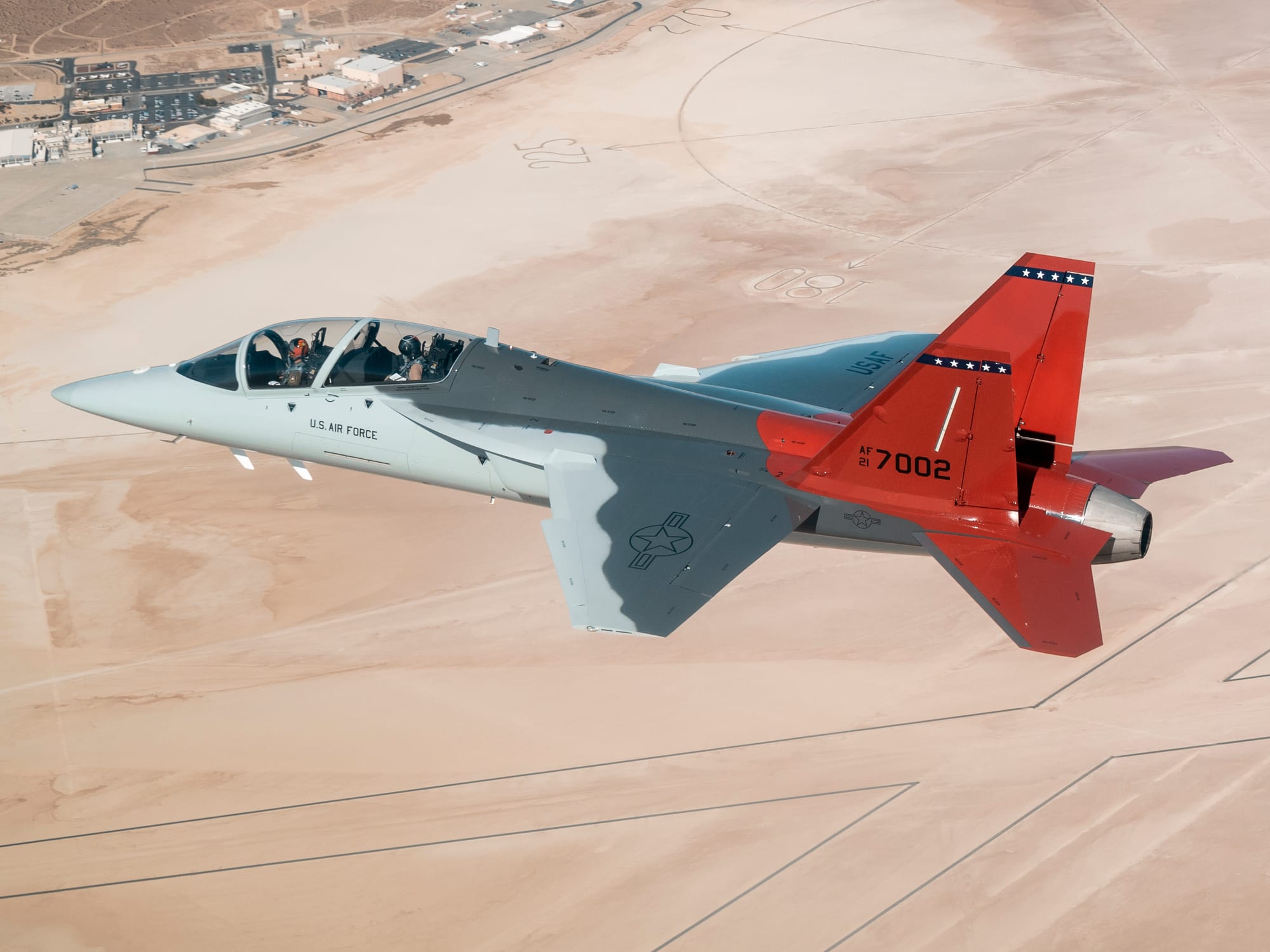
Context · Edwards Air Force Base (California)
T-7A Red Hawk over Edwards Air Force Base.jpg · Wikimedia Commons · Public domain · open original
The night in question
Edwards Air Force Base, in the Mojave Desert, was in 1965 the US Air Force's flight test center. According to the report its headquarters sent to Blue Book on December 21, 1965, signed by Captain John D. Balent, the tower operator, Staff Sergeant Charles A. Sorrels, noticed flashing lights at 1:33 a.m. (08:33 UTC) on October 7. The first and most prominent object appeared at an elevation of 10 degrees and an azimuth of 62, toward the east-northeast; the others at elevations of 20 to 45 degrees and azimuths of 50 to 75. The observers were at base operations and used 7x50 binoculars: besides Sorrels, Captain Darryl Clark, an alert pilot with the 329th Fighter Interceptor Squadron, dispatcher Forrest Honer and weather observer Keith Peneau. The report says all the objects "had the general shape and appearance of stars," were the same color as stars and the size of a star (the largest twice that), numbered between seven and twelve, flashed red, green and white, and that three formed a rough inverted V. Their main change was in altitude: they seemed to hover and then rise almost vertically. Three faded after about 30 minutes; the four most prominent flashed for about two hours and then "seemed to take their place among the stars" and persisted, "looking like all the other stars, until dawn." The brightest was last seen at about 50 degrees elevation and azimuth 135, toward the southeast. The night was clear, with 35 miles of visibility.
It was the tower that queried the radar net through the Los Angeles Air Defense Sector; until then nothing unusual had been held. Over four and a half hours, radars at San Pedro, Laguna, March AFB and Boron showed, at one time or another, up to twelve contacts in the area, most of them very brief and hard to hold because of their slow speeds; the height-finding radar, the report says, "had little luck" in measuring altitude changes, and it is "impossible to determine" which contacts correspond to the lights. Even so, the same report states that search, height-finding and approach radar "all held the objects," that the sector held contacts U090, U091 and U092, the ones that figured in the decision to scramble an interceptor, "in a close enough proximity to those under visual observation that there is a possibility that they were the same," and that "at one point there were three of the objects on which near agreement was reached by the tower operator and radar operator." The unidentified tracks were carried as U090, U091, U092, U103, U104 and U105. The F-106 left George AFB at 5:09 a.m. (12:09 UTC), when the activity "was just about over" and the lights had stopped flashing; controlled visually from the tower, it made passes through the area at 15,000, 20,000 and 40,000 feet and the only thing out of the ordinary he reported was reflections of red lights from the dry lake bed, which he felt came from something other than the beacons in the area. A civilian aircraft that crossed the area at 14,000 feet at the height of the activity saw nothing unusual. The sector taped most of the conversations, and the base sent Blue Book three magnetic tapes with an index of the important passages, together with two rolls of radar scope photographs taken between 2:47 and 5:40 a.m.
The officer who wrote the report arrived at 3:00 a.m., when the activity had subsided but the tower operator still claimed to hold flashing lights on two of the four objects. He wrote that he saw the objects but could not positively say he saw flashing: they "looked like ordinary stars," one very brilliant "but not so brilliant as to preclude its being a star"; at times a couple seemed to flicker, but he "certainly saw no distinct intermittent flashing." He also cautioned that what he observed "was at the tail end of the activity and according to the observers was not representative of what they had seen earlier." He noted that an eighth object, which the witnesses said behaved like the others except that it flashed only white and red and showed more lateral movement, turned out to be the weather balloon released from Edwards at 5:00 a.m., and that "these objects behaved somewhat like balloons." Even so, he concluded that "everyone concerned" at the sector and the base "seems convinced that something unusual occurred." The report also records a third-hand story, of a driver who supposedly saw a red object over Highway 138, whose source the officer could never locate and which he was inclined to consider a hoax. Vincent D. Bryant, of the Defensive Electronics Division at the Foreign Technology Division, reviewed the photographs. He cautioned that without the radar's nomenclature, frequency and type of scope presentation a thorough evaluation was impossible, and that his comments rested on general radar conditions "which may or may not be valid in this particular case." He saw "literally dozens" of returns that appeared, moved and disappeared at random, similar to returns from land masses or clouds, and concluded they were not material targets such as aircraft, balloons or space vehicles. He ruled out clouds because of the clear night, and operator error because "photos rule this out, as does coincident visual sightings"; mainly on the strength of the visual sightings he also judged jamming, interference and equipment malfunction unlikely. He proposed anomalous propagation, "although there evidently was no temperature inversion during the period," and concluded that "the only logical explanation" was "radical variations in the atmosphere during this period which resulted in both visual and radar sightings," and that it was "beyond the realm of probability" that the targets were material. The case card did not follow him on the visual part; it concludes: visual, astronomical (stars and planets), with "balloon" added by hand; radar, returns due to atmospheric conditions. A position check partly supports the astronomical reading: at the time of the first sighting, Jupiter (magnitude −2.3) stood about 33 degrees high at azimuth 83, Capella at 49 degrees and azimuth 58, and Castor and Pollux at about 16 to 20 degrees and azimuths 64 to 67. Low stars scintillate in red, green and white, and as they rise in the east their main change is precisely in altitude. But the brightest object's path is not that of a single star: it appeared at 10 degrees and azimuth 62, just below Castor and Pollux, and after flashing for about two hours it was last seen at 50 degrees and azimuth 135, while in that time Pollux only climbed to about 40 degrees at azimuth 80, and Jupiter to about 57 degrees at azimuth 102. At the place where it was last seen, however, stood Bellatrix (about 53 degrees, azimuth 136) and Betelgeuse (about 50 degrees, azimuth 125), and near where the three lights in a V were lost (35 degrees, azimuth 140 to 150) stood Rigel and Orion's belt, somewhat higher. The report itself suggests that these lights may have faded and been "replaced in the eyes of the observers by stars that happened to be in the area of last sighting."
Why it matters
At Edwards 1965 the file itself preserves the witnesses' detailed description, the radar chronology and the record that the air defense sector taped its communications and sent the tapes to Blue Book. That material makes it possible to check the story against the data, and the check does not point in a single direction. The witnesses themselves described the lights as stars in shape, size and color; they appeared in the part of the sky where Jupiter, Capella, Castor and Pollux were; they climbed as the eastern sky climbs; and in the end they "seemed to take their place among the stars" until dawn. The officer who arrived at 3:00 a.m. saw only ordinary stars, although the witnesses told him that what he saw was not representative of what came before, and the only object identified with certainty was a weather balloon that the witnesses had taken for one more light and which, according to the report, they called representative of what they had seen earlier. In the other direction, the positions the report gives for the brightest object do not follow any star, and the radar was not detached from the lights: the returns were brief and scattered and no one could assign them with certainty, but the report records that at one point the tower and radar operators nearly agreed on three objects, and that the contacts behind the scramble were close enough to the lights that they might have been the same. The analyst who examined the scope photographs used those coincident visual sightings to rule out operator error and interference, and attributed both the returns and the lights to the atmosphere. The interceptor took off almost three and a half hours after the first sighting, when the activity was just about over. The tapes, often presented as proof of a phenomenon, are according to the report itself time-consuming and in large part "not very enlightening"; audio copies attributed to them and interviews attributed to Sorrels have circulated since, whose authenticity has not been verified.
The case therefore serves as an example of a known pattern and of its limits: professional observers, at night and with binoculars, can take the scintillation of low stars for lights that flash and move, and a query to the radar net can produce atmospheric returns that seem to confirm it, because they are looked for after the visual sighting and in the same direction. None of this detracts from the witnesses or makes the explanation certain: the base's report recorded that no one at the sector could provide a plausible explanation at the time and that everyone, at the sector and at Edwards, seemed convinced that something unusual had occurred. The two official conclusions do not agree either: the card puts the lights down to stars and planets, and the radar analyst to the same atmospheric variations as the returns, a mechanism he proposed from general radar conditions and although there was no temperature inversion. What was described does not resemble a craft: had some prototype flown that night, it would not explain lights that stayed until dawn looking like stars. The 5:00 a.m. balloon is the only material object identified, and the radar part remains unresolved in detail; the analyst considered it unrelated to any material target.
What's left on paper
Documented evidence
- Edwards Flight Test Center report to Blue Book (December 21, 1965, Captain John D. Balent): seven to twelve lights with "the general shape and appearance of stars," flashing red, green and white, first sighting at 08:33 UTC
- Witnesses named in the report: SSgt Charles A. Sorrels (tower), Captain Darryl Clark (pilot), dispatcher Forrest Honer and weather observer Keith Peneau, using 7x50 binoculars
- Up to twelve brief contacts on radars at San Pedro, Laguna, March AFB and Boron; the report says it is "impossible to determine" which correspond to the lights, but also that at one point tower and radar operators nearly agreed on three objects and that U090, U091 and U092 were close enough to the lights that they may have been the same
- F-106 scrambled from George AFB at 12:09 UTC, when the activity "was just about over"; no results beyond reflections of red lights from the dry lake bed, which the pilot felt came from something other than the beacons
- Three magnetic tapes of the Los Angeles Air Defense Sector communications and two rolls of scope photographs, sent to Blue Book
Show 3 more items
- An eighth object turned out to be the weather balloon released from Edwards at 5:00 a.m.; the investigating officer saw only "ordinary stars" at 3:00 a.m., although according to the witnesses that was not representative of what came before
- Conclusions: the card puts the visual part down to stars, planets and a balloon, and the radar to atmospheric conditions; the FTD evaluation (Vincent D. Bryant) rules out operator error and interference because of the "coincident visual sightings" and attributes both the returns and the visual sightings to radical variations in the atmosphere, although there was no temperature inversion
- Position check: at 08:33 UTC Jupiter, Capella, Castor and Pollux were inside the elevation and azimuth window described by the witnesses, but the brightest object's path, from azimuth 62 to 135, is not that of a single star
Sources
- Project Blue Book — file "7 Oct 1965, Edwards AFB, California" (card: visual, astronomical; radar, atmospheric conditions), NARA, archive.org mirror — Primary source. 37 pages: card, Flight Test Center report of December 21, 1965, index of the tapes and the Foreign Technology Division's evaluation of the radar photographs
- Project Blue Book — Edwards AFB photo file 10021 (archive.org) — Primary source: prints of the radar scope photographs, with the reflected clock and dozens of scattered returns
- Los Angeles Air Defense Sector communications tapes, October 7, 1965 — Three magnetic tapes attached to the report sent to Blue Book; the audio copies that have circulated since were not checked in this review
- NICAP — Edwards AFB 1965 case directory — Secondary source: documentary compilation of the case
Related cases
same object · same country · same period
Minot AFB B-52
1968 · Tier S
same object · same country · same period
Redmond, Oregon · police, FAA and six F-102s
1959 · Tier A
same object · same country
Ellsworth AFB · Blue Book's 'best report'
1953 · Tier S
same object · same country
Great Airship Wave · U.S.
1896 · Tier B