1952·Haneda AFB, Tokyo Bay
Japan.Haneda AFB · Radar-Visual over Tokyo
On the night of 5-6 August 1952, four tower operators at Haneda AFB (Tokyo) watched through 7x50 binoculars, for about an hour, a bright light low in the northeast surrounded by a dark area; Shiroi GCI radar tracked a weak target in the area and an F-94 obtained a radar contact of about 90 seconds, without achieving lock-on or seeing anything. The Blue Book card reads 'Unknown'; the Condon Report (1968) attributed the light to the star Capella, which calculation places right on that bearing, and the returns to anomalous propagation.
Tier S · SolidWhat do they mean? →
Strong evidence: a contemporary instrumental record (radar, sensor, film or photo of known provenance) that corroborates several independent witnesses.
What it was
63%natural or human cause
Most likely explanation: planet or star
See the split across the six explanations
Natural or human cause
No known cause
Primary documents
Blue Book file on Haneda (August 1952): record card, FEAF intelligence report IR-35-52 with sketch and statements, and Capt. James's note, 11 pp.
The Blue Book record card logs 5 August 1952 at 23:30 at Haneda AFB, a one-hour observation of one circular object, and checks the conclusion "Unknown". FEAF's ATIL Office intelligence report IR-35-52, dated 12 August, summarizes the visual sighting from the tower, the tracking by Shiroi GCI and the brief contact by an F-94's APG-33 radar; it notes that four operators watched it through 7x50 binoculars for 50 minutes to an hour and that the F-94 lost contact after 90 seconds. Statements and the sketch of the object are included. In the closing note, dated 15 September, Capt. R. L. James writes that the report allows neither an explanation of the radar targets nor an estimate of anomalous propagation.
Proyecto Blue Book (NARA), vía archive.org · Public domain · US Government work · open original
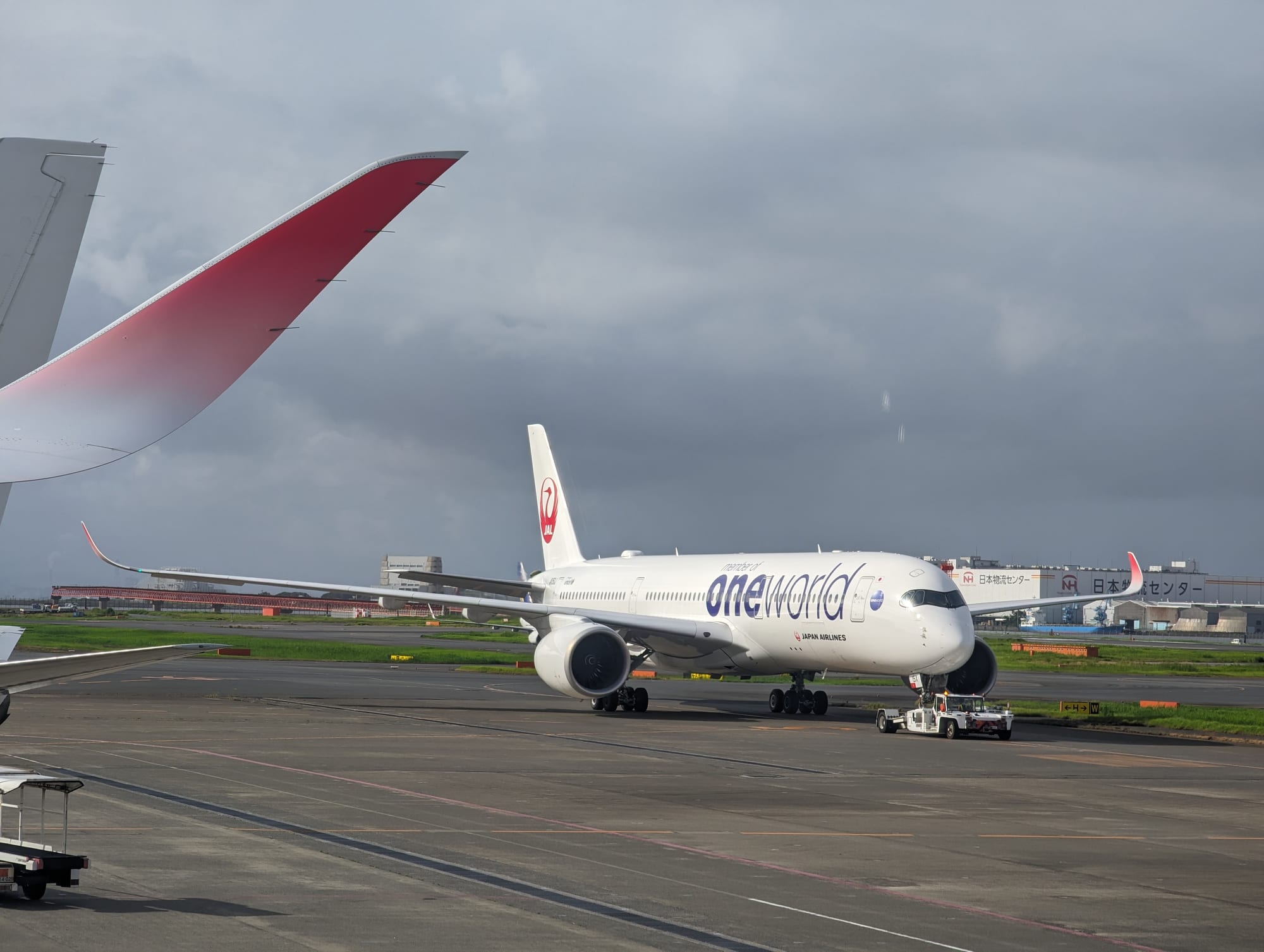
Context · Haneda Airport (Tokyo), site of the 1952 radar-visual contact
Haneda airport 4.jpg · Wikimedia Commons · CC0 · open original
The night in question
Around 23:30 local time on 5 August 1952, two operators of the control tower at Haneda Air Force Base (Tokyo's airport, then under American operation) noticed, while crossing the ramp on their way to their shift, an exceptionally bright light over Tokyo Bay, northeast of the field; once in the tower they pointed it out to two colleagues, and the four watched it through 7x50 binoculars for between half an hour and an hour. According to the Far East Air Forces intelligence report (IR-35-52), they described a circular blue-white light of constant brilliance that seemed to be part of a darker round shape about four times larger, with a few dim lights along the lower edge; but the report itself notes it could not be determined whether that dark area was due to a body or to shadow or a blinding effect from the light. The object faded twice to the east and came back; no sound was heard and no rotation seen. Tachikawa tower, some 30 miles to the west, called to point out the same light over the bay, and the pilot of a C-54 entering the Haneda pattern, asked to look at it, replied that it looked like a brilliant star and dismissed it as such.
The tower alerted the ground-controlled intercept (GCI) centre at Shiroi, of the 528th Aircraft Control and Warning Squadron. The first controller saw only 'three or four blips' on the indicated bearing, with no definite movement; his relief, Lieutenant Albert, tracked a target he described as small and relatively weak but sharply defined, in a right-hand orbit at about 100-150 knots with occasional stops and a maximum of perhaps 250-300 knots; around 00:12 the return broke into three smaller contacts. An F-94 night fighter was scrambled (pilot Lieutenant Holder, radar operator Lieutenant Jones) and, delayed by fuel-system trouble, became airborne at 00:03. Vectored by Shiroi, at about 00:15-00:16 its radar operator picked up a weak contact at 6,000 yards, 10° port; in his statement he wrote that the target was moving rapidly from port to starboard and that 'a lock-on could not be accomplished'; after a turn the blip appeared to accelerate and disappeared from the scope in about 90 seconds. The crew saw nothing at any time despite 60-70 miles of visibility, and both the F-94 and the target were then lost in the Shiroi ground clutter. The tower kept seeing the light until about 00:50, when it was lost among low clouds moving over the bay.
The officer who prepared the report judged all the witnesses serious and called it the first sighting in the Far East combining visual and radar contact over an extended period, but he himself listed possible explanations: full-moon reflections off clouds for the light, and a blinding effect for the dark shape. At Wright-Patterson, Blue Book's radar specialist, Captain Roy James, wrote on 15 September 1952 that the report did not allow a plausible explanation of the targets and that, without temperature and moisture data versus height, no anomalous-propagation estimate could be made, though he noted the targets appeared at times to be permanent echoes. The case card was marked 'Unknown'. The Condon Report (1968), which reviewed the file, argued that the light and the radar return were not the same object: the light remained visible for at least five minutes after the F-94's radar lost the target, and no one at Shiroi saw it although it should have been to their south. It proposed the star Capella, 8° above the horizon at 37° azimuth at midnight, distorted by the atmosphere, and anomalous propagation for the returns, inferred from their coming and going, the break into three and the lack of correlation between the ground and airborne radars. That argument rests on the tower's timeline, and the file itself is not consistent on that point: the summary of the FEAF report says that 'Soon after loss of radar contact by Shiroi and the F-94, the tower lost visual contact as the object either faded, moved away, or was obstructed by clouds', whereas the tower statements keep it in view until about 00:50. Condon, moreover, conceded that the precise optical mechanism that would have produced such a strangely diffracted image 'must remain conjectural' and that, either way, 'the phenomenon must be quite rare'. An ephemeris calculation for Haneda confirms Capella's position: it was rising from about 4° at 23:30 to about 12° at 00:30, on the 30-50° bearing the report gives, and one of the operators noted at the end that the light seemed 'somewhat higher in the sky'. The same calculation shows Venus was below the horizon that night, so the bright planet almost due east with which the witnesses compared the light, and which all of them took to be Venus, must have been Jupiter.
Why it matters
Haneda is often cited as a triple-channel radar-visual case (eyes, ground radar and airborne radar on the same target) and the primary file lets us measure how far that label holds. The three channels existed and were documented by witnesses the report itself judges serious and experienced; the case is still marked unknown and Blue Book's radar specialist found no explanation for the returns. But the file does not support the three channels coinciding: the F-94's radar never locked on, the crew saw nothing in exceptional visibility, the tower, by its own statements, kept seeing the light after the radar had lost the target (although the FEAF report's summary places the visual loss soon after the radar loss), and the light, low in the northeast and also visible from Tachikawa 30 miles away, sat in the position of a bright rising star.
That makes the case instructive rather than conclusive. It shows how a radar-visual can be assembled by adding channels that are not observing the same thing: a low star seen through binoculars across humid air, and weak, intermittent returns on a search radar on a night with no sounding that could rule out anomalous propagation. At the same time, the Condon Report's composite explanation is inferential (there is no temperature profile for that night, and the report itself admits the optical mechanism 'must remain conjectural' and that the phenomenon 'must be quite rare') and the 1952 radar specialist himself could not close out the returns, so a residue of indeterminacy remains in the radar channel. The context matters too: Tokyo in 1952 was the rear area of the Korean War, with air defences on real alert, and a Soviet reconnaissance aircraft was the first operational hypothesis; nothing in the file supports it, since the returns moved at 100-300 knots in tight orbits near the coast and no aircraft was seen.
What's left on paper
Documented evidence
- Observation through 7x50 binoculars by four Haneda tower operators for half an hour to an hour: a circular blue-white light with a surrounding dark area the report could attribute neither to a body nor to glare
- The same light was reported by Tachikawa tower, some 30 miles to the west; a C-54 pilot judged it a brilliant star
- Shiroi GCI: small, weak target orbiting at 100-150 knots, estimated maximum 250-300; around 00:12 it broke into three contacts
- F-94: weak contact of about 90 seconds at 6,000 yards, no lock-on ('a lock-on could not be accomplished') and no visual contact
- Note by Captain Roy James (15 Sep 1952): the data allow no explanation of the returns and, without a sounding, anomalous propagation cannot be estimated; Blue Book card: 'Unknown'
- Condon Report (1968): the light was probably Capella (8° altitude, 37° azimuth at midnight) and the returns anomalous propagation; Capella's position, rising on the report's bearing, is confirmed by ephemeris calculation
Sources
- Project Blue Book — file '5 August 1952, Haneda AFB, Japan' (NARA), archive.org mirror — Primary source: card ('Unknown'), FEAF report IR-35-52 with the statements of the tower, Shiroi GCI and the F-94 crew, and Captain Roy James's note of 15 Sep 1952.
- Condon Report (1968), Section III, ch. 5 'Optical and Radar Analyses of Field Cases', case 237-B — Analysis of the Blue Book file: Capella for the light and anomalous propagation for the returns.
- Robertson Panel report (CIA, January 1953), archive.org mirror — Haneda is among the cases the panel examined in detail.
- NICAP — expediente Haneda/Tokyo Bay 1952 — Secondary compilation; not a substitute for the Blue Book file.
Related cases
same object · same period
Ellsworth AFB · Blue Book's 'best report'
1953 · Tier S
same object · same period
Father Gill · Boianai
1959 · Tier B
same object · same period
Redmond, Oregon · police, FAA and six F-102s
1959 · Tier A
same object
Deception Island · lights over the Antarctic bases (1965)
1965 · Tier A