1959·Boianai, Papua New Guinea
Papua New Guinea.Father Gill · Boianai
On the nights of 26 and 27 June 1959, at the Anglican mission of Boianai (Papua New Guinea), the Reverend William Booth Gill and some three dozen people (including teachers and a medical assistant) observed a large disc-shaped craft with humanoid figures on its upper part. According to the account, the figures appeared to perform tasks; when the witnesses waved, the figures waved back. Gill collected signed statements. It is an entity report with 38 witnesses, according to the signed sketch.
Tier B · IndicativeContacteeWhat do they mean? →
Limited evidence: a single witness, testimony gathered years later, or an account without contemporary primary documentation.
What it was
60%no known cause
Most likely explanation: non-human, controlled by no state
See the split across the six explanations
No known cause
Natural or human cause
Read the full reasoning
Sky conditions at the time were probably responsible for shapes & other characteristics." But the card itself limits this to "some" of the sightings, does not say which, and does not explain the human figures the witnesses drew on top of the object; it is a filing summary, not an analysis of each night.Primary documents
Project Blue Book, 'New Guinea' file, June-July 1959: record card, report of the air attaché in Australia (21 Jan 1960) and the sheet signed on 26 June (3 pp.)
Three pages from the Blue Book file. The card sums up 'Bright white light, upon hovering appeared to have men moving about on top' and closes the case as 'Other: Misinterpretation of Astro Bodies', commenting that the preparing officer pointed to Jupiter, Saturn and Mars, US and USSR satellites, and sky conditions. Air Intelligence Information Report 1,403,022 from the US air attaché in Australia (prepared by Maj. Mance C. Smith, 21 Jan 1960) forwards the Victorian Flying Saucer Research Society report based on correspondence from the mission's reverend and an evaluation by 'an interested local agency'. The third page reproduces the sketch of the appearances of figures from 7:00 to 7:12 p.m., with the note 'This paper drawn up and signed by chief observers at 7:30 p.m. June 26, 1959'; the signatures are blacked out in the copy.
Project Blue Book · NARA, microfilm T-1206 (copia de archive.org, «1959-06-8406927-NewGuinea», págs. 1, 11 y 2) · Public domain · US Government work · open original
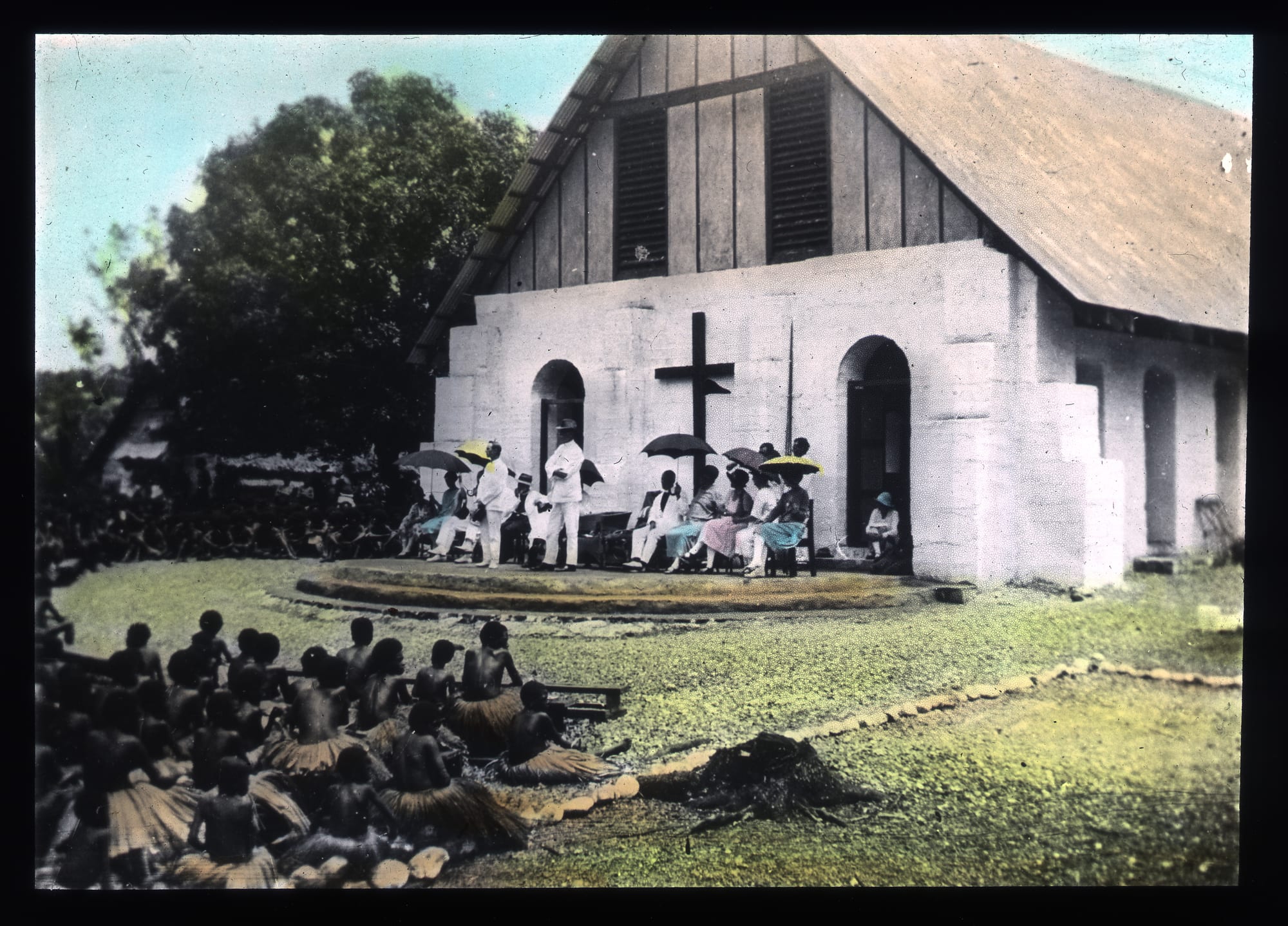
Context · Boianai (Papua New Guinea)
All Saints Church, Boianai, Papua New Guinea (9602443073).jpg · Wikimedia Commons · Public domain · open original
The night in question
On 26 June 1959, around 6:45 p.m., at the Anglican mission of Boianai, on the shore of Goodenough Bay in eastern Papua New Guinea, the Reverend William Booth Gill (a 31-year-old Australian missionary holding a Licentiate in Theology) walked out of the mission house and saw a bright white light in the north-western sky, over the sea. As he later told J. Allen Hynek, on stepping out he saw Venus and, in addition to Venus, a bright white light somewhat above the planet; a mission teacher, Stephen, arrived at 6:52 p.m. and confirmed it was not a star. On a large, disc-shaped form, four humanoid-looking figures could be made out, appearing and disappearing from the upper deck as if busy with some task; from time to time a bluish beam of light projected upward. According to the signed sketch, the main object was clearly visible between 6:55 and 7:22 p.m. to 38 witnesses, Papuans of the mission who included teachers and medical assistants; at 7:10 p.m. the cloud ceiling covered the sky at about 2,000 feet, and Gill noted objects passing in and out of the clouds and casting a halo on them. The activity, with up to five lights at once, lasted about four hours, and in his notes that night Gill even wrote 'satellites?'.
The following night, 27 June, the phenomenon repeated. Gill's first note is at 6:02 p.m.: the sun had already set behind the mountains, but it stayed quite light for fifteen minutes. On the large object four figures appeared, two of them bending over and raising their arms as though adjusting something, while two smaller objects hung motionless further off. Gill raised his arm and waved; to the surprise of the group, about a dozen people, the figure did the same; another witness waved both arms, the two outside figures followed, and all four seemed to wave back. With a torch, Gill directed a series of long dashes at the object, which answered with a pendulum-like swaying and seemed to come closer for half a minute; then the figures disappeared 'below deck'. At 6:30 p.m. Gill went in to dinner; at 7:00 p.m. the object was still there, somewhat smaller, and the observers went to church for Evensong. Asked by Hynek, Gill said he sometimes wondered about this himself, and that he had thought it might be 'just a new device of you Americans'; the next day, by the same account, the local people asked a trader whether he had seen 'the American Air Force'. At 10:40 p.m. a loud explosion woke the mission, with nothing seen. The episode ended without the craft being identified.
Gill documented the case with unusual rigor for the time: he took timed notes as it happened, had three observers draw separately what they saw and obtained the signatures of 27 of the 38 witnesses, who were told to sign only if they were sure. His own report lists the possible objections, from a shared hallucination to the suggestion of witnesses subordinate to the European observer, and in it Gill scaled down his size estimates after practising the hand-span measure; but the same report says the experience took him from scepticism to the conviction that what he saw 'cannot be explained away in terms of natural phenomena', and in the letter he wrote to his colleague David Durry the day after the first sighting he stated that 'there is no doubt whatever that they are handled by beings of some kind'. The US Air Attaché in Australia forwarded the file to Blue Book in January 1960 together with the evaluation of a local agency: in December 1959 Gill told his interviewers that he was not convinced what he had seen were UFOs and would accept any logical explanation, and that the press and flying-saucer groups had distorted some of the facts. The Royal Australian Air Force replied by letter that it could reach no positive conclusions but did not believe they were manned space vehicles, and that an analysis of bearings and angles suggested that at least three of the lights were planets, such as Jupiter, Saturn and Mars, with refraction and tropical weather giving the impression of size and rapid movement; Blue Book closed the case as misinterpretation of astronomical bodies. Hynek, who spoke with Gill in Melbourne and visited Boianai with the Reverend Crutwell some fifteen years later, located six of the original witnesses, who recounted the event in great detail, and rejected the astronomical explanation for the main object: much of it was seen under an overcast sky, with objects descending below the clouds to under 2,000 feet and lighting them up; Gill put its size at about five inches at arm's length, and the second night began in daylight, when no planet would have caused such excitement. Hynek also quotes an Australian air force evaluation that the most probable cause was reflections on a cloud of a major light source of unknown origin, and records that, at the same time as the first sighting, the trader Ernie Evenett, of Samurai, saw a greenish, very bright object with a trail of white flame arrive from the north, hover about 500 feet above him and show the silhouette of a rugby football with brightly lit portholes. Even so, it should be framed for what it is: a close encounter of the third kind, extraordinary and witnessed by many, but testimonial, with no sensor or physical trace.
Why it matters
The Father Gill case is, in its category, the strongest that exists: a close encounter of the third kind with dozens of sober, credible witnesses (led by a university-educated clergyman) and with something almost unique in casework, an apparent interaction (the returned wave) sustained over two nights and backed by signed statements. That is why it has been cited for decades as one of the best 'occupant' reports. And that is precisely why it sharply marks the ceiling of its type: however extraordinary and witnessed by many, it remains a purely testimonial case, with no radar, photograph or material trace. It is documented folklore of very high testimonial quality, with that explicit frontier: enormous historical and human weight, zero hard evidence.
What's left on paper
Documented evidence
- Two-night sighting (26–27 Jun 1959) at the Boianai mission; 38 witnesses on the first night, 27 of whom signed, including teachers and medical assistants
- Humanoid figures on the object's deck; apparent interaction (returned wave) on the second night
- Detailed report and signed statements gathered by the Reverend William B. Gill
- The RAAF attributed at least three lights to Jupiter, Saturn and Mars and Blue Book closed it as astronomical bodies; Hynek objected the overcast sky, the height below the clouds and the daylight of the second night; no radar, photo or physical trace
Sources
- Father Gill / Papua New Guinea Sighting — UFO Evidence — Aggregator; secondary source.
- Patrick Gross — 'Father Gill sighting, Papua-New Guinea, 1959'
- Project Blue Book — 'New Guinea' file, June-July 1959 (US Air Attaché Australia report, Jan 1960) — Primary source: case card, Gill's timed notes and signed sketches, local evaluation of Dec 1959 and RAAF letter (Jupiter, Saturn and Mars).
- J. Allen Hynek — 'The Hynek UFO Report' (1977), ch. 9, 'A Strange New Device of You Americans' — Account by the investigator who interviewed Gill and six witnesses; quotes Gill's notes and an RAAF evaluation.
Related cases
same object · same period
Redmond, Oregon · police, FAA and six F-102s
1959 · Tier A
same object · same period
Deception Island · lights over the Antarctic bases (1965)
1965 · Tier A
same object · same period
Edwards AFB · The 1965 Tapes
1965 · Tier A
same object · same period
Ellsworth AFB · Blue Book's 'best report'
1953 · Tier S