2010·Xiaoshan International Airport, Hangzhou
China.Hangzhou Airport (UFO shutdown)
On the night of 7 July 2010, an unidentified luminous object caused the closure of Hangzhou's Xiaoshan International Airport for about an hour; several flights were diverted or delayed. The episode became one of the most reported sightings in modern China. The press later attributed the closure to an unauthorised private flight (China Daily) or to a military test at a nearby base (South China Morning Post); there was never a conclusive official explanation, and the most widely circulated photographs were not taken at the time of the closure and were attributed to aircraft.
Tier B · IndicativeWhat do they mean? →
Limited evidence: a single witness, testimony gathered years later, or an account without contemporary primary documentation.
What it was
76%natural or human cause
Most likely explanation: aircraft
See the split across the six explanations
Natural or human cause
No known cause
Read the full reasoning
Both readings are aircraft, but they contradict each other and neither was officially confirmed: the head of CAAC air traffic control in Zhejiang said "no conclusion has yet been drawn", and the investigation group of the Beijing and Shanghai UFO societies only concluded that private or military aircraft activity could not be ruled out.Context image (not a document from the case)
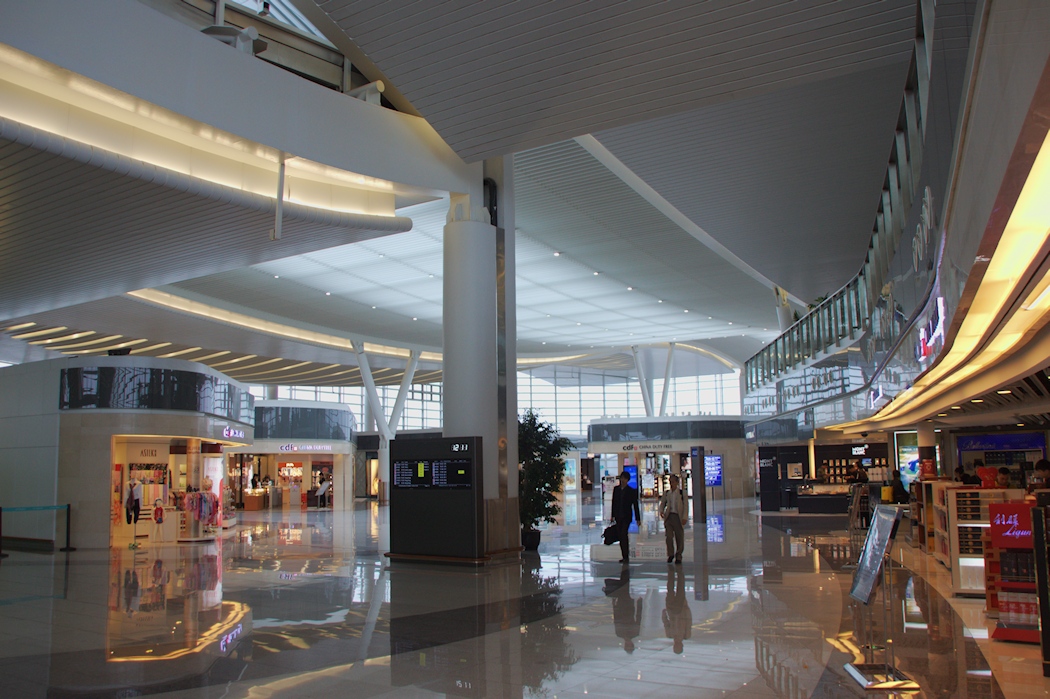
Context · Xiaoshan International Airport, Hangzhou (China)
Hangzhou Xiaoshan Airport (7719450282).jpg · Wikimedia Commons · CC BY 2.0 · open original
The night in question
Around 8:40 PM on 7 July 2010, according to ABC News, the crew of a flight preparing for descent into Hangzhou's Xiaoshan International Airport (Zhejiang province) detected an unidentified object and notified air traffic control. Within minutes, aviation authorities grounded outbound flights and diverted inbound ones to the airports of Ningbo and Wuxi: 18 flights were affected (more than 20 delayed by 56 minutes, according to Beijing Review) and operations returned to normal about an hour later. According to ABC, Hangzhou residents said that less than an hour before the closure they saw a flying object emitting red and white rays of light. For a country where an airport closure is major news, the episode had enormous media impact, and it was part of a run of reported sightings in China that summer.
Several photographs circulated, but they were not from the time of the closure: Hangzhou residents released images taken in the afternoon of an object bathed in golden light with a comet-like tail, which the city's meteorological authorities attributed to sunlight reflecting off an airplane, and a resident, Ma Shijun, photographed at 8:26 PM a streak of white light that, according to Beijing Planetarium curator Zhu Jing, looks just like a plane shining its strobe lamps; Ma himself told Xinhua he did not know whether it was a plane or the airport's object. According to later summaries not checked against sources of the time, the investigation was joint between the Civil Aviation Administration of China (CAAC) and the regional military command's air force; the head of CAAC air traffic control in Zhejiang, Wang Jian, told Xinhua that 'no conclusion has yet been drawn', and the reports consulted mention no radar return from the object. No closed official explanation was published, and the ones the press gave contradict each other: on 5 August China Daily blamed the closure on a 'black flight', a private plane or helicopter flying without authorisation, and later the South China Morning Post reported that it was due to a military test at a nearby air force base. An investigation group from the Beijing UFO Research Society and the Shanghai UFO Research Center visited the airport on 14 July and on the 25th concluded that there was no evidence of an alien craft, but that private or military aircraft activity could not be ruled out; no reading was officially confirmed.
The case should be read for what it is and is not. What is solid and verifiable is institutional: the airport did close and there was a documented operational response with flight figures. The anomalous part (the 'object') is much weaker: the most circulated images are not from the time of the closure and were attributed to aircraft, and the reports provide no instrumental record of the object. Hangzhou stands as a reference case for China (a huge, opaque country on the matter) and, at the same time, as a good example of how a real event (the closure) and fragile evidence (the photo) combine in public perception.
Why it matters
Hangzhou matters for two almost opposite reasons. On one hand, it opens a window onto China: the world's most populous country, with an opaque state apparatus, yields few verifiable cases, and this one (by the magnitude of the airport closure and its coverage) is the most institutionally solid. On the other, it is a reminder of discipline: a real operational event (closure, diverted flights) does not make the visual evidence anomalous, which here is weak and consistent with prosaic explanations. That asymmetry defines it (strong institutional response, weak object), with the explicit caution that 'they closed the airport' is not the same as 'there was a craft'. The file is also a good reminder of how informational opacity manufactures mystery: in a system where military activity and investigation details are not published, official silence is read as confirmation of something extraordinary, when the published hints themselves point to a conventional cause (an unauthorised flight or a military test) that simply was never publicly clarified. The file's caution does not deny that something triggered the closure; it denies that that something should be read as anomalous.
What's left on paper
Documented evidence
- Operational closure of Hangzhou's Xiaoshan Airport for ~1 hour (7 Jul 2010); 18 flights affected, diverted to Ningbo and Wuxi or held
- Detection by the crew of a flight preparing to land, which notified air traffic control
- CAAC and air force investigation according to later summaries; the Beijing and Shanghai UFO group did not rule out private or military aircraft; the press blamed an illegal private flight (China Daily, 5 Aug 2010) or a military test (SCMP), with no official explanation
- Most circulated photographs taken before the closure and attributed to aircraft (Hangzhou meteorological authorities; Zhu Jing, Beijing Planetarium)
Sources
- ABC News — 'UFO in China's Skies Prompts Investigation' (2010) — Contemporary report (Mary Huang, 14 Jul 2010): time, flights affected and origin of the photographs.
- UFO sightings in China — Wikipedia — Secondary source.
- The Korea Times — 'UFO incident in Inner Mongolia blamed on a black flight incident' (15 Nov 2010) — Contemporary press: reports China Daily's 'black flight' explanation (5 Aug 2010) and the South China Morning Post's military-test explanation.
- Beijing Review — 'UFOs Buzz the Private Sector' (29 Sep 2010) — Preliminary findings of the Beijing and Shanghai group (25 Jul 2010) and the figure of over 20 flights delayed 56 minutes.
- Christian Science Monitor — 'China UFO spotted again. Why skepticism is warranted' (16 Jul 2010) — Contemporary press: quotes Wang Jian (CAAC Zhejiang) via Xinhua.
Related cases
same explanation · same period
Stephenville
2008 · Tier A
same explanation · same period
Pudahuel · the silvery object over Santiago airport
2008 · Tier B
same explanation · same period
Aguadilla Puerto Rico
2013 · Tier S
same explanation · same period
An eight-pointed star with unequal-length arms
2013 · Tier A