1964·El Dorado Airport, Bogotá
Colombia.Bogotá · T-33 over El Dorado
One morning in mid-1964, according to the account of controller Eduardo Russi, ramp staff and Avianca alerted the tower at Bogotá's El Dorado airport to a round, deep-yellow object above it. An Avianca pilot had earlier warned that 'another aircraft' crossed his path at his same altitude, even though the tower had no other traffic in the area. A Colombian Air Force T-33 fighter that was landing asked for clearance to chase it; after three minutes, at 31,000 feet and short of fuel, it gave up. It is the classic aviation/interception case of Colombian casework.
Tier B · IndicativeWhat do they mean? →
Limited evidence: a single witness, testimony gathered years later, or an account without contemporary primary documentation.
What it was
66%natural or human cause
Most likely an ordinary cause that no one has identified
See the split across the six explanations
Natural or human cause
No known cause
Read the full reasoning
The absence of a published analysis is not evidence against an ordinary cause: in its 2024 report AARO stated that 'all 174 cases have been finalized as resolved to prosaic objects including balloons, birds, UAS, satellites, and aircraft'. The same report adds that 'many other cases remain unresolved', so the figure is the rate among resolved cases, not among all cases.Primary documents
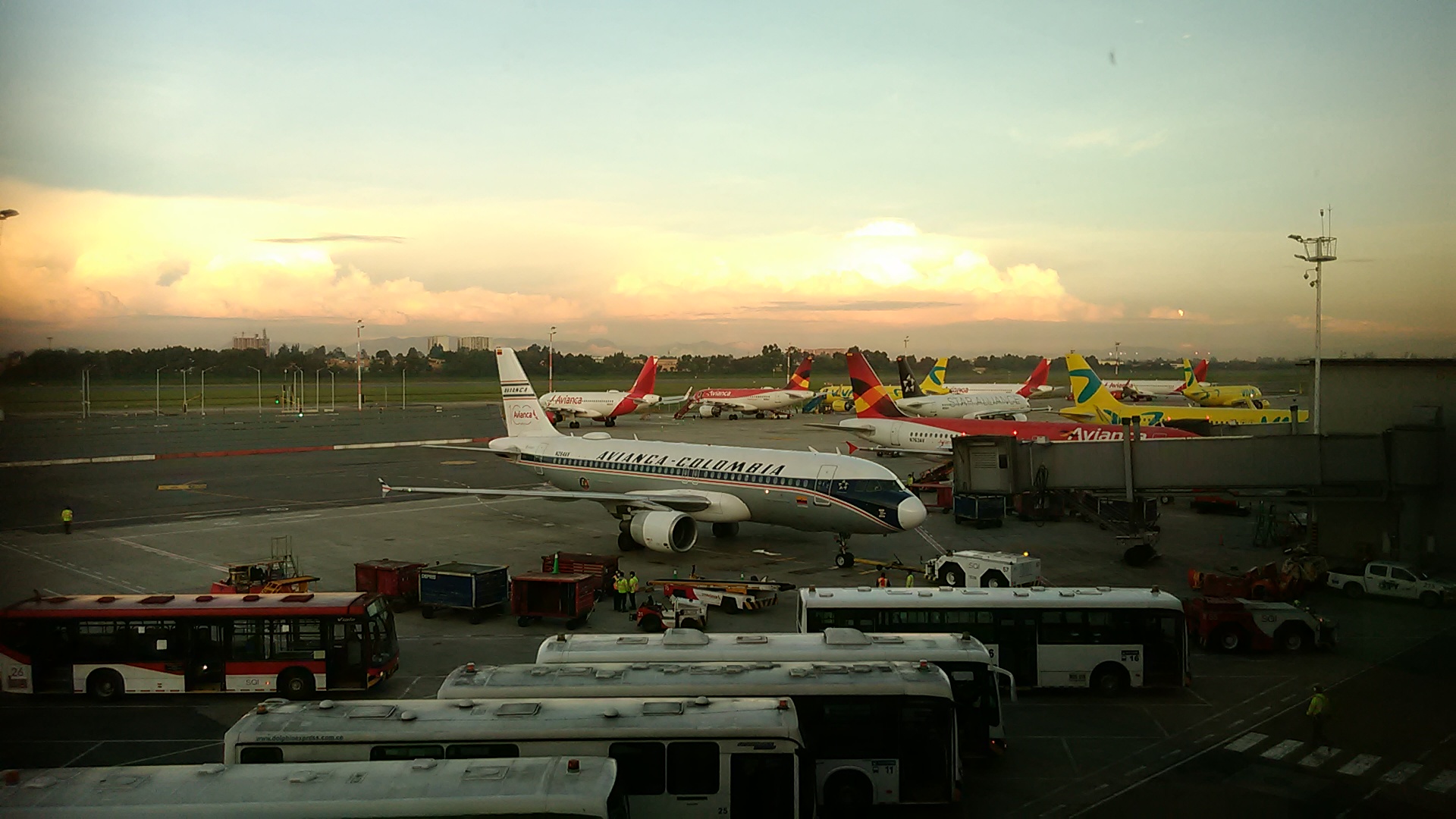
Context · El Dorado Airport in Bogotá (Colombia)
Apron or Ramp internacional airport "El Dorado", Bogotá, Colombia.jpg · Wikimedia Commons · CC BY-SA 4.0 · open original
El Tiempo, "Air traffic controller reveals how a warplane chased a UFO over Bogotá" (24 June 2019)
Testimony of the controller Eduardo Russi, the case's only source, given 55 years later. He places the event around 9 a.m. in mid-1964 and reconstructs from memory the exchanges with the tower: the warning from the ramp staff and from Avianca, the round object, deep yellow with black parts and a white light "like electric welding", the T-33 FAC 2072 asking clearance to chase it and giving up at 31,000 feet short of fuel, and the object moving off to the west. Russi admits he did not note the pilots' names and that his chief ordered silence. Copyrighted article: it is linked.
El Tiempo (Colombia) · view source
The night in question
In 1964, in the vicinity of Bogotá's El Dorado airport, several aviation reports chained together, reconstructed from the testimony of air traffic controller Eduardo Russi, then on duty in the tower. Weeks before the central episode, around 8:00 PM, the pilot of an Avianca DC-4 approaching the Bogotá plain, near Facatativá, told air traffic control that another aircraft had just crossed his path at the same altitude; alarmed, he asked for information, but the tower replied that the only plane in flight in that area was his own. A week later, the pilot of an Avianca Constellation from Cartagena reported lights passing above and below his aircraft, and according to Russi the airport staff saw them too.
The major event came later. As Russi told El Tiempo in 2019, the Colombian Air Force decided to send two Lockheed T-33 'Silver Star' fighters, U.S.-made and veterans of the Korean War, FAC 2072 and 2070, to El Dorado on a transfer flight from Palanquero air base; his chief, Pedro Sánchez, told him they were coming 'in case something happens'. At about 9 in the morning, under a clear sky, as FAC 2072 was approaching to land, ramp staff and then Avianca phoned the tower to say there was something above it. Russi described it as a round object, 'like a wheel', deep yellow with black parts and an intense white light at the centre, like electric welding, that 'shone brighter than the Sun'. The tower asked FAC 2072 whether it had the object in sight; the pilot said yes and asked for clearance to pursue it, which was granted. According to Russi, the fighter got to about 2,000 feet from the object, which rose vertically without a sound; after three minutes the pilot reported he was at 31,000 feet, that the aircraft 'could give no more' and that he lacked fuel, and asked to descend. The object moved off to the west at a 45-degree angle and was lost from sight. Russi says his chief ordered the controllers to keep quiet, and that he never noted the pilots' names.
The case is preserved as the most cited aviation/interception episode of Colombian ufology, revived by Russi's interviews in the national press, such as El Tiempo's 'Archivos X de Colombia' series (2019). Its value is testimonial and institutional (professional pilots, the control tower and a military response, according to Russi's account), but with no preserved radar record or photographs: the documentation is journalistic and archival, not instrumental, and rests largely on the memory of a single key witness decades later. Astronomer Germán Puerta, director of the Bogotá Planetarium, consulted in the same El Tiempo piece, recalled in general terms that aircraft, drones, satellites and the International Space Station are often mistaken for unidentified objects, but proposed no explanation for this episode: about the images the Planetarium receives, he said, 'not much can be said'.
Why it matters
Bogotá 1964 matters as a foundational piece of Colombian casework: an aviation case with multiple qualified witnesses, a control tower involved and a military interception response (the pattern that recurs in the world's best casework). But it also exemplifies the limit of old Latin American casework: however solid the account, with no preserved radar, no photos and essentially journalistic documentation, it cannot go further. It serves to anchor Colombia (a good historical case) and to introduce its scientific counterweight, astronomer Germán Puerta, who recalls how many sightings dissolve when examined. Testimonial anomaly, prudent conclusion. Astronomer Germán Puerta Restrepo, former director of the Bogotá Planetarium, is the Colombian science-communication reference who contextualizes this kind of report. It is also worth marking the evidential limit: the bulk of the file rests on the testimony of controller Eduardo Russi, given decades after the events, and such long-delayed memory is malleable, prone to consolidating details and merging distinct episodes. Without the radio tape, the radar record or a preserved official Air Force report, the T-33 pursuit cannot be independently verified, nor can conventional candidates (another aircraft, a balloon, an optical phenomenon) be ruled out. The case weighs as a foundational piece and a good example of the aviation-plus-interception pattern, not as proof.
What's left on paper
Documented evidence
- Avianca DC-4 pilot reports an aircraft crossing his path at his altitude; the tower records no other traffic (1964)
- Ramp staff and Avianca report a round, deep-yellow object over the El Dorado control tower, which Russi saw
- T-33 FAC 2072, cleared by the tower, chases it for three minutes up to 31,000 feet and gives up for lack of fuel
- Journalistic documentation based on Russi's testimony 55 years later (El Tiempo, 2019); no preserved radar or photographs
Associated actors (1)