1954·Petare, Caracas
Venezuela.The Petare Case (González–Ponce)
In the early morning of 28 November 1954 (29 according to the URECAT catalogue), in Petare (east of Caracas), two merchandise-transport workers (Gustavo González and José Ponce) recounted finding a luminous spherical object hovering in the middle of the street and hairy figures about one meter tall.
Read the rest of the summary
González said he wrestled with one of them, which broke free and sent him to the pavement; at the emergency post he was found to have slight bruises on his left side. It drew attention because there was police intervention and a record by the duty officers of the General Traffic Inspectorate that the witnesses were not intoxicated, although González arrived "quite nervous".
Tier B · IndicativeContacteeWhat do they mean? →
Limited evidence: a single witness, testimony gathered years later, or an account without contemporary primary documentation.
What it was
56%natural or human cause
Most likely an ordinary cause that no one has identified
See the split across the six explanations
Natural or human cause
No known cause
Read the full reasoning
The absence of a published analysis is not evidence against an ordinary cause: in its 2024 report AARO stated that 'all 174 cases have been finalized as resolved to prosaic objects including balloons, birds, UAS, satellites, and aircraft'. The same report adds that 'many other cases remain unresolved', so the figure is the rate among resolved cases, not among all cases.Primary documents
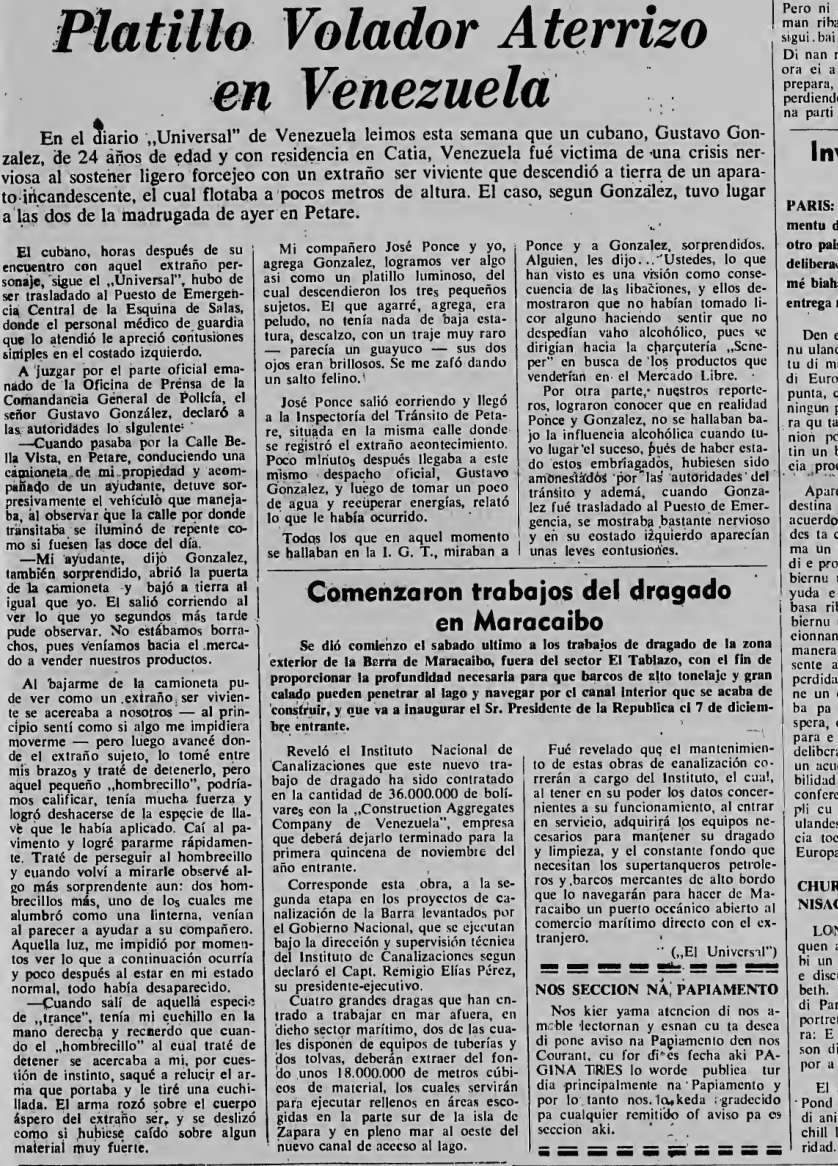
Arubaanse Courant, 1 December 1954, p. 3: 'Platillo volador aterrizó en Venezuela', with González's account per El Universal and the police report
Arubaanse Courant (Oranjestad), Biblioteca Nacional Aruba, vía archive.org · Public domain · unsigned press article published in 1954 (over 70 years) · open original
The night in question
In the early morning of 28 November 1954 (29 according to the URECAT catalogue), Gustavo González and José Ponce were traveling through the Petare area, east of Caracas, on merchandise distribution and transport tasks (a common pre-dawn activity to supply markets). According to the account collected at the time, the completely dark street suddenly lit up as if it were daytime: the source was a luminous spherical object hovering at low height, blocking the way.
González described seeing, next to the object, one or several figures about one meter tall, covered in dark hair, with bright eyes, robust limbs and hands with claws or long nails. On impulse (he said) he tried to grab one of them to capture it, and the creature, with strength disproportionate to its size, broke free and he fell to the pavement; in the SICO wire, by contrast, the little being repelled him "easily" and threw him some distance. According to the statement released by the Press Office of the Police General Command, carried by El Universal, he slashed at it with a knife and the blade "slid off as if it had struck some very hard material", and then a second "little man" dazzled him with a light like a lantern; Ponce, for his part, claimed to have seen other figures carrying something toward the sphere, which then rose and vanished.
What sets the case apart from a mere tale is its documentary trace for the period: González was treated at the Central Emergency Post for slight bruises, and duty officers Manuel Moreno and E. Domínguez, of the General Traffic Inspectorate, recorded the time the men arrived and that they showed no signs of intoxication or mental disturbance. The press of the time qualifies that picture in both directions: El Universal wrote that González suffered "a nervous crisis" and was "quite nervous", and specified that their breath did not smell of alcohol; a wire report from early December added that the psychiatrists who examined him found him in perfect health, although it already gave another version (a "zeppelin"-shaped craft, four dwarfs one metre ten tall and a helper named José Carrizales, aged 19). The episode is part of the great worldwide wave of close encounters of 1954 and remained one of the most cited humanoid files in Latin America. According to the summary in the URECAT catalogue, which draws on the Caracas press and on González Ganteaume but states that it lacks the El Universal article of 29 November, several neighbours stated that day that at the time of the encounter they had seen a very bright light pass over their houses, 'like a very intense star', and heard an explosion and a strange noise; Police and National Security patrols searched the area for the source of the explosion, and El Universal reported that numerous neighbours said they had seen an unidentified flying object. It should be read for what it is: a CE-III type encounter, dramatic and with two witnesses, historically valuable and with police backing, but with no physical trace beyond the reported injuries.
What makes Petare a landmark (more than the episode itself) is the documentary density it accumulated. Venezuelan ufologist Horacio González Ganteaume recorded it in his book 'Platillos voladores sobre Venezuela', and the case soon jumped to the international literature: Coral E. Lorenzen investigated it for APRO, Morris K. Jessup discussed it, Brazilian journalist João Martins spread it across the Southern Cone, and Frank Edwards included it in his influential 'Flying Saucers: Serious Business'. That circulation fixed it as an obligatory reference in the 'occupant' casework. Petare, moreover, was not an isolated event: it headed a Venezuelan wave of humanoid encounters in December 1954 (Valencia, with José Parra; Carora, with Lorenzo Flores and Jesús Gómez; Chico) and preceded by a few months the famous Kelly-Hopkinsville case of 1955 in the United States, with which it shares the pattern of small hairy figures repelled by the witnesses.
Why it matters
Petare matters for its historical place and for what it delimits. It is the foundational case of Venezuelan casework and one of the most cited humanoid encounters in all of Latin America, within the 1954 worldwide wave that installed the figure of the UFO 'occupant' in the popular imagination. And it has something uncommon for such an extraordinary account: an official record (by the traffic officers and the police) that the witnesses were sober. But it also clearly marks a limit: a two-witness CE-III, with no sensor or verifiable material trace, cannot weigh like a military case with radar. It is documented folklore, with that explicit caution: important as a cultural milestone, not as hard evidence. Its real weight is traceability: few 1950s 'occupant' reports reached the international literature (Lorenzen, Jessup, Edwards) with an official record of sobriety behind them, and having headed a documented national wave makes it a useful anchor for measuring how much of the phenomenon is shared culture of the era and how much survives scrutiny.
What's left on paper
Documented evidence
- Convergent account of two witnesses (Gustavo González and José Ponce) in Petare, Caracas (29 Nov 1954)
- Slight bruises on González's left side, treated at the Central Emergency Post after the alleged struggle
- Record by the General Traffic Inspectorate duty officers (Manuel Moreno and E. Domínguez): the witnesses were not intoxicated or disturbed
- Part of the 1954 worldwide wave of close encounters; no physical trace beyond the injuries
- Documented by Horacio González Ganteaume in 'Platillos voladores sobre Venezuela' and collected by APRO (Coral E. Lorenzen), Morris K. Jessup and Frank Edwards ('Flying Saucers: Serious Business')
- Headed a Venezuelan wave of humanoid encounters in December 1954 (Valencia, Carora, Chico); pattern shared with Kelly-Hopkinsville 1955
Sources
- URECAT / Patrick Gross — '1954-11-29 Petare, Venezuela, González & Ponce'
- Espacio Misterio — 'Ovnis en Venezuela: el extraño caso Petare'
- Inexplicata (Institute of Hispanic Ufology) — 'The Gustavo González Confrontation (1954)' — English synthesis of the file and its reception in the international ufology literature (Lorenzen/APRO, Jessup, Edwards).
- Horacio González Ganteaume — 'Platillos voladores sobre Venezuela' — Venezuelan work that collected and disseminated the case; primary source of the early national casuistry.
- «Platillo volador aterrizó en Venezuela» (reproduce El Universal de Caracas y el parte de la Oficina de Prensa de la Comandancia General de Policía), Arubaanse Courant, 1 dic 1954 — Press of the time: González's statement to the police, bruises on his left side, the knife that slides off, the «nervous crisis» and the absence of alcohol on their breath.
- «El cubano Gustavo González asegura que luchó con un marciano cerca de Caracas» (cable de SICO, 5 dic), El Diario (La Paz), 27 dic 1954 — Press of the time: the psychiatrists found him healthy; divergent version with a zeppelin-shaped craft, four dwarfs and a helper named José Carrizales.
- AARO — Fiscal Year 2024 Consolidated Annual Report on UAP (Nov 14, 2024)
Entity form (1)
Associated actors (2)