1986·Airspace of São Paulo / Rio / Goiás
Brazil.The Official UFO Night (Brazil)
On the night of 19–20 May 1986, Brazilian controllers and radars logged unidentified lights and returns over São Paulo and Goiás; the press later spoke of some 21 objects. The FAB scrambled five fighters (F-5 and Mirage) from Santa Cruz (Rio) and Anápolis (Goiás): three had onboard-radar or visual contacts (one of them with a return that pulled away even at supersonic speed) and two detected nothing.
Read the rest of the summary
The Minister of Aeronautics, Brigadier Octávio Moreira Lima, confirmed the episode at a press conference with the pilots, and the confidential report of the Aerospace Defence Command concluded that the phenomena were "solid" and reflected "in some way intelligence".
Tier S · SolidWhat do they mean? →
Strong evidence: a contemporary instrumental record (radar, sensor, film or photo of known provenance) that corroborates several independent witnesses.
What it was
64%no known cause
The evidence is not enough to decide between the explanations
See the split across the six explanations
No known cause
Natural or human cause
Read the full reasoning
The absence of a published analysis is not evidence against an ordinary cause: in its 2024 report AARO stated that 'all 174 cases have been finalized as resolved to prosaic objects including balloons, birds, UAS, satellites, and aircraft'. The same report adds that 'many other cases remain unresolved', so the figure is the rate among resolved cases, not among all cases.Primary documents
'Relatório de Ocorrência' by the Aerospace Defence Command (COMDA), signed by Brigadier José Pessoa Cavalcanti de Albuquerque (2 Jun 1986), 8 pp.
Arquivo Nacional (Brasil), ARX.0.0.249 · Public official document (Arquivo Nacional; Law 9.610, art. 8, IV) · open original
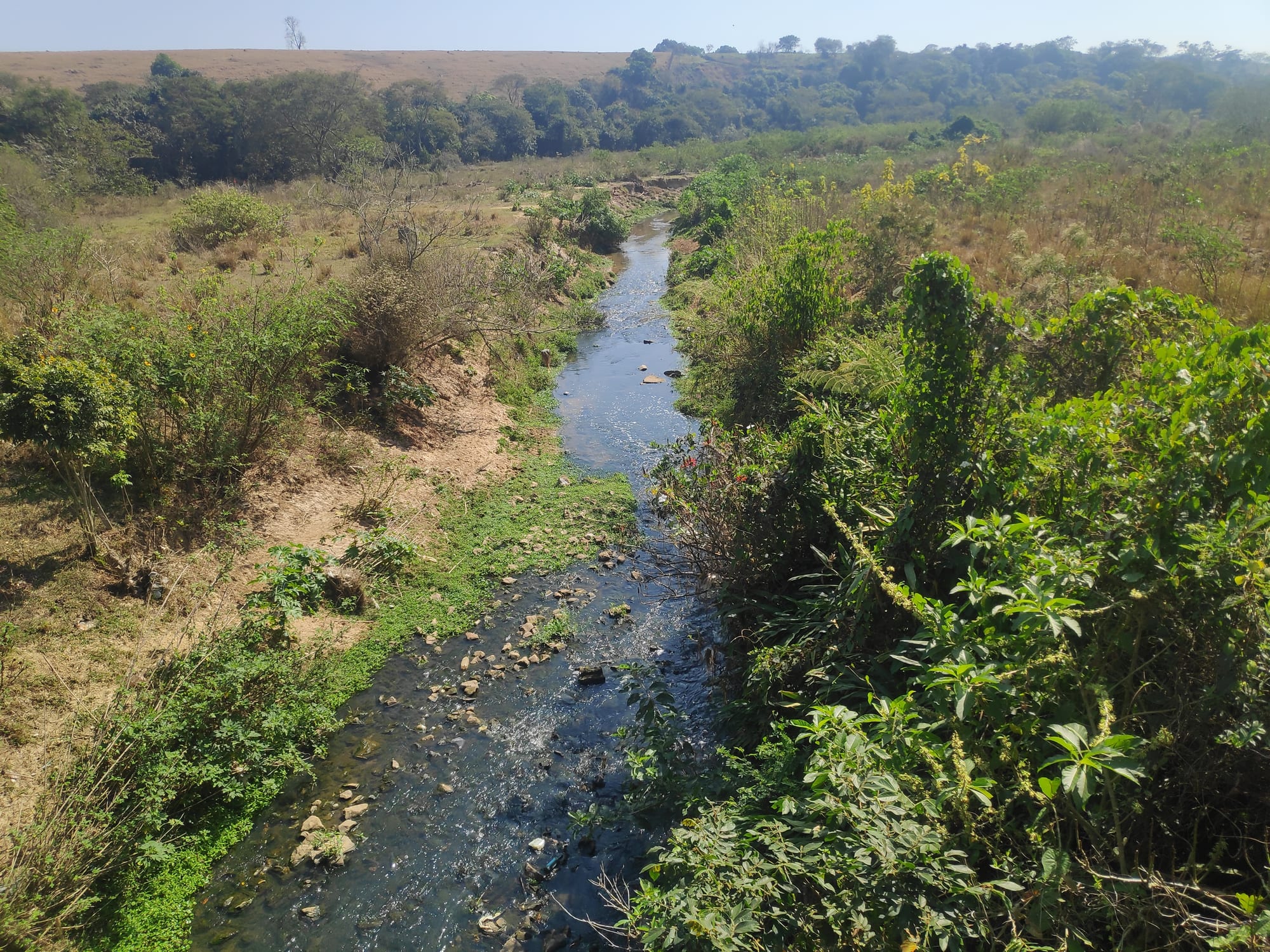
Context · São José dos Campos (Brazil), from where the fighters scrambled on the 'Official Night'
Pararangaba River - Eugênio de Melo - São José dos Campos - Brazil.jpg · Wikimedia Commons · CC BY-SA 4.0 · open original
The night in question
During the night of 19 May 1986, the Brazilian air defence system recorded unusual activity. According to the report of the Aerospace Defence Command (COMDA), the first alert came at 23:15 UTC (20:15 Brasília time): the Brasília Area Control Centre reported that the São José dos Campos tower operator (named in the press as Sérgio Mota da Silva) was seeing lights moving over the city, mostly red but changing to yellow, green and orange, and São Paulo approach control confirmed radar contacts in the area. At 00:08 UTC the pilot of aircraft PT-MBZ saw, on the 150 radial of the São José dos Campos VOR, lights that "looked like large red stars" moving from east to west, and could not get closer to them. Later, Anápolis (Goiás) approach control reported returns on its radar with defined heading and speed. The figure of some twenty-one objects spread by the press does not appear in the COMDA report, which speaks of "some plots" and of returns without giving a number. Among the civilian witnesses, according to the press, was Colonel Ozires Silva, founder of Embraer, who was flying to São José dos Campos after meeting President José Sarney in Brasília.
The Brazilian Air Force (FAB) responded with an interception operation that scrambled five fighters: F-5Es of the 1st Fighter Group from Santa Cruz Air Base (Rio de Janeiro) and Mirage F-103s (Mirage III) of the 1st Air Defence Group from Anápolis (Goiás). The COMDA report sets the takeoffs: the first F-5 from Santa Cruz at 01:34 UTC (22:34 local time), the first Mirage from Anápolis at 01:48, the second F-5 at 01:50 and two further Mirages at 02:17 and 02:36; the pilots named by the press were Lieutenant Kleber Caldas Marinho and Captains Armindo Sousa Viriato de Freitas, Márcio Brisolla Jordão, Rodolfo Silva e Souza and Júlio Cézar Rozemberg. According to the report, the first F-5 pilot, levelled at 17,000 feet, saw a white light below him that climbed until it held about 10 degrees above him, followed it to 33,000 feet with a contact on his onboard radar at 10 to 12 miles, and chased it out to sea for some 180 miles before breaking off for fuel. The first Mirage made five passes with contact and lock-on on its radar but saw nothing; once it came within 2 miles of a return that zigzagged or turned sharply, varied its speed and suddenly pulled away even though the fighter was flying at supersonic speed. The second F-5 saw a red light where ground radar indicated, which did not come closer and went out just as the contact was lost; at one point thirteen plots appeared behind the aircraft, which turned 180 degrees without gaining visual or onboard-radar contact. The last two Mirages had no contact at all.
What turned the episode into 'the Official Night' was its recognition by the state. On 23 May 1986 the Minister of Aeronautics, Lieutenant Brigadier Octávio Júlio Moreira Lima, called a press conference with the pilots at his side and confirmed that the FAB had chased objects it could not identify, with no conclusive technical explanation. On 2 June the acting commander of COMDA, Brigadier José Pessoa Cavalcanti de Albuquerque, sent the General Air Command a confidential eight-page 'Relatório de Ocorrência'. After warning that, for lack of time and specialised knowledge, it confined itself to a "simple narration of the facts", the report lists constant features: the phenomena produced returns simultaneously on ground radars and on the interceptors' radars, varied their speed from subsonic to supersonic and could hover, changed altitude between below 5,000 and above 40,000 feet, sometimes showed white, green or red lights and at other times none, accelerated and decelerated abruptly, and made turns sometimes of constant radius and sometimes of undefined radius. It concludes that the phenomena "are solid and reflect in some way intelligence, through their ability to follow and keep distance from the observers as well as to fly in formation, not necessarily crewed". According to the press, the National Archive also holds audio of that night's pilot-controller communications, which allows the episode to be reconstructed from the primary source.
The sceptical reading of the case should not be omitted, and some of its arguments are in the COMDA report itself: the network's radars were air-traffic-control sets, not specific to air defence, detections required manual initiation and the contacts "were not strong enough" to be tracked; the plots that prompted the first scramble "did not constitute defined radar returns"; the Anápolis approach returns did not show on the military centre's equipment; and two of the five fighters detected nothing. Part of the analytical community has proposed anomalous propagation, mis-correlated air traffic and astronomical sources. Computing positions shows that Mars, reddish and at magnitude −1.2, was rising in the east-south-east around midnight UTC and stood about 21 degrees high when the first Mirage took off, with Saturn and Antares high in the east; they may explain some lights the pilots saw, but not the 20:15 observation over São José dos Campos, when Mars had not yet risen, nor the onboard-radar contacts. What none of those explanations fully closes is the convergence the report describes: ground radars, onboard radars on two fighters and visual observations coinciding within the same time window, plus the explicit institutional acknowledgment.
Why it matters
The Official Night combines radar detection at several control centres, an interception operation with five fighters, onboard-radar contacts in two of them, professional pilot witnesses and the public acknowledgment of the phenomenon by the Minister of Aeronautics, with the pilots present, and an official report that speaks of "intelligence". It does not prove a non-human origin: the radar returns admit readings (anomalous propagation, traffic, balloons) that sceptics have proposed, and the report itself admits that the network was not built for this. But the returns appeared on ground and onboard radars at the same time, and the minister acknowledged the phenomenon in public.
The COMDA report also matters for what it does not do. It does not count the objects or offer a hypothesis, relies on what controllers and pilots said and on earlier I CINDACTA reports that it does not attach, and states that it confines itself to narration so as not to feed speculation; its conclusion about "solid" and "intelligent" phenomena is an operational judgment by a military command based on what controllers and pilots said, not the result of analysing raw data. That is why the figure of twenty-one objects, which does not appear in the COMDA report and which the press attributes to Ministry of Justice records not reviewed here, and the specific speeds in popular accounts should be treated with caution, whereas the takeoff times, the onboard-radar contacts and the two fighters' lack of contact are in the document.
What's left on paper
Documented evidence
- Radar detections by São Paulo approach, Anápolis approach and the military centre (19-20 May 1986); the COMDA report gives no number of objects
- Five FAB fighters (F-5 and Mirage) take off from Santa Cruz and Anápolis between 01:34 and 02:36 UTC; onboard-radar contacts in two, no contact in two others
- Official acknowledgment by the Minister of Aeronautics (Brig. Octávio Moreira Lima) at a press conference with the pilots (23 May 1986)
- Confidential COMDA 'Relatório de Ocorrência' (2 Jun 1986): "solid" phenomena that "reflect in some way intelligence… not necessarily crewed", with the caveat that the radar network was not an air-defence system
Sources
- Brazilian National Archives — COMDA 'Relatório de Ocorrência', confidential, signed by Brigadier José Pessoa Cavalcanti de Albuquerque (2 Jun 1986), file ARX.0.0.249 — The official Aerospace Defence Command report, 8 pp., with the timeline from 23:15Z, the limits of the radar network and the conclusion about "solid" phenomena.
- Arquivo Nacional (Brasil) — 'Fundo Óvnis' (audios liberados, 2015) — Pilot-controller recordings from the night of 19 May 1986.
- CNN Brasil — 'Noite dos OVNIs: caças da FAB perseguindo objetos voadores' — Secondary source; attributes the figure of "at least 21" objects to Ministry of Justice records and links an Arquivo Nacional audio clip.
- Noite dos discos voadores — Wikipedia (PT) (secondary source)
- AARO — Fiscal Year 2024 Consolidated Annual Report on UAP (Nov 14, 2024)
Related cases
Associated actors (2)