1975·Northern Uruguay (Asunción–Montevideo route, toward Artigas)
Uruguay.FH-227 PLUNA · light that escorted the plane
On 25 September 1975, at 7:30 PM, a Uruguayan Air Force FH-227 on PLUNA service was flying from Asunción to Montevideo at 14,000 feet. Past Monte Caseros, the pilot saw a very bright yellowish-white light that rose to his altitude and accompanied him at 3–5 miles.
Read the rest of the summary
When he turned on the landing light, the object approached; when he turned it off, it withdrew, and during that approach there was a strong smell of burnt cable in the cabin with no electrical fault found. Area Control had no traffic in the area. A passenger took two slides which, according to CRIDOVNI, were examined; a later analysis proposed that the light was Jupiter.
Tier B · IndicativeWhat do they mean? →
Limited evidence: a single witness, testimony gathered years later, or an account without contemporary primary documentation.
What it was
60%natural or human cause
Most likely explanation: planet or star
See the split across the six explanations
Natural or human cause
No known cause
Context image (not a document from the case)
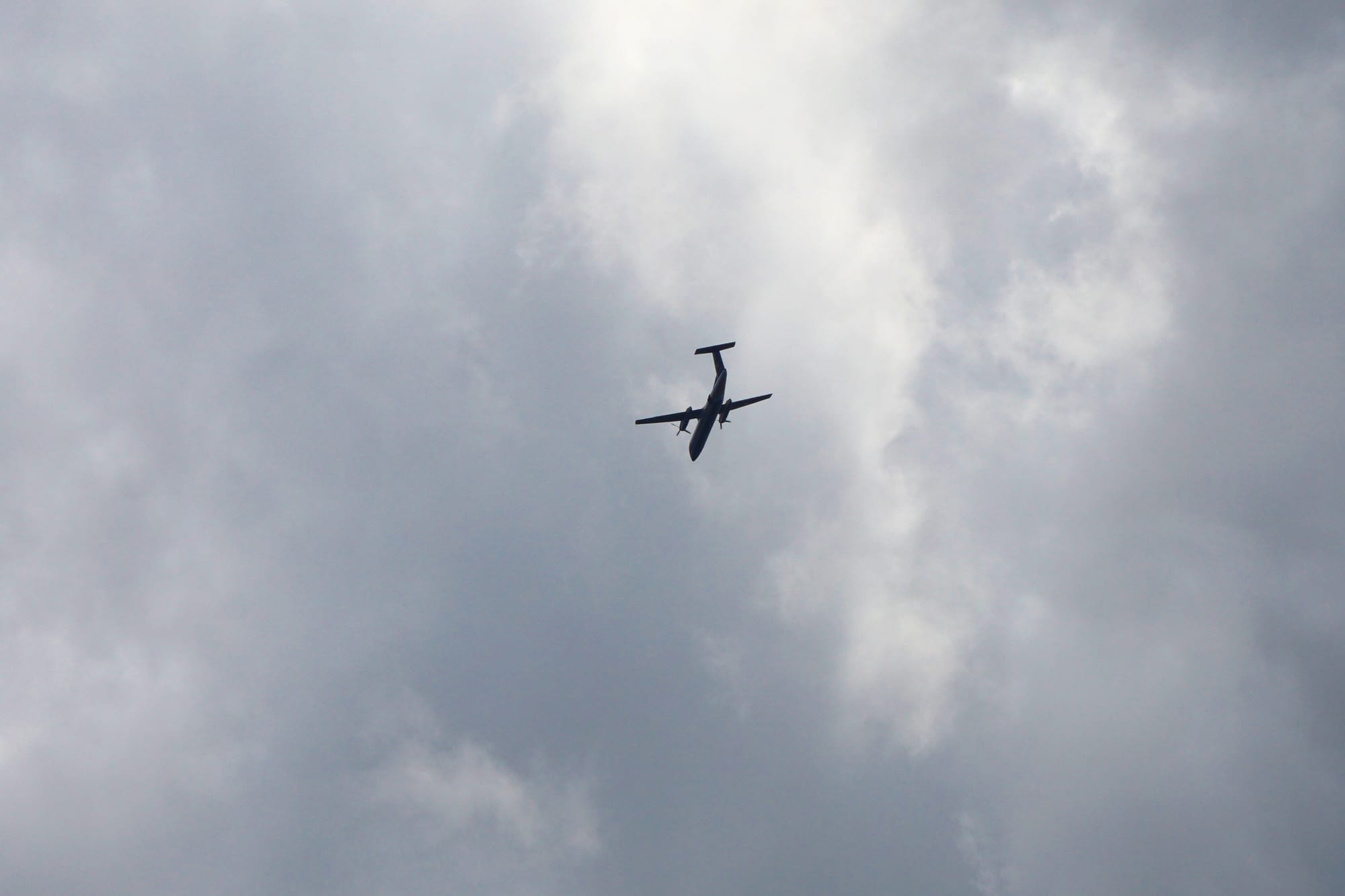
Context · a Fairchild F-27, the type of the PLUNA aircraft escorted by the light
2024 Milwaukee Air and Water Show 059 (United States Army Golden Knights Parachute Team Fokker F27 Friendship).jpg · Wikimedia Commons · CC BY-SA 4.0 · open original
The night in question
On 25 September 1975, at 7:30 PM, a Fairchild FH-227 of the Uruguayan Air Force, on service for the state airline PLUNA, was covering the route between Asunción, Paraguay and Montevideo. It was flying at 14,000 feet (about 4,300 meters) and a cruise speed of 250 knots (around 450 km/h). Well into the night, after overflying the Monte Caseros area (on the border between Argentina and northern Uruguay, toward Artigas), the pilot noticed to his left and below, near the ground, a yellowish, almost white, very bright light that stood out against the night landscape.
The light did not stay on the ground: it began to ascend and, about five minutes later, had positioned itself at the aircraft's altitude, an estimated 3 to 5 miles away, from where it accompanied the uniform movement of the Uruguayan aircraft. To check whether the object reacted to a stimulus, the pilot made a deliberate decision: he turned on the aircraft's left landing light. He immediately observed the light approach significantly, a tendency that ceased (and reversed, the object returning to its previous position or size) when the pilot turned it off. This apparent correlation between the aircraft's light and the object's movement is the feature that has made the case famous, and also the hardest to assess, because a genuine interactive response and a temporal coincidence produce, from the cockpit, exactly the same impression. During the brief approach, the crew perceived a strong smell of burnt cable in the cabin, like that of an overheated electrical connection; however, checks of the systems found no fault to explain it, no smoke was seen and the smell disappeared within a few minutes. The captain called Area Control to report that he had an aircraft to his left and at his level; control replied that there was no reported air traffic on the route, at his level, or even in the area. Approaching Florida, the aircraft began to descend and went through clouds for the first time on the flight; the light kept accompanying it, but without descending, and at 6,000 feet, on entering the clouds, visual contact was lost for good. According to CRIDOVNI's officers, the two flight attendants and the captain's nephew watched the phenomenon from the cockpit, and many passengers corroborated it from their seats.
The nephew, who happened to be on board, was called to the cockpit and took two slide photographs which, according to the officers of the Uruguayan Air Force's CRIDOVNI (Commission for Receiving and Investigating Reports of Unidentified Flying Objects), were 'later examined by the official authorities'. It is worth placing the chronology precisely: the sighting predates the commission itself, which was created on 7 August 1979. The account in circulation is the one given to the press, decades later, by Colonel Ariel Sánchez Ríos and Lieutenant Enrique González of CRIDOVNI, who described it as one of the cases that most troubled the investigators; the result of that examination has not been published.
Why it matters
The 'interactivity' (the light approaching when the landing light is turned on and withdrawing when it is turned off) is the most suggestive feature, but also the most fragile: with a single recorded on-off cycle, a coincidence between the pilot's maneuver and an object that was oscillating in distance anyway produces exactly the same impression as a deliberate response, with no way to tell one from the other from the cockpit. The smell of burnt cable with no electrical fault found is striking, but smells have many mundane causes, and the absence of a found fault is not equivalent to the presence of an exotic cause. No radar confirmation or material recovery is on record; what is on record is that Area Control had no reported traffic in the area.
And there is a concrete candidate. Juan Carlos Victorio, author of the Misterios del Aire blog, who examined the account, the surveys of the observers and the slides, proposed in 2014 that the light was the planet Jupiter, at its brightest because of its opposition on 13 October: at the start it lay to the aircraft's left, toward the east and very close to the horizon, exactly where the pilot saw the light 'apparently near or on the surface of the earth', and it rose steadily during the hour and a half of the observation. According to him, the slides show only 'a tiny dot' and, in one, an irregular trail from camera movement, typical of photographing a bright planet by hand. An ephemeris calculation for that night supports the essentials: seen from 14,000 feet over Monte Caseros, Jupiter, at magnitude −2.8, cleared the east-northeast horizon (azimuth about 83°) at about 20:05 Uruguayan time and stood about 20° high by about 22:00, always to the left of a heading toward Montevideo; and an astronomical light does not descend when the aircraft descends either, which is what the light did over Florida. The timing fits as well: CRIDOVNI's account places the aircraft in flight 'siendo las 19,30 hs.' and the sighting later, 'después de sobrevolar Monte Caseros y siendo ya noche profunda', that is, when Jupiter had already risen or was rising. What remains against it is that the hypothesis's only source is a blog, and that the light's rise to the aircraft's level in five minutes, the apparent response to the landing light and the smell in the cabin are elements the hypothesis does not explain by itself, although the first two are consistent with perceptual illusions known among pilots. CRIDOVNI's officers still cite it among the cases that most troubled their investigators.
In Uruguay the commission worked alongside civilian researchers such as Milton Hourcade, founder of CIOVI (1958).
What's left on paper
Documented evidence
- Sighting by the captain of a FAU FH-227 on PLUNA service, 25 Sep 1975, at 14,000 feet on the Asunción–Montevideo route; according to CRIDOVNI it was also watched by the two flight attendants, the captain's nephew and many passengers
- Yellowish-white light first seen near the horizon, to the left and toward Artigas, which rose to the aircraft's altitude and accompanied it at 3–5 miles; it did not descend when the aircraft descended and was lost in the clouds at 6,000 feet near Florida
- Apparent response to the landing light over one on-off cycle; smell of burning in the cabin during the approach, with no fault or smoke
- Area Control replied that there was no reported air traffic on the route, at the aircraft's level or in the area
- Two slides taken by the captain's nephew, 'later examined by the official authorities' according to CRIDOVNI; result not published
- Jupiter hypothesis (Juan Carlos Victorio, 2014): eastern position near the horizon, steady rise and slides showing only a dot; the ephemerides support it, and the account places the sighting after 7:30 PM, in full night, when Jupiter was rising
Sources
- Fuerza Aérea Uruguaya — CRIDOVNI (Comisión Receptora e Investigadora de Denuncias de OVNI) — The commission's institutional page; it did not respond from here in Sep 2026.
- Punta del Este Internacional (Carlos Brieba) — 'Las fotografías tomadas del OVNI serán analizadas por C.R.I.D.O.V.N.I.' — The headline refers to a different sighting, in Punta del Este; within the piece, Colonel Ariel Sánchez Ríos and Lieutenant Enrique González of CRIDOVNI recount the 1975 case: Area Control, witnesses in the cockpit and the examined slides.
- Misterios del Aire (Juan Carlos Victorio) — «Incidente OVNI de un avión militar uruguayo» (19 may 2014) — Secondary analysis proposing Jupiter, with the planet's azimuth from Monte Caseros and the passenger's slides; it takes the account from the CRIFAT site.
Related cases
Associated actors (1)