2019·Off Jorge Chávez Airport, Lima (over the sea)
Peru.Jorge Chávez · double sighting (DIFAA)
On 27 February 2019, around 1:30 AM, the tower at Lima's Jorge Chávez airport observed to the west, over the sea, 'apparently two UFOs' at about 8,000 feet, and the crews of two flights waiting to take off (LANPERÚ 2437 and LATAM ECUADOR 1442) confirmed having them in sight. One appeared intermittently on the radar screen at 5 nautical miles, and by 07:12 UTC they were no longer visible. The Air Force's DIFAA received the reports; a civilian adviser told CNN of a radar confirmation, but the FAP stated that it had not confirmed any UFOs, and their nature was left undetermined.
Tier S · SolidWhat do they mean? →
Strong evidence: a contemporary instrumental record (radar, sensor, film or photo of known provenance) that corroborates several independent witnesses.
What it was
57%natural or human cause
Most likely explanation: aircraft
See the split across the six explanations
Natural or human cause
No known cause
Primary documents
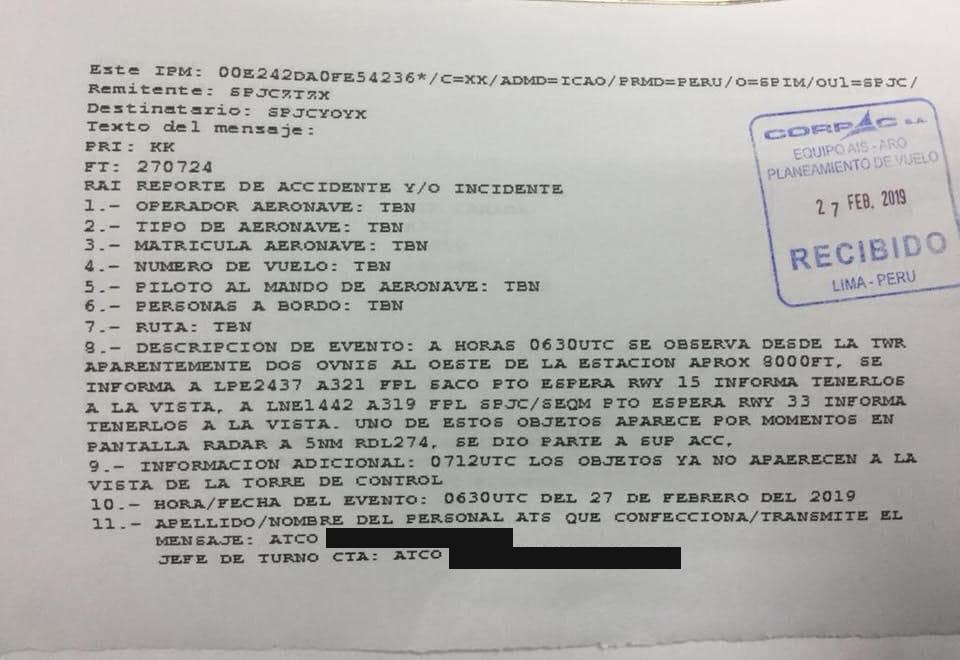
Accident and/or Incident Report (RAI) from the Jorge Chávez tower, with CORPAC's receipt stamp of 27 Feb 2019
Fotografía del documento filtrado en feb 2019, reproducida por Expediente Oculto; nombres del personal de control tapados por UAP Codex · Operational form without protectable originality; third-party photographic reproduction; staff names covered · open original
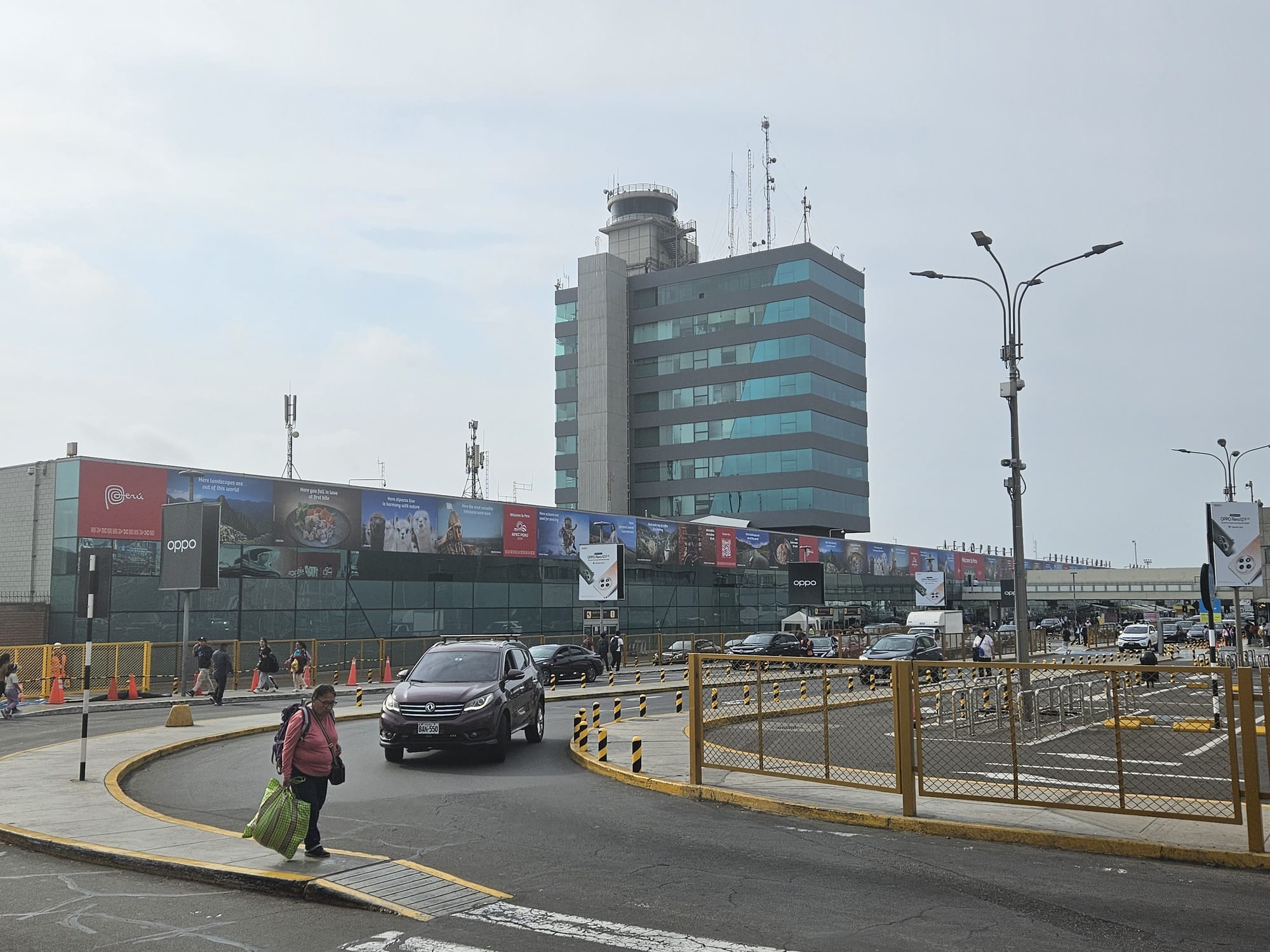
Context · Jorge Chávez Airport (Lima, Peru), site of the double sighting
Aeropuerto Internacional Jorge Chávez en 2024.jpg · Wikimedia Commons · CC0 · open original
The night in question
In the early hours of 27 February 2019, at 06:30 UTC (1:30 AM in Lima), the control tower of Jorge Chávez International Airport, in Callao, observed to the west of the station, out over the sea, two objects it could not identify, at about 8,000 feet (some 2,400 meters). The tower alerted two aircraft waiting to take off, LANPERÚ 2437 (an A321 on a flight plan to Córdoba, Argentina, at the runway 15 holding point) and LATAM ECUADOR 1442 (an A319 bound for Quito, at the runway 33 holding point), and both crews reported having them in sight. The report does not describe the objects' shape, colour, brightness or motion: those details ('very luminous', 'at San Lorenzo Island') appear later, in the press coverage and in the DIFAA adviser's account.
The sighting was set down in an operational document. That same day the tower transmitted an Accident and/or Incident Report (RAI) over the aeronautical network, which CORPAC's AIS-ARO team (the Corporación Peruana de Aeropuertos y Aviación Comercial, the state company that provides air traffic control) stamped as received on 27 February. Its description field says that from the tower 'apparently two UFOs' are observed 'west of the station approx 8000FT', that one of them 'appears intermittently on the radar screen at 5NM RDL274' (five nautical miles on the 274 radial, almost due west) and that the area control center supervisor was notified; the additional-information field notes that at 07:12 UTC the objects were no longer in view of the tower. That is about forty minutes, too long for a meteor or a fleeting flash, in Peru's most closely watched airspace. The report leaked onto social media within days, and ufologist Anthony Choy presented it on radio as the first official report of its kind in the country, although he placed the objects 'above runway 33', which the document does not say: it puts them five miles out, over the sea. It should be read on its own terms: it is the standard incident form, written by the controller on duty, and the word 'UFO' there means what it means in aviation, an object the tower did not identify; the operator, registration and route fields read TBN, to be notified.
The Peruvian Air Force's Department for the Investigation of Anomalous Aerial Phenomena (DIFAA) (see ↗) received the reports through the Center for Aerospace Interests (CINAE). The case came to light in June 2019, when CNN en Español reported that the FAP had confirmed it for the first time, in a verification it attributed to the Directorate of Aerospace Information and Interests (DINIA): it quoted Major General Robert Baxerias Vucanovich, who said the occurrence did happen and that air operations were never at risk, and Marco A. Barraza, presented as the office's lead investigator, who spoke of two objects over the sea, near San Lorenzo Island, and of a confirmation on the radar screen. Barraza was not an FAP officer: at the 2013 relaunch he was listed on DIFAA's civilian advisory board as a researcher and communicator. The next day the FAP issued a statement specifying that it had not confirmed any UFO sighting, only the existence of reports submitted for analysis, and that as an institution it could only speak to duly verified facts. Baxerias told Perú21 that his institution never spoke of a UFO and that what was seen could have been a kite, one of Google's Project Loon balloons or debris in the air.
Why it matters
The Lima double sighting brings together qualified witnesses (trained commercial pilots), institutional corroboration (the control tower that coordinates and documents), a sensor independent of the human eye (CORPAC radar), and a state office (DIFAA) that received and logged the reports. What the case lacks is the institutional confirmation the press credited it with: the FAP denied it by statement the next day.
What it does not do is prove what they were. Two objects seen at night over the sea, with no shape or motion described, admit a list of conventional candidates that the investigation, as far as has been published, did not rule out: drones (increasingly common in 2019), balloons, vessels, reflections or low bright stars. A position calculation for that hour (done by UAP Codex) shows there were no planets to the west (Jupiter and the Moon were in the east) but there were two of the brightest stars in the sky: Sirius, to the west-southwest, sinking from about 17° to about 7° in altitude between 06:30 and 07:12 UTC, and Procyon, almost due west (azimuth 282° to 279°), sinking from 26° to 16°. The matching direction is suggestive, but the sky was clear (CAVOK in the airport's 06:00 and 07:00 UTC METARs) and at 07:12 Procyon was still 16° and Sirius 7° above the horizon, so the disappearance at that time does not fit setting stars well; nor do they explain the radar return at five miles. That is why the best astronomical candidate loses strength, though it does not vanish. There is also unexamined material: according to Panamericana, citing Radio Capital, the lights were seen from the terminal itself and photographs circulated, and two videos attributed to the sighting were posted on YouTube; nobody has analysed them. The objects' only-intermittent appearance on radar is ambivalent: it may indicate a small or low-radar-cross-section object, but also a weak echo or a spurious return. And the high command went further than any adviser: Baxerias himself offered conventional explanations (a kite, a Loon balloon, debris in the air). The case thus shows two things: that a multi-sensor sighting in controlled airspace deserves to be treated with procedural seriousness, and that in Peru one must separate the voice of DIFAA's civilian advisers from the official position of the Air Force, which only speaks to verified facts. Reading an adviser's statement as state confirmation is exactly the mistake the June 2019 coverage made.
What's left on paper
Documented evidence
- The Jorge Chávez tower observes 'apparently two UFOs' to the west at about 8,000 feet, and the crews of LANPERÚ 2437 and LATAM ECUADOR 1442 confirm having them in sight (27 Feb 2019, 06:30 UTC); the report describes no shape, brightness or motion
- The tower's Accident and/or Incident Report (RAI), stamped as received by CORPAC (AIS-ARO) on 27 Feb 2019; the objects are lost from view at 07:12 UTC
- One of the objects appears intermittently on radar at 5 NM on the 274 radial; the area control supervisor is notified
- Reports sent to CINAE for DIFAA; civilian adviser Marco A. Barraza tells CNN of a radar confirmation (18 Jun 2019)
- FAP statement (19 Jun 2019): it did not confirm UFOs; Baxerias suggests a kite, Loon balloon or debris in the air
Show 2 more items
- Astronomical calculation: no planets to the west; Sirius (west-southwest, 17° to 7°) and Procyon (almost due west, 26° to 16°) were setting during the episode, but with a CAVOK sky and still 7° and 16° high at 07:12
- Photographs taken from the terminal (Panamericana, citing Radio Capital) and two videos posted on YouTube as showing the sighting; none has been analysed
Sources
- Reporte de Accidente y/o Incidente (RAI) de la torre del aeropuerto Jorge Chávez, sello de CORPAC del 27 feb 2019 — fotografía del documento filtrado, reproducida por Expediente Oculto — The blog's transcription reads '900FT'; the photograph of the document itself, which the blog reproduces, reads '8000FT'.
- Panamericana TV — 'CORPAC habría confirmado presencia de ovnis sobre aeropuerto Jorge Chávez' (1 mar 2019) — First coverage of the CORPAC document, with Anthony Choy's remarks; according to Radio Capital, the lights were seen from the terminal and photographs circulated.
- CNN en Español — 'La Fuerza Aérea de Perú confirma avistamiento de ovnis cerca del aeropuerto de Lima' (jun 2019) — The report that credited the FAP with the confirmation; the institution disowned it the next day.
- El Comercio (Perú) — 'FAP confirma a CNN el primer avistamiento de ovnis cerca del Jorge Chávez'
- RPP Noticias — 'La FAP se pronunció sobre reporte de avistamiento de ovnis en el cielo limeño' (19 jun 2019) — Quotes the FAP's official statement and Baxerias's remarks to Perú21.
- Diario Correo — '¿Ovnis en el cielo de Lima? Fuerza Aérea del Perú lo aclara' (19 jun 2019) — Text of the statement: reports submitted to CINAE for DIFAA to investigate.
- La Mula — directorio consultivo de la DINAE-DIFAA (14 oct 2013) — Lists Marco Barraza Camacho as a civilian member of the advisory council, not as an FAP officer.
- Iowa Environmental Mesonet — SPJC (Jorge Chávez) METARs, 27 Feb 2019, 04:00–08:00 UTC — Every report in the window reads CAVOK (no significant cloud and visibility of 10 km or more), with a south-southeasterly wind of 6 to 7 knots at 06:00 and 07:00 UTC.
- YouTube — 'Two UFOs sighted and photographed at Jorge Chávez airport' (Matergia channel, Rafa Mercado) — Amateur material posted as showing the sighting; not analysed.
- YouTube — 'First videos of the UFOs reported over Jorge Chávez airport, 27 February' (Matergia channel, Rafa Mercado) — Amateur material posted as showing the sighting; not analysed.
Related cases
same explanation · same period
USS Russell — 'pyramid' video (night vision)
2019 · Tier A
same explanation · same period
'Jellyfish' Video · Iraq
2018 · Tier B
same explanation · same period
'A large, somewhat deformed balloon': the observer identifies the object himself
2020 · Tier A
same explanation · same period
The object that appeared to cross an erupting volcano's plume
2018 · Tier A
Associated actors (1)