2019·Restricted warning area off San Diego, California
United States.USS Russell — 'pyramid' video (night vision)
In July 2019, off San Diego, the destroyer USS Russell (DDG-59) recorded an ~18 s night-vision clip of several triangular or 'pyramid'-shaped objects flashing among the clouds. Jeremy Corbell and George Knapp released it in 2021, and the Pentagon (Susan Gough, Apr 2021) confirmed Navy personnel captured it. The pyramid shape has a strong conventional explanation, bokeh from the camera's aperture on out-of-focus point lights, and Scott Bray told Congress in 2022 they were 'reasonably confident' such triangles correlate with unmanned systems, by analogy with a later case.
Tier A · AcceptableWhat do they mean? →
Institutional evidence: several identified independent witnesses, or contemporary official documentation, without an instrumental record to corroborate them.
What it was
78%natural or human cause
Most likely explanation: drone
See the split across the six explanations
Natural or human cause
No known cause
Primary documents
Video shown by Scott Bray to Congress (May 17, 2022): objects harassing Navy ships, later reclassified as unmanned systems
US Navy, exhibido en audiencia pública del Congreso, vía DVIDS · Public domain · US Government work · open original
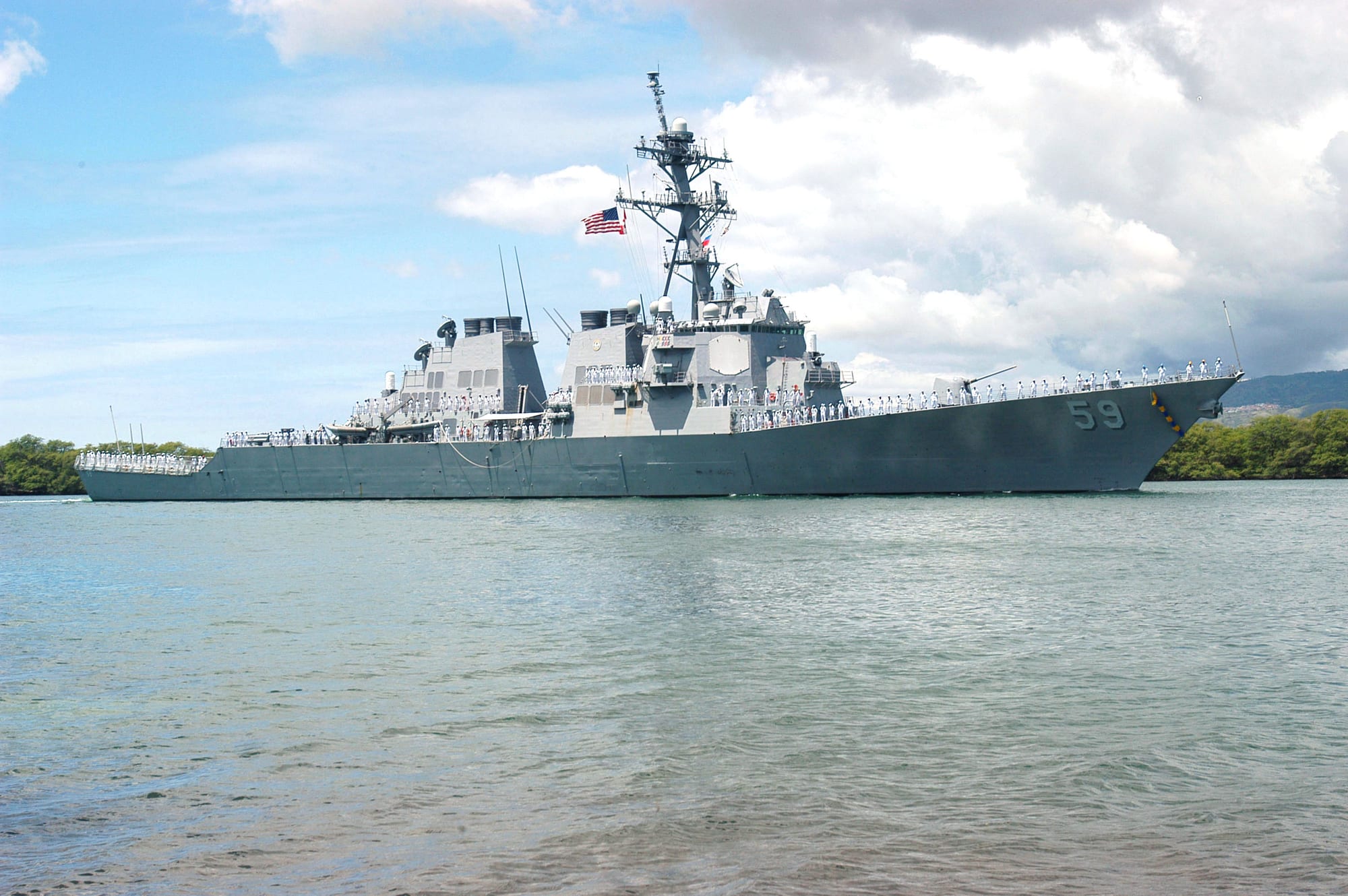
Context · USS Russell (DDG-59), ship of the 2019 'pyramid' video
US Navy 030901-N-4033C-023 Guided missile destroyer USS Russell (DDG 59) passes Hospital Point, Hawaii, after returning from a routine four-month deployment to the Western Pacific Ocean.jpg · Wikimedia Commons · Public domain · open original
The night in question
In July 2019, in the same restricted warning area off the coast of San Diego (California) where the USS Omaha was operating, the guided-missile destroyer USS Russell (DDG-59) recorded with a night-vision camera a short clip, about 18 seconds, showing several triangular or 'pyramid'-shaped objects flashing and moving slowly among the night clouds. In the released material, one of the objects appears to hover over the ship's stern. The footage is part of the same wave of incursions that in those days affected a formation of several U.S. Navy destroyers (Omaha, Russell, Kidd, Rafael Peralta, John Finn, among others), an episode the Navy itself treated as a genuine concern: unidentified objects maneuvering in coordinated fashion over warships in an exercise area.
The material came to light in 2021, released by filmmaker Jeremy Corbell alongside investigative journalist George Knapp, who stated that the photos and videos came from an Office of Naval Intelligence (ONI) and UAP Task Force (UAPTF) briefing dated May 2020. In April 2021, Pentagon spokesperson Susan Gough publicly confirmed that 'the referenced photos and videos were taken by Navy personnel' and that they fell within the task force's scope of analysis. As with the rest of the batch, the official confirmation covered the footage's provenance and authenticity (that the Navy did record it) not an explanation of its content.
Unlike the USS Omaha 'transmedium' sphere, the Russell 'pyramid' clip has a strong and widely accepted conventional explanation. Skeptical analyst Mick West showed that the triangular shape is an optical defocus artifact (bokeh): an out-of-focus point light source (an aircraft, a star or a drone) takes on the shape of the camera's aperture, and many photographic lenses have bladed apertures that produce triangular or polygonal bokeh. The flashing fits aircraft navigation lights and the slow drift fits distant objects. The official explanation came on May 17, 2022, when Deputy Director of Naval Intelligence Scott Bray showed this same video before the House Intelligence Counterterrorism, Counterintelligence, and Counterproliferation Subcommittee, at Congress's first public UAP hearing in over 50 years, and it is more precise on one point: according to Bray, this video, recorded while the ship observed a number of small unmanned aerial systems, 'remained unresolved for several years'; what resolved it was a later case, off a different coast, in which Navy personnel, again in a swarm of drones and again through night-vision goggles and an SLR camera, recorded the same image while other Navy assets observed drones nearby. 'We are now reasonably confident that these triangles correlate to unmanned aerial systems in the area', he said, attributing the triangular appearance to 'light passing through the night vision goggles and then being recorded by an SLR camera'. Asked by Adam Schiff, he said the UAP Task Force was aware of studies that had reproduced the effect by flying a drone. Per the official description accompanying the footage's later public release, the objects (there described as 'multiple objects... harassing Navy ships participating in Naval Exercises off Southern California') were 'subsequently reclassified as unmanned aerial systems' based on additional information from other sightings. That is more categorical language than Bray's own at the hearing ('reasonably confident'), which rested the reclassification on the analogy with the later case; the DVIDS record, moreover, does not name the ship: it says the video was 'taken by Sailors onboard one of the ships'. In short, the public DVIDS record presents the reclassification as an accomplished fact; before Congress, Bray presented it as probable.
Why it matters
The USS Russell case matters less for what it shows than for what it teaches about reading UAP evidence. It belongs to the same institutional chain of custody as the strongest 2019 clips (it was recorded by Navy personnel, confirmed by the Pentagon and examined by the UAPTF) and yet its anomaly dissolves under technical scrutiny. That combination makes it valuable as a calibration case: it shows that 'authenticated by the Pentagon' means 'the Navy recorded it', not 'it is inexplicable', and that within a single official batch data of very different strength coexist. Treating the whole package as equally mysterious (a frequent error in sensationalist coverage) is precisely what this case corrects.
The night-vision-optics-plus-drones explanation is sober, reproducible and sufficient for the pyramid shape, although the Navy established it by analogy with another case rather than from data on this recording. What does remain as a serious residue is not the 'triangular' phenomenon but its context: in July 2019 there were real, coordinated incursions of objects (very probably drones) over U.S. warships, a fact the Navy documented in its bridge logs and which constitutes a genuine security and counterintelligence problem, with or without ontological mystery. The Russell case's value is twofold: it trims the exaggeration about the pyramid shape and, in doing so, sharpens the uncomfortable fact that does resist: that it is still not publicly established who was operating those drones or to what end. It is an example of the site's standard applied in the least glamorous direction: separating the hard datum (incursions over the fleet) from the camera artifact layered on top of it.
What's left on paper
Documented evidence
- ~18 s night-vision clip from the USS Russell (DDG-59) showing triangular/pyramid-shaped objects, July 2019, off San Diego
- Part of the July 2019 multi-ship wave (Omaha, Russell, Kidd, Rafael Peralta, John Finn) documented by the Navy
- Source of the material: ONI/UAPTF briefing (May 2020) per Corbell and Knapp; released in 2021
- Pentagon confirmation (Susan Gough, Apr 2021): footage captured by Navy personnel, within the task force's analysis
- Bokeh analysis (Mick West): the triangular shape is a camera-aperture artifact on an out-of-focus point light source
- Scott Bray to Congress (May 17, 2022): the video 'remained unresolved for several years'; after a later case off another coast, 'reasonably confident' the triangles correlate with drones, from light passing through night-vision goggles before the SLR camera
Sources
- DVIDS — video exhibido por Scott Bray ante el Congreso (17 may 2022), con nota de reclasificación como UAS — Video embedded in this case's viewer.
- Wikipedia — 'Pentagon UFO videos' (secondary source; authenticity confirmation, April 2021)
- Global News — 'Leaked footage of pyramid-shaped UFOs is real, Pentagon says' (abr 2021)
- Metabunk / Mick West — análisis de bokeh del video 'pirámide' del USS Russell — Explanation of the triangular shape as an optical artifact of the camera diaphragm; a detail verifiable in the Metabunk thread.
- House of Representatives — transcript of the 'Unidentified Aerial Phenomena' hearing (May 17, 2022), congress.gov — Bray: the triangles video 'remained unresolved for several years' and the resolution came from a later case off another coast.
Referenced by 1 case
Related cases
same object · same country · same period
Drone Incursions · Langley AFB
2023 · Tier A
same explanation · same country · same period
'A large, somewhat deformed balloon': the observer identifies the object himself
2020 · Tier A
same object · same period
Arica · the light chased by the Carabineros aircraft
2018 · Tier A
same explanation · same country · same period
Three 'UAPs' resolved: they were three commercial aircraft, per AARO's radar cross-check
2021 · Tier A