2023·Joint Base Langley-Eustis, Virginia
United States.Drone Incursions · Langley AFB
Between 6 and 22 December 2023, swarms of unidentified drones overflew Langley Air Force Base (Virginia) (home to F-22 squadrons and Air Combat Command) for 17 nights. Some were up to 20 feet long. Despite high-level DoD, FBI and AARO meetings, and the deployment of NASA's WB-57, the origin was never publicly determined.
Tier A · AcceptableWhat do they mean? →
Institutional evidence: several identified independent witnesses, or contemporary official documentation, without an instrumental record to corroborate them.
What it was
76%natural or human cause
Most likely explanation: adversary technology
See the split across the six explanations
Natural or human cause
No known cause
Primary documents
Senate Armed Services Committee hearings, S. Hrg. 118-741: Gen. Guillot (14 Mar 2024) and Gen. Allvin's written answer, 5 pp.
Extract from the official Senate record. At the Northern Command posture hearing of 14 March 2024, Gen. Gregory Guillot, asked by Sen. Kaine, says counter-drone work has dominated his first month, that he "was not prepared for the number of incursions" he sees, and that he has made the events at Joint Base Langley-Eustis the centerpiece of his 90-day assessment. In the questions for the record of the Air Force hearing of 16 April, Sen. Cotton says Langley was swarmed by drones for weeks in December 2023, and Gen. David Allvin answers that "Langley was not attacked, but its airspace was violated by drones".
Senado de EE. UU., Comité de Servicios Armados (GPO, govinfo) · Public domain · US Government work · open original
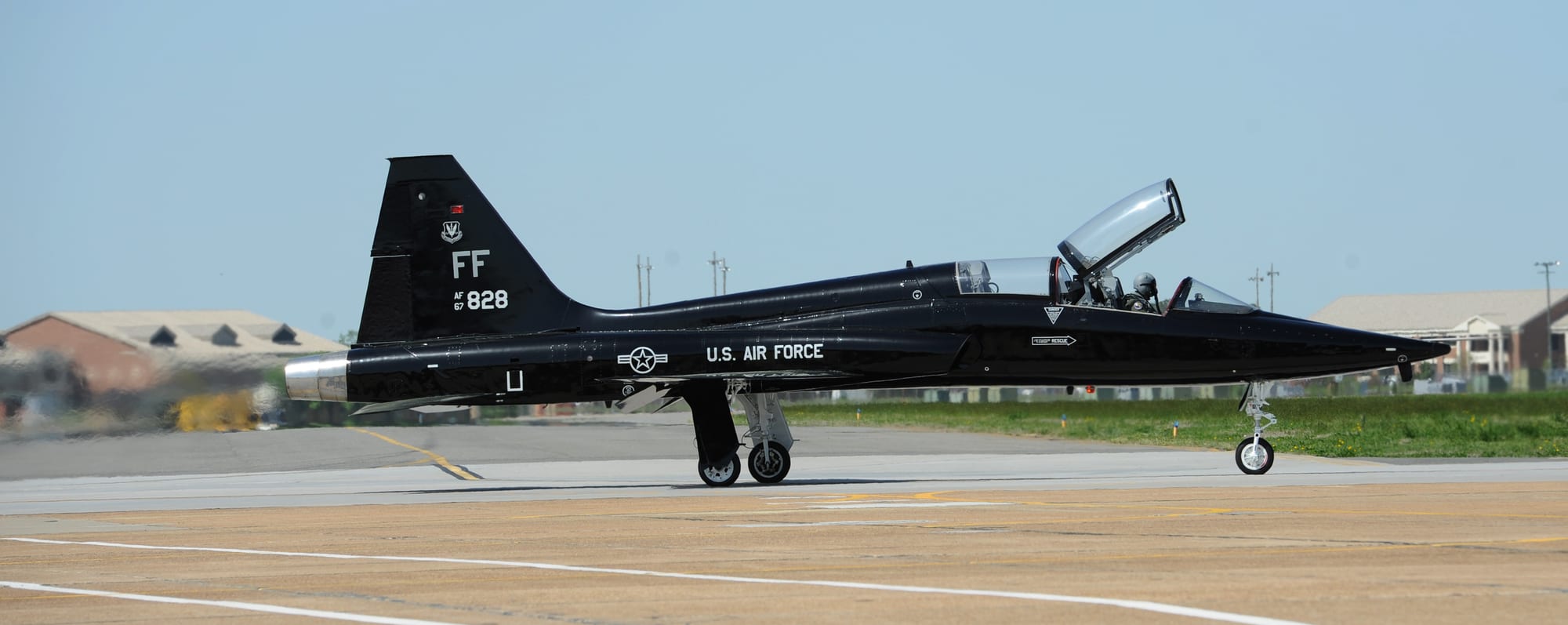
Context · Langley Air Force Base (Virginia), overflown by the drone incursions
A T-38 Talon taxis down the runway at Langley Air Force Base, Virginia. March 26, 2012.jpg · Wikimedia Commons · Public domain · open original
DTRA PHALANX reports on drones detected around U.S. bases, December 2024 (FOIA 25-024)
FOIA response from the Defense Threat Reduction Agency (27 Jun 2025, 348 pp. released, 350 in the PDF) with its PHALANX reports for December 2024, which log the drones detected by factory serial number around several bases. The Langley-Eustis report (pp. 29 to 40) counts 56 serial numbers and 113 events within 8 km of Langley in December 2024, none inside the boundary, all rotary-wing and nearly all commercial DJI models. It dates from a year after the 2023 incursions.
Defense Threat Reduction Agency · respuesta FOIA publicada por Government Attic · view source
NRC security reports on drones over nuclear plants, 2024 to 2026 (FOIA-2026-000270)
Table of Nuclear Regulatory Commission security reports on drone flights over plants, released under FOIA and published by Liberation Times. Five concern the Surry plant in Virginia between 3 and 17 December 2024 (pp. 10 to 14): multiple drones over the owner controlled area, a larger one and a triangular one on 10 December, and a radar return confirmed by the Fort Eustis tower on the 12th. All five carry the status "Closed Unresolved" with the note that they remain open pending ILTAB/ILTAT review.
U.S. Nuclear Regulatory Commission · respuesta FOIA publicada por Liberation Times · view source
The night in question
Starting the night of 6 December 2023, personnel at Joint Base Langley-Eustis, in southeastern Virginia, began observing unmanned aerial systems entering the installation's restricted airspace. Langley is no ordinary base: it hosts F-22 Raptor stealth fighter squadrons and the headquarters of Air Combat Command, making it one of the U.S. Air Force's most sensitive assets. The incursions recurred over 17 nights, until 22 December, often in the evening; according to Task & Purpose, summarising the Wall Street Journal, the drones flew at about 100 miles per hour and made a noise likened to a lawnmower.
Accounts describe strikingly coordinated and heterogeneous behavior. It was not a single craft but groups of drones of widely varying sizes: from small quadcopters to large fixed-wing platforms, some estimated at around 20 feet (6 metres) in length, with steady and navigation lights. They flew on a defined heading over the base and its surroundings and, according to testimony leaked to the press, did not match recreational hobbyist patterns. The Air Force chose not to shoot them down: doing so over U.S. soil, in a populated area and without knowing what they were, posed legal and safety risks. As a precaution, the Pentagon temporarily relocated F-22 fighters to another base.
The institutional response was significant. The Department of Defense, the FBI and the All-domain Anomaly Resolution Office (AARO) (the office created to resolve unidentified-object incidents) held two weeks of meetings to try to determine the origin. NASA deployed its high-altitude research aircraft WB-57F (registration N927NA), which flew circular orbits centered on Langley with sensor instrumentation. Despite all that effort, months later the Pentagon still publicly stated it did not know where the drones came from.
The episode belongs to a broader wave of incursions over U.S. military installations in 2023-2024. In a related but distinct case, on 6 January 2024 a Chinese national, Fengyun Shi, a graduate student in Minnesota, flew a drone over the Newport News shipyards, some 15 kilometres from Langley, until rain brought it down into a tree; he was arrested on 18 January in San Francisco as he was about to board a flight to China, pleaded guilty to two misdemeanour counts of photographing a designated installation without authorization (Navy ships under construction) and was sentenced to six months in prison. That incident, however, does not explain the massive, coordinated December incursions, which remain formally unattributed.
Two records released under FOIA describe what was happening in the surrounding area a year later, in December 2024; they do not document the 2023 nights. The first are the PHALANX reports of the Defense Threat Reduction Agency (DTRA), which log the drones detected by their factory serial number around several bases; the agency released them on 27 June 2025 (FOIA file 25-024) and Government Attic published them. The Langley-Eustis report for 1 to 31 December 2024 says no activity was detected within 8 km of Fort Eustis and all of it occurred within 8 km of Langley, "with no detects occurring within Langley's base boundary": 56 serial numbers and 113 events, all rotary-wing craft and nearly all commercial DJI models (the most frequent being the DJI Mini 3). Thirty of those serial numbers had been detected before, and activity fell compared with November, when there were 69 serial numbers and 138 events. Thirty-seven exceeded the FAA altitude allowance and seven flew at night. The report describes the activity of craft 2, 3 and 4 as recreational, and another report in the same release, for 1 to 3 December, says craft 2 to 9 "appear recreational in nature". The two reports place a Skydio flight of 2 December differently: the monthly one says it appears to have launched from the tarmac of a private airfield some 250 m west of the perimeter, while the 1 to 3 December report puts it some 250 m from the perimeter and some 570 m from the Langley airstrip, near a possible maintenance hangar; they also give different durations (22 min 56 s and 13 min 38 s). The reports list only craft identified by serial number, do not mention fixed-wing or large drones, and do not say whether the system detects craft that do not transmit that number.
The second are the Nuclear Regulatory Commission (NRC) security reports on drones over nuclear plants, released under FOIA (FOIA-2026-000270) and published by Liberation Times in October 2026. Five concern the Surry plant in Virginia and describe events of 3, 10, 12, 13 and 17 December 2024. The 3 December report describes multiple drones at about 150 feet with blinking white lights over the plant's owner controlled area and protected area. The 10 December report counts five craft between 18:05 and 18:57 and three more around 19:49: "a larger drone with red, green, and white lights", a triangular one and a third; the two smaller ones linked up and flew in a zigzag pattern around the larger one, and all three flew off east by northeast. In the 12 December report, the Fort Eustis control tower, which the plant notified, confirmed that the drone "appeared on radar at approximately 300 feet", and Norfolk Radar Approach Control "had no additional information". In the 13 December report, the drone "did not cross into the protected area", the Fort Eustis controller said there was no military drone activity in the area and the Norfolk controller "had no information to report". The 17 December report says the three drones were believed to be the same as in the previous reports: one crossed the protected area westward over the Unit 1 and 2 containments, others passed over the plant's information center and the switchyard, Fort Eustis repeated that there was no military drone activity and, at 20:57, the North Anna plant reported that its local law enforcement had told it of drone sightings in its area. The searches that followed the sightings of the 13th and the 17th found nothing. All five carry the status "Closed Unresolved" and, at the same time, the note "This report is open pending ILTAB/ILTAT review"; none identifies the operator or attributes the flights.
Why it matters
Unlike the classic visual cases, here there is no doubt the objects were physical craft (drones) nor that they repeatedly penetrated the airspace of a top-tier military asset. The anomaly is not ontological but strategic and operational: how could coordinated swarms overfly the Air Combat Command headquarters for 17 nights without the United States managing to identify, intercept or attribute them. The case exposes a doctrine and counter-drone capability gap over its own soil that the authorities themselves acknowledged.
The possible explanations are: surveillance by a state adversary (the most unsettling reading and the one fitting pattern 8s), an own or allied program or exercise not communicated to the base, or incursions by civilian operators (recreational or commercial) misread as a coordinated threat. What remained open is attribution. By 2023, the phenomenon of 'unidentified objects over sensitive installations' had become a conventional national-security problem, with manifestly technological drones, and still unresolved as to authorship.
What's left on paper
Documented evidence
- 17 consecutive nights of incursions (6-22 Dec 2023) over Joint Base Langley-Eustis, documented by military personnel
- Drones of varying sizes, some estimated at ~20 feet (6 m), with navigation lights and a defined heading
- Temporary relocation of F-22 fighters as a Pentagon precaution
- Two weeks of DoD, FBI and AARO meetings without determining the origin
- Deployment of NASA's WB-57F research aircraft (N927NA) in orbits centered on Langley
Show 3 more items
- Pentagon public acknowledgment, months later, that the origin remained undetermined
- DTRA PHALANX report for Langley-Eustis, 1 to 31 December 2024, a year after the incursions: 56 serial numbers and 113 events within 8 km, none inside the base boundary, all rotary-wing and nearly all commercial DJI models; 30 had been detected before, and the report itself and the 1 to 3 December report describe the activity of several as recreational
- Five NRC reports on the Surry plant (Virginia) between 3 and 17 December 2024: multiple drones over the owner controlled area, a larger one and a triangular one on 10 December, a radar return at the Fort Eustis tower on the 12th, a drone over the containments on the 17th; all five with status "Closed Unresolved" and pending ILTAB/ILTAT review
Sources
- The War Zone (TWZ) — 'Mysterious Drones Swarmed Langley AFB For Weeks'
- Task & Purpose — 'Drones swarmed an air base for days. They're still a mystery.'
- Washington Examiner — 'Mystery drones swarmed Langley Air Force Base for weeks'
- WAVY — «Chinese national sentenced to 6 months for espionage involving Navy ships in Newport News» (oct 2024, fuente secundaria sobre el expediente judicial) — Fengyun Shi case: drone over the Newport News shipyards, arrest in San Francisco and six-month sentence.
- Defense Threat Reduction Agency, informes PHALANX de actividad de sistemas aéreos no tripulados de diciembre de 2024 (respuesta FOIA 25-024, publicada por Government Attic) — DTRA response of 27 Jun 2025, 348 pp. released (350 in the PDF) The Langley-Eustis report for 1 to 31 December 2024 is on PDF pp. 29 to 40, and another for 1 to 3 December on pp. 249 to 255. It covers December 2024, not the 2023 incursions.
- Comisión Reguladora Nuclear de EE. UU., partes de seguridad sobre drones en centrales nucleares (FOIA-2026-000270, PDF publicado por Liberation Times) — Table of reports from 2024 to 2026. The five Surry reports of December 2024 are on pp. 10 to 14 (SID-03275, 03276, 03278, 03281 and 03286). Report SID-03276 is dated 9 Dec in the table and describes 10 Dec.
Related cases
same object · same country · same period
USS Russell — 'pyramid' video (night vision)
2019 · Tier A
same explanation · same country · same period
Lake Huron F-16 shootdown
2023 · Tier S
same explanation · same country · same period
USS Jackson — Transmedium Incident (Wiggins, 2023)
2023 · Tier B
same explanation · same country · same period
Mother Orb · Western U.S.
2023 · Tier A