1561·Nuremberg, Holy Roman Empire
Germany.Celestial Phenomenon · Nuremberg
On 14 April 1561, at dawn, many inhabitants of Nuremberg reported seeing in the sky a display of spheres, cylinders, crosses and two large crescents that seemed to fight one another, followed by smoking objects falling and the appearance of a large dark shape. The printer Hans Glaser published a broadsheet with a woodcut and text describing the event.
Tier B · IndicativeWhat do they mean? →
Limited evidence: a single witness, testimony gathered years later, or an account without contemporary primary documentation.
What it was
67%natural or human cause
Most likely explanation: folklore or literary account
See the split across the six explanations
Natural or human cause
No known cause
Quote in the original language
«Einblattdrucke nun berichten nicht tatsächliche Ereignisse, ihnen geht es vor allem um die Botschaft»; «Ob damals etwas über Nürnberg gesehen wurde, das wissen wir nicht und können wir nicht wissen»Primary documents
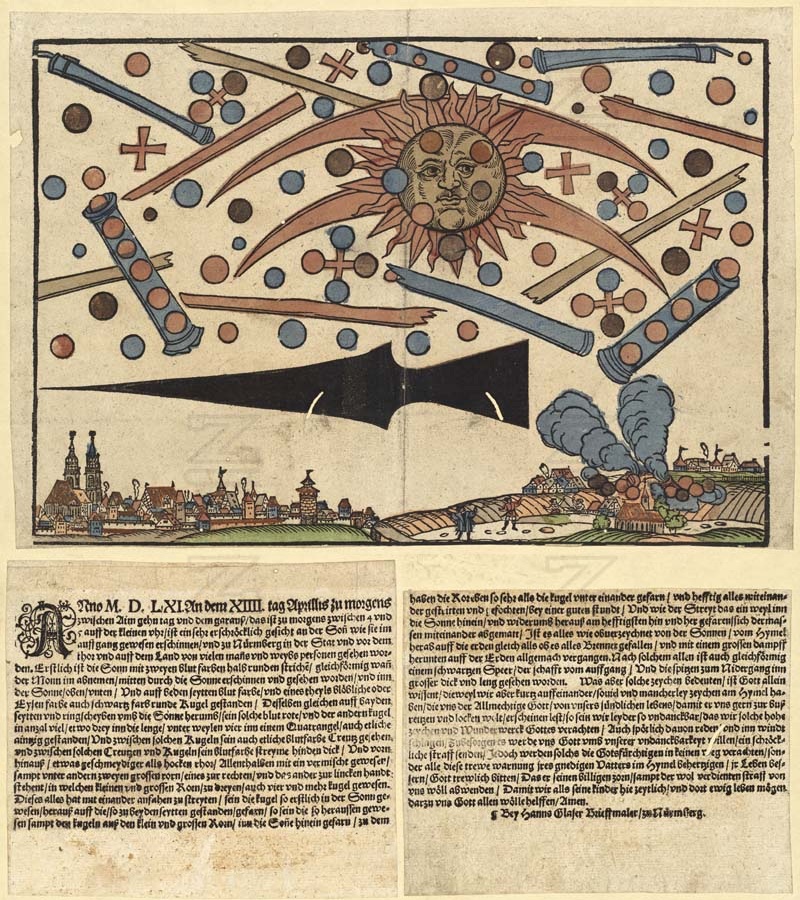
Hans Glaser's broadsheet on the celestial phenomenon over Nuremberg, 14 April 1561
Himmelserscheinung über Nürnberg vom 14. April 1561.jpg · Wikimedia Commons · Public domain · open original
The night in question
The account comes from a broadsheet (Flugblatt) printed in Nuremberg by Hans Glaser (block-cutter, printer and publisher of the city) in 1561. The document, measuring about 26 by 38 centimetres and combining a woodcut with an explanatory text, is held today in the prints and drawings collection of the Zentralbibliothek in Zurich. According to the text, the event occurred around dawn on 14 April 1561, between four and five in the morning, and was witnessed by 'many men and women' of the city.
The description is vivid and concrete. Above the rising sun appeared numerous objects of various shapes: blood-red, bluish and black spheres or globes; long cylinders from which, in turn, smaller spheres seemed to emerge; crosses, some with globes on their arms; and two large 'crescents' or half-moons. According to the text, everything 'started to fight among themselves': the globes flew out of the sun to those on either side and back in, and fought vehemently 'for over an hour', until, 'fatigued', they fell from the sun to the earth 'as if they all burned' and wasted away on the ground with immense smoke. Afterward something 'like a black spear, very long and thick' was seen, the shaft pointing east and the point west. 'Whatever such signs mean, God alone knows', Glaser writes. Glaser read the whole spectacle providentially: as a divine warning calling the population to repentance.
The Nuremberg document is not isolated in its era. Barely five years later, in 1566, another broadsheet described a similar phenomenon over Basel (Switzerland), with large black spheres crossing the sky before the sun. These sheets belonged to a flourishing editorial genre after the printing press: illustrated news of celestial prodigies, comets, eclipses and 'signs' sold at fairs and read as omens amid intense religious anxiety, in the thick of the Reformation and Counter-Reformation.
The source, it should be stressed, is a single document of popular, propagandistic nature, not an instrumental record or official report. The woodcut was rediscovered by modern audiences when Carl Jung reproduced and discussed it in his 1958 book 'Flying Saucers: A Modern Myth of Things Seen in the Skies', where he treated it not as proof of craft but as psychological material: the projection of the era's martial and religious imagery onto a real atmospheric phenomenon. That remains, to this day, the dominant reading among historians.
Why it matters
Nuremberg 1561 matters for a reason different from most cases: not as evidence of an object, but as the historical document that anchors the temporal depth of the phenomenon-as-account. Long before the age of radar and cameras, entire communities described and published observations of lights and shapes in the sky organized as a meaningful 'event'. The case is, in this sense, a historiographic control: it shows that the perception of aerial prodigies and their transformation into a warning narrative long predates 20th-century UFO culture, which weakens any thesis that the phenomenon is a mere artifact of modern imagination.
But its antiquity and its reliance on a single popular document weigh against reading it as a literal observation. Historian Ulrich Magin reads the sheet as belonging to the 'celestial battle' genre: broadsheets of the time did not report actual events but copied a fixed format (here, with cannons and cannonballs instead of horsemen) to deliver a religious warning, and whether anything was seen over Nuremberg that day cannot be known. Magin shows the model: a 1554 sheet about Plech, near Nuremberg, in which the parson and the whole community saw, shortly after sunrise, blue globes and horsemen who fought for two hours and fell to earth; in Glaser's, he says, the horsemen have been swapped for cannon ('Rohr' then meant a cannon) and their balls, and the woodcut does not even show the castle and has the balls fall next to a church destroyed since 1508. Moreover, two months earlier a Nuremberg printer, Georg Kreydlein, had published a sheet on an aurora seen on 27 February 1561 near Eisleben, with two columns of smoke, a rod and a crucifix, elements that reappear in Glaser's. Atmospheric optics (parhelia, solar halos) which produce arcs, crosses and multiple 'suns', have also been proposed, but no scholarly source located supports them; added to that is the commercial incentive of a broadsheet that sold better the more portentous it was. Jung's reading (psychological projection onto a real phenomenon) is the other prosaic option. We cannot audit witnesses from almost five centuries ago, and nothing in the sheet gives a basis to infer technology. Its place is as a witness to the longue durée, not as proof.
What's left on paper
Documented evidence
- Broadsheet (Flugblatt) by Hans Glaser, Nuremberg, 1561, with woodcut and descriptive text (~26 × 38 cm)
- Original held in the prints and drawings collection of the Zentralbibliothek, Zurich
- Text dating the event to daybreak on April 14, 1561, between 4 and 5 a.m., citing 'many men and women' as witnesses and describing a fight of over an hour
- Parallel Basel case (1566), another broadsheet with a similar aerial phenomenon five years later
- Reproduction and analysis by Carl Jung in 'Flying Saucers: A Modern Myth of Things Seen in the Skies' (1958)
- Model of the genre: a 1554 sheet about Plech, near Nuremberg, with globes and horsemen who fought for two hours and fell to earth (Magin)
Sources
- Wikipedia — 1561 celestial phenomenon over Nuremberg — Secondary source: case synthesis.
- The Public Domain Review — 'Celestial Phenomenon Over Nuremberg, April 14th, 1561' — Reproduces Glaser's broadsheet with a full English translation of its text.
- C. G. Jung — 'Flying Saucers: A Modern Myth of Things Seen in the Skies' (1958) — Reproduces and discusses the woodcut as psychological projection onto a natural phenomenon.
- Magin, U. — «Ein Ufo im Jahr 1561?» (ufo-information.de) — Quotes the broadsheet's original text and compares it with the 1554 sheet about Plech.