1977·Big Ear radio telescope, Delaware, Ohio
United States.Wow! Signal · Big Ear
On 15 August 1977, Ohio State University's Big Ear radio telescope logged a narrow-band signal 30 times stronger than the background noise, near the hydrogen line (1420 MHz), coming from Sagittarius. Astronomer Jerry Ehman circled the code '6EQUJ5' on the printout and wrote 'Wow!' in the margin. It never recurred despite later searches.
Tier A · AcceptableWhat do they mean? →
Institutional evidence: several identified independent witnesses, or contemporary official documentation, without an instrumental record to corroborate them.
What it was
57%natural or human cause
Most likely explanation: natural phenomenon
See the split across the six explanations
Natural or human cause
No known cause
Primary documents
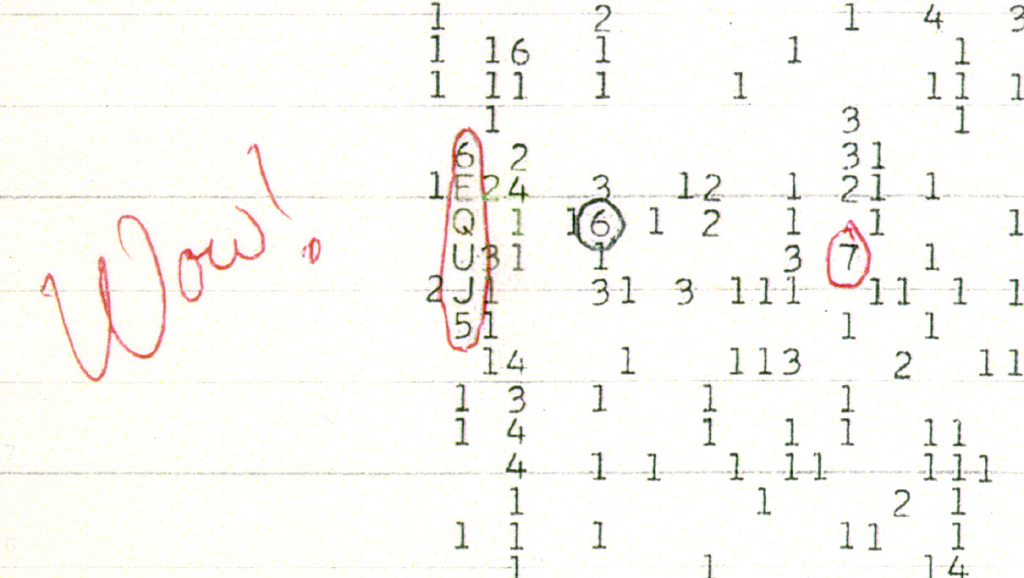
Wow! signal · the original Big Ear telescope printout with Jerry Ehman's annotation (15 Aug 1977)
Big Ear Radio Observatory / North American AstroPhysical Observatory vía Wikimedia Commons · Public domain · open original
The night in question
At about 11:16 p.m. Eastern Daylight Time on 15 August 1977, with nobody at the observatory, Ohio State University's Big Ear radio telescope (then dedicated to the institution's SETI project) automatically logged an extraordinarily strong radio signal. The instrument did not steer mechanically; it let Earth's rotation sweep the sky, so any point source stayed within the antenna's beam for about 72 seconds. The signal rose and fell with exactly that temporal profile: climbing to a peak and back down along the response curve expected for a fixed celestial source, not for terrestrial interference.
A few days later, volunteer astronomer Jerry R. Ehman reviewed the continuous-feed paper printouts the observatory's computer generated. Intensity was encoded with a single character per interval: digits 0-9 and then letters for the highest values. In one column he read the sequence '6EQUJ5': an intensity climbing far above anything normally recorded, about 30 times the background noise. Struck, he circled the sequence in red pen and wrote a single word in the margin: 'Wow!'. That gesture named the case forever.
The signal had the characteristics any SETI program deemed promising. It was very narrow-band (on the order of 10 kHz or less) something hard to produce by broadband natural phenomena and more typical of a deliberate transmitter. Its frequency, near 1420 MHz, fell around the neutral-hydrogen emission line, the spectral region theorists had pointed to for decades as the 'natural channel' where a civilization would seek to communicate. The direction pointed toward the constellation Sagittarius, near the globular cluster M55.
The decisive problem came afterward: the signal never recurred. Ehman and others re-pointed Big Ear at the same region on multiple occasions, and later other instruments (including the Very Large Array and, in 1995-1999, dedicated searches) scanned the area without recovering anything. An unrepeatable signal can be neither confirmed nor confidently attributed. For decades, mundane explanations circulated: reflection of a terrestrial transmission off space debris, a satellite, or radio-frequency interference. Ehman examined them in his 1997 report: an aircraft or satellite would not produce the point-source response that was recorded, no transmitter should have been operating in the protected band around 1420 MHz, and a reflection off space debris would require a metallic fragment that was neither tumbling nor moving with respect to the sky, so he judged it 'much less likely' than he had first thought. He also pointed to a feature that bounds the signal: the receiver had two horns that swept the same source about three minutes apart, and the signal appeared in only one, so while the beam covered it, it lasted no more than about 2.5 minutes; Ehman notes, however, that it could have been present for up to almost 24 hours earlier, the time the Earth's rotation takes to bring the beam back over the source, and that it did not reappear in the same strip of sky over the following 30 days. In 2017 it was proposed that a hydrogen cloud from a comet (266P/Christensen) could have produced the emission, a hypothesis criticized for failing to fit the narrow band. In 2024, a team reanalyzing data from the Arecibo Wow! project proposed an astrophysical mechanism (a stimulated hydrogen maser flash from a transient source) as the stronger candidate. No explanation has conclusively closed the case.
Why it matters
The Wow! Signal sits on the border between rigorous astronomy and the question of non-human intelligence: it was logged by a calibrated scientific instrument, in a formal project, with a temporal profile consistent with a real celestial source, and it still resists forty years of attempts at explanation. Its value is not that 'it was a message' (there is no basis for that claim) but that it precisely delimits what evidence demands: a single, unrepeatable detection, however solid its signature, cannot rise from anomaly to fact.
Recent astrophysical hypotheses (stimulated hydrogen maser, transient emission) are the strongest explanations standing, and the inability to reproduce the signal favors a rare natural phenomenon or unidentified interference over a deliberate transmission.
What's left on paper
Documented evidence
- Original Big Ear computer printout with the sequence '6EQUJ5' circled and Jerry Ehman's handwritten 'Wow!' note (15 Aug 1977)
- ~72 s temporal profile consistent with a fixed celestial source swept by Earth's rotation, not with local interference
- Narrow bandwidth (one 10 kHz channel) near the neutral-hydrogen line (1420 MHz); peak 30.5 ± 0.5 times the background noise; seen in only one of the two horns, which limits its presence during the sweep to about 2.5 minutes, though it could have existed up to almost 24 hours earlier (Ehman, 1997)
- Direction toward Sagittarius, near globular cluster M55
- Re-observation searches (Big Ear, VLA, META, 1995-1999) failing to recover the signal
- Arecibo Wow! reanalysis (2024) proposing a stimulated hydrogen maser as a candidate astrophysical source
Sources
- Wikipedia — Wow! signal
- Smithsonian Magazine — 'Forty Years Later, SETI's Famous Wow! Signal May Have an Explanation' (2017)
- Méndez et al. — 'Arecibo Wow! I: An Astrophysical Explanation for the Wow! Signal' (arXiv, 2024)
- Ehman, J. R. — «The Big Ear Wow! Signal: What We Know and Don't Know About It After 20 Years» (Big Ear Radio Observatory, 1997) — Report by the discoverer himself: time (11:16 p.m. EDT), signal-to-noise ratio, frequency, single horn and review of terrestrial explanations.
- Méndez, A. et al. — «Arecibo Wow! I: An Astrophysical Explanation for the Wow! Signal», arXiv:2408.08513 (2024), resumen
Related cases
same explanation · same country · same period
Val Johnson · patrol car with documented physical damage (USA, 1979)
1979 · Tier A
same explanation · same country · same period
New Mexico cattle mutilation wave (Dulce)
1975 · Tier A
same explanation · same country · same period
Delphos · glowing hydrophobic soil ring (USA, 1971)
1971 · Tier B
same explanation · same country · same period
Apollo 12 · 'streaks of light' (NASA)
1969 · Tier B