Case No. 03·United States
1947–1948·Muroc Field, California
United States.NARA RG 38 incident summaries
From 1947 the Office of Naval Intelligence compiled structured incident summaries over naval air stations — including Muroc, on the same day as the Roswell press release — preserved in National Archives Record Group 38: internal operational documentation, not press statements.
Year
1947–1948
Tier
S
Probability
85%
Category
Document
Strong evidence: instrumental sensor record + multiple witnesses (typically military). Three independent axes: the «tier» measures the strength of the evidence; the «probability» estimates how genuinely unexplained the case is —a natural phenomenon can remain unexplained, so it does not equal «non-prosaic»—; and the partition of explanations (below) says what it most plausibly was. So a well-documented case can have a possible hoax as its most plausible cause, and a Tier B is not, for that reason, a hoax.
Primary documents · viewer
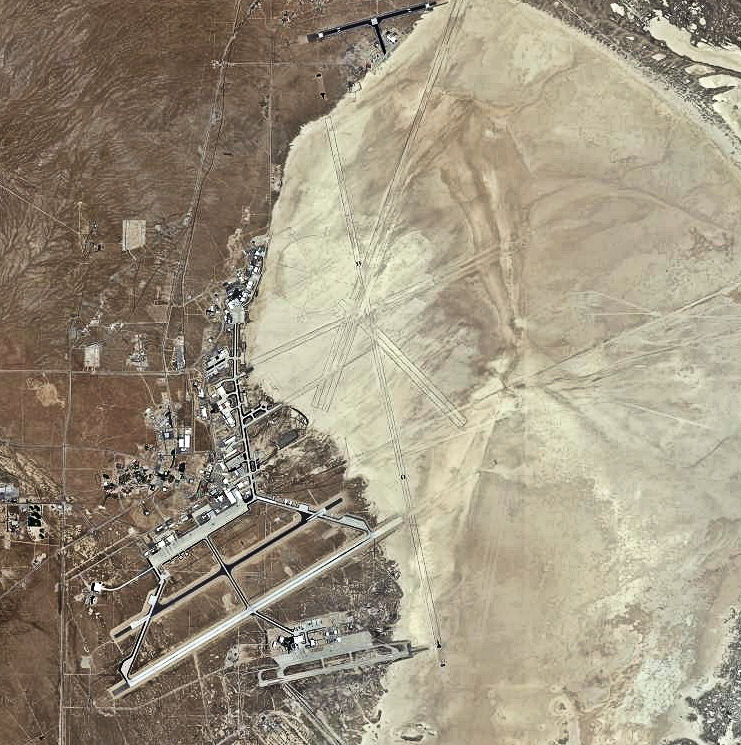
Context · Rogers Dry Lake (Muroc / Edwards, California), cited in the 1947 reports
Edwards Air Force Base - Rogers Dry Lake CA 2006.jpg · Wikimedia Commons · Dominio público · open original
Part 01
The file in question
The U.S. National Archives Record Group 38 corresponds to the 'Records of the Office of the Chief of Naval Operations', the holdings that preserve the records of naval intelligence (ONI) and the U.S. Navy's operational commands. Within that record group are preserved, among thousands of series, Incident Summaries and operational messages generated during the first modern wave of 'flying disc' sightings in 1947, when the Navy — like the then Army Air Forces — received and processed reports from its personnel at naval and air stations.
The 1947 context is decisive. That summer saw a national wave of reports after Kenneth Arnold's sighting (June 24) near Mount Rainier, which coined the term 'flying saucers'. On July 8, 1947 — the same day Roswell Field issued its famous communiqué about the recovery of a 'disc', retracted hours later as a weather balloon — Southern California had its own episode: military witnesses around Muroc Army Air Field (future Edwards AFB), the country's principal experimental aircraft test site, reported disc-shaped objects with behaviors that did not fit known platforms. These reports were channeled in writing within the intelligence apparatus.
The value of RG 38 is not an extraordinary claim about a specific object but documentary and structural: it shows that the Navy generated and archived formal records of the phenomenon in parallel with the Army Air Forces channel (the Twining → Project Sign → Grudge → Blue Book chain). In other words, from the outset more than one agency was collecting data through separate channels, some classified. The identification and cataloging of these documents in open archives is owed largely to researchers and historians who applied FOIA and systematic archival review from the 1980s-1990s onward (among them Barry Greenwood and Michael Swords's team).
A necessary note of caution: the precise wording, speed figures, and kinematic descriptions attributed to individual cases within RG 38 vary by series and must be verified document by document; this corpus treats them as illustrative of the type of content, not as certified verbatim quotes. The solid, verifiable point is the existence of the holdings themselves and the fact that parts of the intelligence documentation from that era have remained withheld or partially classified for decades, in tension with the normal automatic-declassification timelines for material over 25-75 years old.
Part 02
Why this case moved the needle
RG 38 matters for what it proves without needing to interpret testimony: that the U.S. military apparatus generated structured, internal documentation of the phenomenon from the first wave of 1947, and that this documentation was not confined to the Army Air Forces channel that would eventually feed into Project Blue Book. The naval participation, in parallel, is the earliest evidence of a multi-agency, partially classified system for recording sightings — the same dual pattern the Bolender memo would explicitly confirm in 1969.
The sober reading of the case avoids two excesses. The content should not be overinterpreted: most RG 38 material is operational and incidental — messages, summaries, correspondence — and does not constitute proof about the nature of the objects nor a high-level decision. But the structural fact should not be minimized either: the existence of the holdings, their origin contemporary with the events, and the prolonged withholding of parts of the material under classification are verifiable data points that say something about how the institution treated, and still treats, the information.
That is why the case's weight is limited and directed at the classified-program (human) narrative, not the nature of the phenomenon: RG 38 documents the institutional system; it does not resolve what was observed. Its greatest utility for the corpus is to serve as an archival anchor — an entry point to auditable primary sources — against cases that depend on testimony. The methodological caution is part of the value: the corpus distinguishes between the verifiable (the holdings exist, there was a parallel naval channel, there is withholding) and what requires document-by-document verification (the figures and descriptions of specific incidents).
Part 03
What's left on paper
Documented evidence
- Contemporary naval documentation of the 1947 'flying discs' wave held in NARA RG 38
- Muroc Army Air Field episode on July 8, 1947 (same day as the Roswell press release)
- Independent cataloging via FOIA and archival review (Greenwood, Swords) from the 1980s-1990s
- Prolonged withholding / partial classification of some intelligence material from the era
Sources
- NARA Record Group 38 — ONI Records
- Swords, M. & Powell, R. — UFOs and Government (2012) — Chronological catalog of military documents
- Greenwood, B. — Just Cause (CAUS 1985-2000) — Newsletter dedicated to FOIA-recovered documents
Location
Muroc Field, California · 34.95°, -117.88°
Related cases