1947·Roswell, New Mexico
United States.Roswell · ranch debris the base announced as a “flying disc”
Roswell Army Air Field's press office, home of the 509th Bomb Group, announced on July 8, 1947 the recovery of a “flying disc”; that same afternoon the Eighth Air Force identified it as a balloon with a radar reflector, and the only official records from 1947 (the unit history and an FBI teletype) say the same. In 1994 the USAF attributed it to the secret Mogul balloon project, and in 1997 it explained the stories of bodies as test dummies.
Tier A · AcceptableWhat do they mean? →
Institutional evidence: several identified independent witnesses, or contemporary official documentation, without an instrumental record to corroborate them.
What it was
78%natural or human cause
Most likely explanation: classified human technology
See the split across the six explanations
Natural or human cause
No known cause
Record of the event

Gen. Roger Ramey holding the telegram next to the debris. Fort Worth, July 8, 1947: the same day the Roswell base announced a "flying disc recovered" and the Eighth Air Force identified it as a weather balloon with a radar reflector.
US Army Signal Corps · Public domain · US Government work · open original
What happened
In the summer of 1947 (at the height of a national wave of "flying disc" sightings following Kenneth Arnold's June 24 report) rancher William "Mac" Brazel found debris scattered across a property he managed near Corona, New Mexico, about 120 km from Roswell. According to his own interview, published by the Roswell Daily Record on July 9, he and his son came upon the debris on June 14: rubber strips, tinfoil, a rather tough paper and sticks, with Scotch tape and some tape printed with flowers, some letters but no words, no sign of engine metal or propellers, about five pounds in all. He picked some of it up on July 4, heard about the flying discs, and on July 7 went to Roswell. There he notified Sheriff George Wilcox, who contacted Roswell Army Air Field (RAAF), home of the 509th Bombardment Group, the only operational nuclear-bombardment unit in the world at the time, which made any fallen object in its area a matter of maximum sensitivity. Major Jesse Marcel (the base intelligence officer) and a man in plain clothes, who decades later identified himself as Captain Sheridan Cavitt of the Counter Intelligence Corps, went with Brazel to the ranch to collect the rest and brought it to the base.
On July 8, 1947, Colonel William Blanchard authorized Lt. Walter Haut to issue an official press release, asserting that RAAF had recovered a "flying disc" and that it had been flown to higher headquarters. The story went out over the wires nationally within hours. That same afternoon, General Roger Ramey, commander of the Eighth Air Force in Fort Worth, Texas, corrected the announcement: he called in the press, displayed the debris and identified it as a weather balloon; most of what appears in the photos is a radar reflector of the kind hung from such balloons. The same July 8, the FBI's Dallas office relayed by teletype what headquarters had told it: the "disc" was hexagonal and suspended by a cable from a balloon about twenty feet in diameter, and the object found "resembles a high altitude weather balloon with a radar reflector". The original release, the retraction, and the photographs of Ramey with the debris are part of the contemporary journalistic record (Roswell Daily Record, Fort Worth Star-Telegram).
The case lay dormant for nearly three decades until, in 1978-1980, nuclear physicist Stanton Friedman and researchers Charles Berlitz and William Moore located Jesse Marcel and published "The Roswell Incident" (1980), reintroducing the crashed-craft hypothesis. In 1994, while the GAO was searching for records at Congressman Steven Schiff's request, the USAF concluded in a July report (published in 1995 as "The Roswell Report: Fact vs. Fiction in the New Mexico Desert") that the debris most likely came from Project Mogul, a secret program of high-altitude balloon trains designed to detect Soviet nuclear tests at a distance, and pointed to New York University Flight 4, which, as Charles Moore and the USAF read geophysicist Albert Crary's journal, was launched from Alamogordo on June 4, 1947 and never recovered by the team; the entry for that day only says "No balloon flight again on account of clouds. Flew regular sonobuoy mike with cluster balloons". In 1997 it released "Case Closed", explaining later accounts of bodies as chronological confusion with parachute test dummies (which were in fact used in the 1950s). That same year, retired Lieutenant Colonel Philip J. Corso claimed in his book The Day After Roswell that in July 1947 he saw the body of one of the occupants at Fort Riley and that in 1961 he inherited crash debris and fed it to defense contractors, giving rise, in his account, to night vision, fiber optics, the laser and integrated circuits. Senator Strom Thurmond distanced himself from the foreword he had written, which was withdrawn from the book, and AARO's 2024 historical report found no evidence of reverse engineering of extraterrestrial technology. The GAO (1995) found only two official 1947 records of the event: the July history of the 509th Bomb Group and RAAF, which says the object "turned out to be a radar tracking balloon", and the FBI teletype. Both USAF explanations are disputed by participants and by some researchers. In October 2026 Jay Stratton, who led the Pentagon's UAP Task Force, wrote in his memoir, Out of the Shadows, that a source assured him there was a crash at Roswell in 1947, that the craft "broke into two pieces" and that the wreckage and non-human bodies were recovered, some of which, "allegedly", were alive and died later. It is a second-hand account: Stratton does not name the source or produce a document, and it adds no 1947 evidence.
Why it matters
It combines an official military press release announcing the recovery of a "flying disc" with a same-day correction. Regardless of the actual nature of the material, it establishes the institutional pattern of announcement followed by denial (release+walk-back) that would repeat across eight decades and that defines several later cases.
The most robust conventional explanation (and the official U.S. administrative position) is Project Mogul. Charles B. Moore, a physicist who worked on the NYU balloon program, reconstructed the trajectory of Flight No. 4 using June 1947 wind data and concluded its descent was consistent with a landing on the Foster ranch, about 137 km northeast of the Alamogordo launch site. Mogul naturally explains the most-cited features of the material: the reflective foils, the balsa-wood reinforcements bearing markings that looked like "hieroglyphs" (adhesive tape printed with flowers, per the manufacturers), and the unusual, secret nature of the deployment, which would account both for the initial confusion and for the secrecy. Researcher Karl Pflock, starting from pro-UFO sympathies, concluded in 1994 that the ranch debris was probably from a Mogul balloon, although at the time he still held that a craft with three bodies had crashed somewhere nearby, which the USAF could not corroborate. The serious counterpoint is twofold: some Project Mogul records are ambiguous about whether Flight No. 4 was actually launched, (Crary's journal notes on June 4 that there was no flight "on account of clouds" and, right after, that a sonobuoy microphone was flown on a cluster of balloons), and the so-called "memory metal" (a foil that sprang back to shape after being crumpled), described by Marcel and by Bill Brazel, exceeds what the Mogul kit contained. But that feature appears only in testimony and sworn statements from the 1970s to the 1990s; in 1947 Mac Brazel himself spoke of tinfoil and rubber and said there was no sign of any metal, which skeptics read as memory drift and proponents as evidence of an anomalous material. The GAO (1995) did not resolve the nature of the material, but documented that RAAF administrative records from March 1945 to December 1949 and its outgoing messages from October 1946 to December 1949 had been destroyed, with the disposition form not indicating who destroyed them, when, or under what authority, a finding that feeds both sides of the debate. Nuclear physicist Stanton Friedman reopened the case in 1978 by locating and interviewing Jesse Marcel, the work that returned Roswell to the debate after three decades of obscurity. In sum: the only two official 1947 records and the rancher's own contemporary description point to a balloon with a radar reflector, a specific, well-supported explanation exists (Mogul), unresolved documentary anomalies coexist with it, and most of the "bodies" narrative rests on late secondary testimony without primary evidence.
Documents and sources
Primary documents
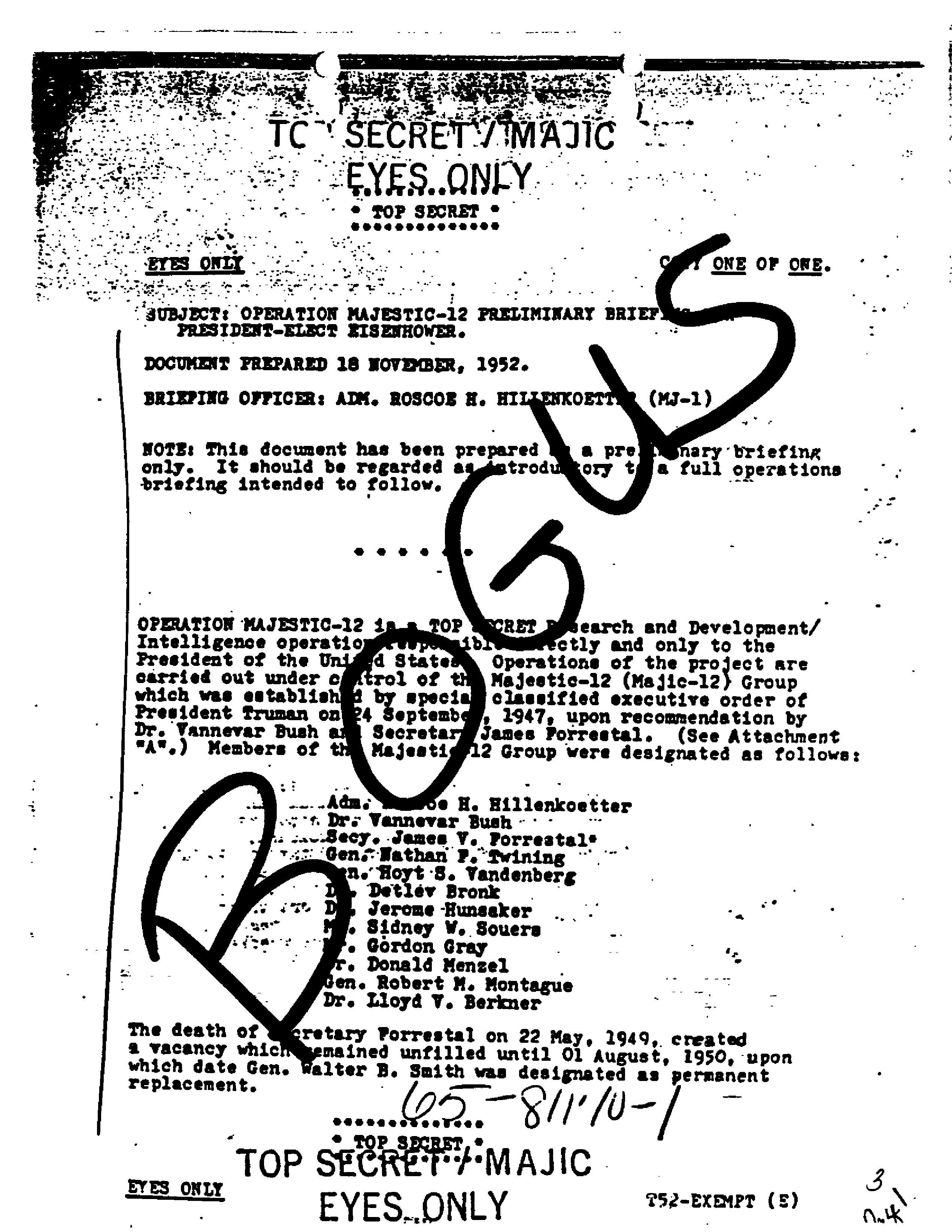
One of the circulating Majestic-12 documents, investigated by the FBI
The "Operation Majestic-12" documents surfaced between 1984 and 1987: an anonymous roll of film received by Jaime Shandera in December 1984, later circulated by him, William Moore and Stanton Friedman.
Read more
They describe a secret committee of twelve senior officials created by Truman in 1947 to manage crashed UFOs and recovered bodies, in connection with Roswell. In 1988 two FBI offices received copies and the AFOSI replied that they were "completely bogus", a verdict recorded in the FBI's Vault file. Examiners found a Truman signature traced from a 1947 letter, anachronistic date formats and inconsistent letterhead. They prove neither the committee nor the UFOs; their exact origin remains unclear.
Majestic 12 Part 1 of 1 (page 4 crop).jpg · Wikimedia Commons · Public domain · open original
Documented evidence
- RAAF press release (July 8, 1947) announcing the recovery of a "flying disc", reproduced by the Roswell Daily Record
- General Ramey's correction in Fort Worth the same July 8 and Mac Brazel's interview in the Roswell Daily Record (July 9, 1947): rubber, tinfoil, paper, sticks and flower-printed tape, no metal
- FBI Dallas teletype (July 8, 1947): hexagonal object suspended from a balloon, "resembles a high altitude weather balloon with a radar reflector"
- 509th Bomb Group and RAAF history (July 1947): the object "turned out to be a radar tracking balloon"
- 1994 USAF report (published in 1995 as "The Roswell Report: Fact vs. Fiction"): attribution to Project Mogul, Flight 4 of June 4, 1947
Show 2 more facts
- GAO/NSIAD-95-187 (1995): only two official 1947 records; RAAF administrative records and outgoing messages destroyed with no record of who did it or under what authority
- Sworn statement by Jesse Marcel Jr. (May 6, 1991), son of Major Marcel, describing the material his father brought home
Sources
- USAF, The Roswell Report: Fact vs. Fiction in the New Mexico Desert (1995) — copia DTIC ADA326148 — Primary document: includes the 1994 Weaver report, the FBI teletype, Brazel's 1947 interview, Crary's journal and the Cavitt and Moore statements.
- USAF Roswell Report: Case Closed (1997)
- GAO/NSIAD-95-187, Government Records: Results of a Search for Records Concerning the 1947 Crash Near Roswell (1995) — copia en archive.org — Primary document: the GAO's full report to Congressman Schiff.
- GAO Report B-262046 — ficha en gao.gov
- Roswell Daily Record, 8 jul 1947 — portada escaneada (Wikimedia Commons)
- PEOPLE (Johnny Dodd), «Pentagon's UFO Hunter Reveals Himself and What He Learned», 13 oct 2026 (republicado en Yahoo) — Quotes the passage of Stratton's memoir on Roswell, attributed to an unnamed source.
- FBI Records: The Vault — Majestic 12 — FBI file with the AFOSI's "bogus" verdict on the MJ-12 documents.
- Brad Sparks, 'Philip Corso's Roswellmania', Skeptical Inquirer, March-April 1998, pp. 52-54 — Critical review of The Day After Roswell: date errors and Thurmond's withdrawn foreword.
- Government Executive (Louis Jacobson), 'The Senator and the UFOs', June 4, 1997 — Contemporary press: Thurmond's statement on his foreword to Corso's book.
- AARO, Report on the Historical Record of U.S. Government Involvement with UAP, Volume I (February 2024; The Black Vault copy) — Primary source: no empirical evidence of reverse engineering of extraterrestrial technology.
Related cases
same object · same country · same period
Muroc · airmen see silver objects over the test base
1947 · Tier A
same object · same country · same period
Gorman dogfight · a pilot chases a light for 27 minutes
1948 · Tier A
same object · same country · same period
Fort Monmouth · a fast radar contact and a disc seen from a jet
1951 · Tier A
same object · same country · same period
The Battle of Los Angeles · anti-aircraft fire over the city
1942 · Tier A
Associated actors (3)
