1948·Fargo, North Dakota
United States.Gorman Dogfight · F-51 vs. maneuvering light (Fargo)
On October 1, 1948, Air National Guard 2nd Lt. George F. Gorman chased a small white light over Fargo for about 27 minutes in his F-51 Mustang, a light he said out-maneuvered his fighter. The tower controllers and the occupants of a Piper Cub saw a fast light for seconds, not the maneuvers. Project Sign investigated it; in 1949, under Project Grudge, an analysis attributed it to a lighted weather balloon.
Tier A · AcceptableWhat do they mean? →
Institutional evidence: several identified independent witnesses, or contemporary official documentation, without an instrumental record to corroborate them.
What it was
77%natural or human cause
Most likely explanation: balloon
See the split across the six explanations
Natural or human cause
No known cause
Primary documents
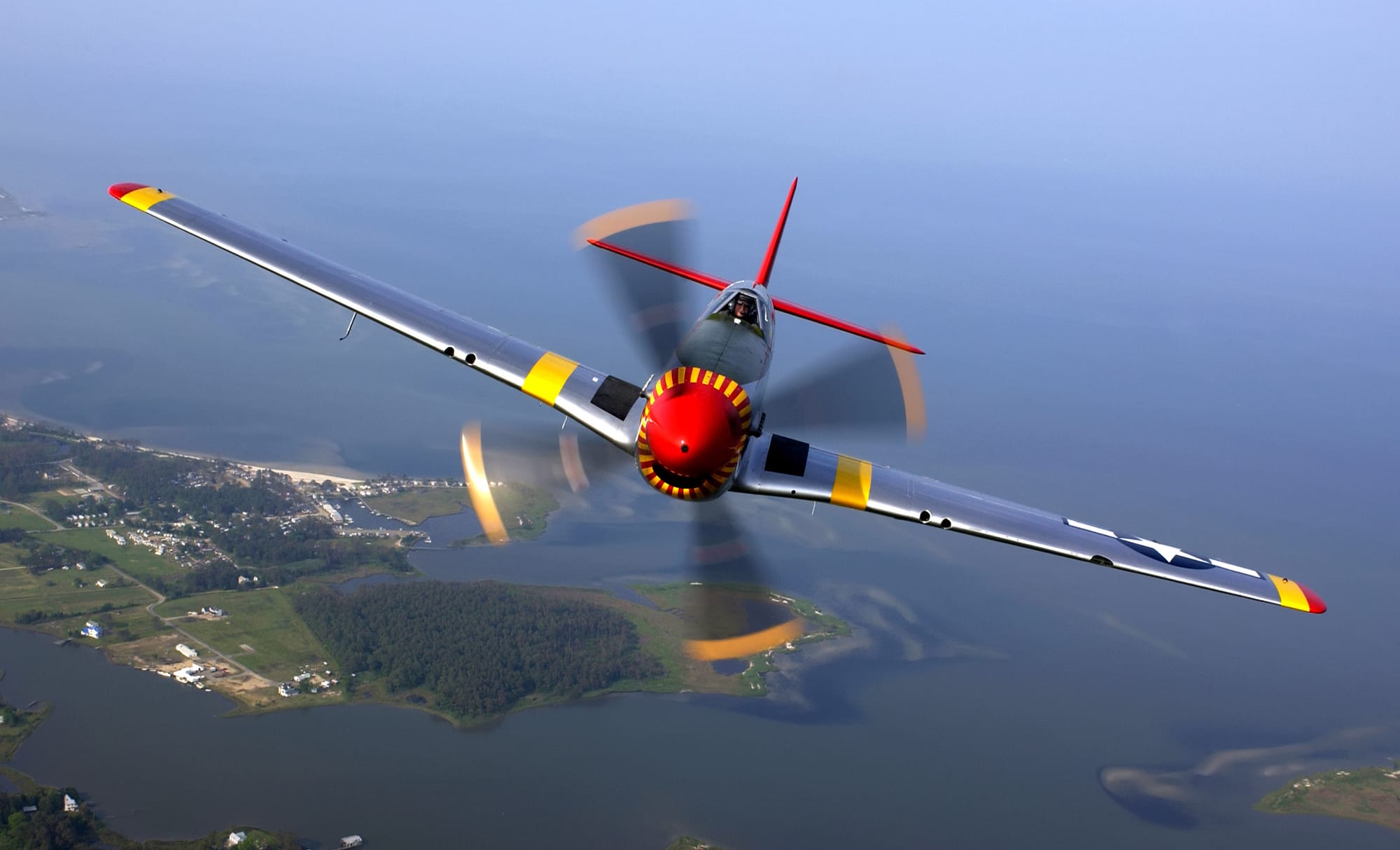
Context · a P-51 Mustang, the fighter type of the Gorman dogfight
P-51 Mustang edit1.jpg · Wikimedia Commons · Public domain · open original
Incident Summaries 1-100 — 'Check-List: Unidentified Flying Objects' cards (USAF)
Three volumes of US Air Force "Incident Summaries", covering incidents numbered 1 to 233, drawn from its records at the National Archives and declassified in the first PURSUE release on 8 May 2026. Each summary is built around a standardized form, "Check-List - Unidentified Flying Objects", recording date, place, object description, heading, weather and witness reliability, and many add witness lists and statements. It is the instrument with which Projects Sign (1948) and Grudge (1949) tabulated flying-disc reports, the forerunner of Blue Book's record cards. A form proves that a report was received and processed, not that it was anomalous: most were resolved as balloons, astronomical bodies, aircraft or misidentifications.
Department of War / USAF (PURSUE Release 01) · Public domain · US Government work · open original
Incident Summaries 101-172 — 'Check-List: Unidentified Flying Objects' cards (USAF)
Department of War / USAF (PURSUE Release 01) · Public domain · US Government work · open original
Incident Summaries 173-233 (part 1/4) — 'Check-List: Unidentified Flying Objects' cards (USAF)
Department of War / USAF (PURSUE Release 01) · Public domain · US Government work · open original
Show the other 3 documents
Incident Summaries 173-233 (part 2/4) — 'Check-List: Unidentified Flying Objects' cards (USAF)
Department of War / USAF (PURSUE Release 01) · Public domain · US Government work · open document
Incident Summaries 173-233 (part 3/4) — 'Check-List: Unidentified Flying Objects' cards (USAF)
Department of War / USAF (PURSUE Release 01) · Public domain · US Government work · open document
Incident Summaries 173-233 (part 4/4) — 'Check-List: Unidentified Flying Objects' cards (USAF)
Department of War / USAF (PURSUE Release 01) · Public domain · US Government work · open document
The night in question
On the night of October 1, 1948, Second Lieutenant George F. Gorman, a 25-year-old North Dakota Air National Guard pilot, was circling over Fargo after a cross-country flight when he saw a Piper Cub circling the football field on the north end of the city, where a night game was underway, and almost at the same time a light traveling east to west between the Hector Airport tower and the stadium. The time was 21:00. He first took it for the rear navigation light of another aircraft, although it had no glare and was blinking on and off. At 21:07 he asked the tower, which knew of no local traffic other than the Cub, whose outline Gorman could distinguish clearly against the city lights.
For 27 minutes, Gorman chased the light in his F-51 Mustang in a sequence later retellings called a dogfight. He described the object as a white light 6 to 8 inches across, with a clear-cut edge and no discernible structure, that turned tighter than his fighter and climbed vertically; on two head-on passes the light seemed to come straight at him, and on one of them it passed, by his statement, 500 feet or less above his canopy. Gorman, at full power, followed it up to 14,000 feet, where he stalled with the light about 2,000 feet above him; he then saw it pull away to the northwest, return for another pass and climb straight up until lost. He estimated its top speed at above 600 miles per hour and stated there was "thought" behind the maneuvers.
The Project Sign file (incident 172) shows far more limited corroboration than is usually told. The two tower controllers, L. D. Jensen and Manuel E. Johnson, saw a round white light the size of a tail lamp for "several seconds", in horizontal flight or a single turn, and saw it leave in a straight line; the oculist A. D. Cannon, who was flying in the Cub with his passenger Einar Neilson and later went up to the tower, saw it "at intervals for seconds only", also in a straight line. No one but Gorman saw the maneuvers; Ruppelt summarized that the other witnesses "did not witness all the maneuvers". Sign's investigators flew to Fargo within hours and ran a Geiger counter over the aircraft, whose slightly higher radioactivity was later attributed to cosmic rays from a recent flight; their October 1948 summary stated that meteorological balloon releases had been discredited, and Ruppelt found in the file an old memo on the meeting held upon the ATIC team's return which concluded that "some weird things were taking place". The explanation came later: in January 1949 the Air Weather Service listed incident 172 among the cases where a synoptic balloon "could have been" at the location, and an Aero Medical Laboratory memorandum of April 28, 1949, by then under Project Grudge, concluded the light may simply have been rising steeply on a relatively straight course, as a lighted weather balloon would, and that the Fargo weather station had released one within 10 minutes of the first sighting. The same memo added that at night, chasing a point of light with no other reference, a pilot can hardly tell which is moving, himself or the object. That explanation is contested (Gorman insisted the object responded actively) but is not dismissible, especially because the case is entirely visual, with no radar or instrumental record.
Why it matters
Contemporary with Mantell and Chiles-Whitted, in the first year of official U.S. investigation, Gorman is an early example of the pattern that would recur for decades: 'an object out-maneuvers a fighter'. The original file survives complete, with each observer's statement, and it sets the case's limit: the tower and the Cub's occupants confirm that a fast light crossed over Fargo, not the dogfight, which rests on Gorman's account alone.
Its limit, and what sets it apart from modern sensor cases, is that it rests entirely on human perception. The balloon explanation does not sit comfortably with an account of active response, but the very mechanism investigators invoked (parallax and self-induced motion illusion while chasing a point of light against a featureless sky) is a real, well-documented perceptual phenomenon in aviation. The case is thus a clear example of the epistemic frontier of the pre-instrumental era: a light also seen by others but maneuvers seen only by the pilot, and no datum to arbitrate between 'maneuvering object' and 'balloon plus motion illusion'.
What the case illuminates, beyond its verdict, is the psychology of the intercept. A trained pilot, convinced he faced a responding intelligence, is a good witness caught in a deceptive geometry. Chasing a small point of light, with no scale or reference horizon, makes each of one's own maneuvers project onto the object as if it were the one executing them; the sense of an adversary that 'charges and breaks off' can arise from the pursuer's own motion. Gorman is thus an early reminder of why maneuver accounts without sensors warrant distrust: the sincere conviction of a qualified professional and the physical reality of the object can diverge precisely in the most dramatic cases, and only an independent instrument arbitrates between the two.
What's left on paper
Documented evidence
- 27-minute chase by 2nd Lt. George F. Gorman (Air National Guard) in an F-51 Mustang, Oct 1, 1948, per his statement
- Controllers Jensen and Johnson and oculist A. D. Cannon, from the Cub, saw a fast light for seconds and in a straight line; no one else saw the maneuvers
- Maneuvers reported by Gorman alone: tight turns, vertical climbs, head-on passes and a stall at 14,000 ft
- Investigated by Project Sign (incident 172); its October 1948 summary discounted weather balloons
- Aero Medical Laboratory memo (April 1949, Project Grudge): lighted balloon released by the Fargo station within 10 minutes of the sighting
Sources
- Project Sign · incident 172 file (Fargo, Oct 1, 1948), 38 pages — copy at NICAP — Primary source. Incident summary (p. 2), checklists for Jensen, Johnson and Cannon (pp. 3-5) and the Gorman interview (pp. 14-17).
- Project Grudge (August 1949), part 7 — Internet Archive — Primary source. Aero Medical Laboratory memo of Apr 28, 1949 on incident 172 and the Fargo balloon (PDF pp. 43-44); Hynek's comment (p. 11).
- Project Grudge (August 1949), part 6 — Internet Archive — Primary source. Air Weather Service letter of Jan 24, 1949 listing incident 172 among possible synoptic balloons (PDF pp. 29-31).
- Edward J. Ruppelt, "The Report on Unidentified Flying Objects" (1956), ch. 3 — Project Gutenberg at Internet Archive — Account by the head of Project Blue Book drawn from the file: the partial corroboration, Sign's visit and the balloon conclusion.
Related cases
same object · same country · same period
Roswell
1947 · Tier A
same object · same country · same period
Discs over Muroc Army Air Field
1947 · Tier A
same object · same country · same period
Fort Monmouth · the case that revived Grudge
1951 · Tier A
same object · same country · same period
'Battle of Los Angeles' · anti-aircraft barrage over LA
1942 · Tier A