1942·Los Angeles, California
United States.'Battle of Los Angeles' · anti-aircraft barrage over LA
On the night of February 24-25, 1942, amid invasion panic after Pearl Harbor, U.S. Army anti-aircraft batteries fired 1,440 rounds at one or more unidentified objects over Los Angeles. No enemy aircraft or shootdown was confirmed. The official history of the Army Air Forces points to weather balloons as the cause of the initial alarm and to the anti-aircraft bursts themselves, lit by searchlights, mistaken for planes; UAP culture cites it as an early mass sighting.
Tier A · AcceptableWhat do they mean? →
Institutional evidence: several identified independent witnesses, or contemporary official documentation, without an instrumental record to corroborate them.
What it was
88%natural or human cause
Most likely explanation: balloon
See the split across the six explanations
Natural or human cause
No known cause
Primary documents
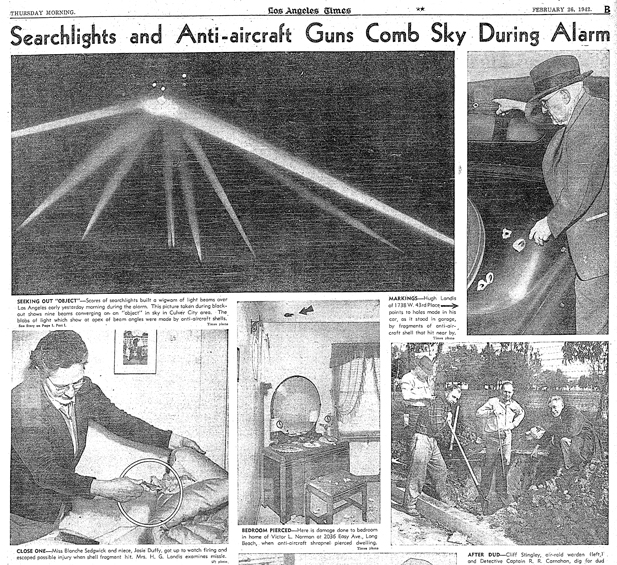
«Battle of Los Angeles» · Los Angeles Times photograph (25 Feb 1942)
Los Angeles Times (1942) vía Wikimedia Commons · Public domain · 1942 work, copyright not renewed · open original
The night in question
Context is everything. Barely three months after Pearl Harbor, the U.S. West Coast was living under an almost hysterical invasion alert. On the night of February 23-24, 1942, a Japanese submarine (the I-17) had surfaced off Santa Barbara and shelled the Ellwood oil facility: the first Axis attack on the U.S. continental mainland since the War of 1812. Material damage was minimal, but the psychological effect was enormous. Just twenty-four hours later, naval intelligence had warned that an attack on the area could be expected within ten hours. That evening flares and blinking lights were reported near defense plants, and a first alert, called at 19:18, was lifted at 22:23. In the early morning, radars picked up an unidentified target 120 miles west of Los Angeles and tracked it to within a few miles of the coast, where it seems to have vanished. At 02:21 a blackout was ordered; at 02:43 planes were reported near Long Beach and a coast artillery colonel saw "about 25 planes at 12,000 feet". According to the official history, at 03:06 a balloon carrying a red flare was seen over Santa Monica and four anti-aircraft batteries opened fire; in all, 1,440 rounds were fired while searchlights swept the darkness, until dawn.
The outcome is the most revealing part. No enemy bombs fell, no hostile aircraft was confirmed, there were no shootdowns, although reports circulated of four enemy planes downed and one landing in flames at a Hollywood intersection. Witnesses described anything from one to several hundred craft, at altitudes from a few thousand feet to over 20,000. According to the official history, the only damage was that caused by the excitement (at least one death from heart failure), traffic accidents in the blacked-out streets and shell fragments from the artillery itself. At the end of the war, the Japanese stated that they had not sent planes over the area during that alert. Shrapnel from the anti-aircraft rounds themselves (which fall back to earth) damaged homes and vehicles on the ground. The official response was immediately contradictory: Navy Secretary Frank Knox, already on February 25, called the episode a false alarm produced by war nerves; the Army, whose Western Defense Command had predicted that same morning that most reports would prove "greatly exaggerated" and whose Fourth Air Force believed there had been no planes, changed its view after questioning witnesses, and War Secretary Henry Stimson announced that from one to five unidentified airplanes had flown over the area: commercial planes operated by the enemy from secret fields in California or Mexico, or light planes launched from Japanese submarines. That discrepancy between two departments of the same government is, paradoxically, what kept the mystery alive for decades.
The famous photograph published by the Los Angeles Times on February 26 (half a dozen searchlight beams converging on a luminous point in the sky) became the visual icon of the episode and is still cited today by UFO culture as proof of a solid object. Later analysis, however, established that the image was heavily retouched in the darkroom, a routine editorial practice of the era to 'clean up' and dramatize press photographs; what looks like an illuminated disc is largely a retouching artifact. The official history of the Army Air Forces (Craven and Cate, published in 1948 and reissued in 1983 by the Office of Air Force History) concluded that a careful study of the evidence suggests that meteorological balloons, known to have been released over Los Angeles, may well have caused the initial alarm, a theory supported by the fact that anti-aircraft units were officially criticized for firing at targets moving too slowly to have been airplanes; and that probably much of the confusion came from the anti-aircraft shell bursts, caught by the searchlights, being themselves mistaken for enemy planes. It adds that, once the firing started, drifting smoke from the bursts made observation difficult; that the acting commander of the anti-aircraft artillery brigade testified he had first been convinced he saw fifteen planes, but quickly decided he was seeing smoke; and that correspondents such as Ernie Pyle and Bill Henry witnessed the shooting and wrote that they were never able to make out an airplane. It is a fully documented institutional event whose interpretation as an anomalous phenomenon is weak.
Why it matters
A Western military opened massive fire on an unidentified object and left an openly contradictory official record: the Navy declared it a false alarm that same day while the War Department insisted on real aircraft. That tension between two branches of the state is exactly the kind of material that documents the institutional processing of the phenomenon; here, however, it serves as skeptical calibration, not as evidence of anomaly.
Its pedagogical value is twofold. First, it shows with textbook clarity how a 'UAP case' is manufactured without any extraordinary phenomenon: a charged context (invasion panic after Pearl Harbor and the Ellwood shelling), a banal stimulus (a drifting weather balloon), a contagion mechanism (shell bursts mistaken for enemy planes) and a retouched press image that seals the legend. Second, it illustrates the risk opposite to the one ufology usually fears: not that the authorities are hiding a real sighting, but that the military apparatus itself, under pressure, generates a spectacular event out of nothing. The conventional reading is that of the official Army Air Forces history. It is included for its institutional documentation and its usefulness as a disciplined counter-example, not for its anomaly.
What's left on paper
Documented evidence
- 1,440 anti-aircraft rounds fired over Los Angeles in the early hours of Feb 25, 1942, after a radar target at 120 miles that vanished near the coast
- No enemy bombs or shootdowns; damage from friendly shell fragments, traffic accidents and at least one death from heart failure
- Contradictory official records: Navy (Knox) = false alarm; War (Stimson) = one to five unidentified airplanes
- Los Angeles Times photograph (Feb 26, 1942) heavily retouched
- Official AAF history: weather balloons as the probable cause of the initial alarm; lit shell bursts mistaken for planes
Sources
- Wikipedia — Battle of Los Angeles — Secondary source (encyclopedia).
- W. F. Craven y J. L. Cate (eds.), «The Army Air Forces in World War II», vol. I, cap. 8 (1948; reed. Office of Air Force History, 1983) — Official history based on the period records: alert timeline, rounds fired and explanation.
Related cases
same object · same country · same period
Roswell
1947 · Tier A
same object · same country · same period
Discs over Muroc Army Air Field
1947 · Tier A
same object · same country · same period
Gorman Dogfight · F-51 vs. maneuvering light (Fargo)
1948 · Tier A
same object · same country · same period
Fort Monmouth · the case that revived Grudge
1951 · Tier A