1967·Cussac, Cantal
France.Cussac
On 29 August 1967, in Cussac (Cantal, France), two shepherd children, François Delpeuch (13) and his sister Anne-Marie (9), said they saw a bright sphere about two meters across and four small black figures that climbed into it before it took off with a whistle.
Read the rest of the summary
Gendarmes came that afternoon but drew up no report; in 1968 the gendarmerie confirmed they noticed a sulphurous smell, and one of them spoke in 1978 of a patch of yellowed grass. In 1978 GEPAN, the official French agency, reinvestigated and concluded in a confidential internal report that the children had seen an unknown vehicle; the skeptical reading is a helicopter.
Tier B · IndicativeContacteeWhat do they mean? →
Limited evidence: a single witness, testimony gathered years later, or an account without contemporary primary documentation.
What it was
56%natural or human cause
Most likely explanation: helicopter
See the split across the six explanations
Natural or human cause
No known cause
Context image (not a document from the case)
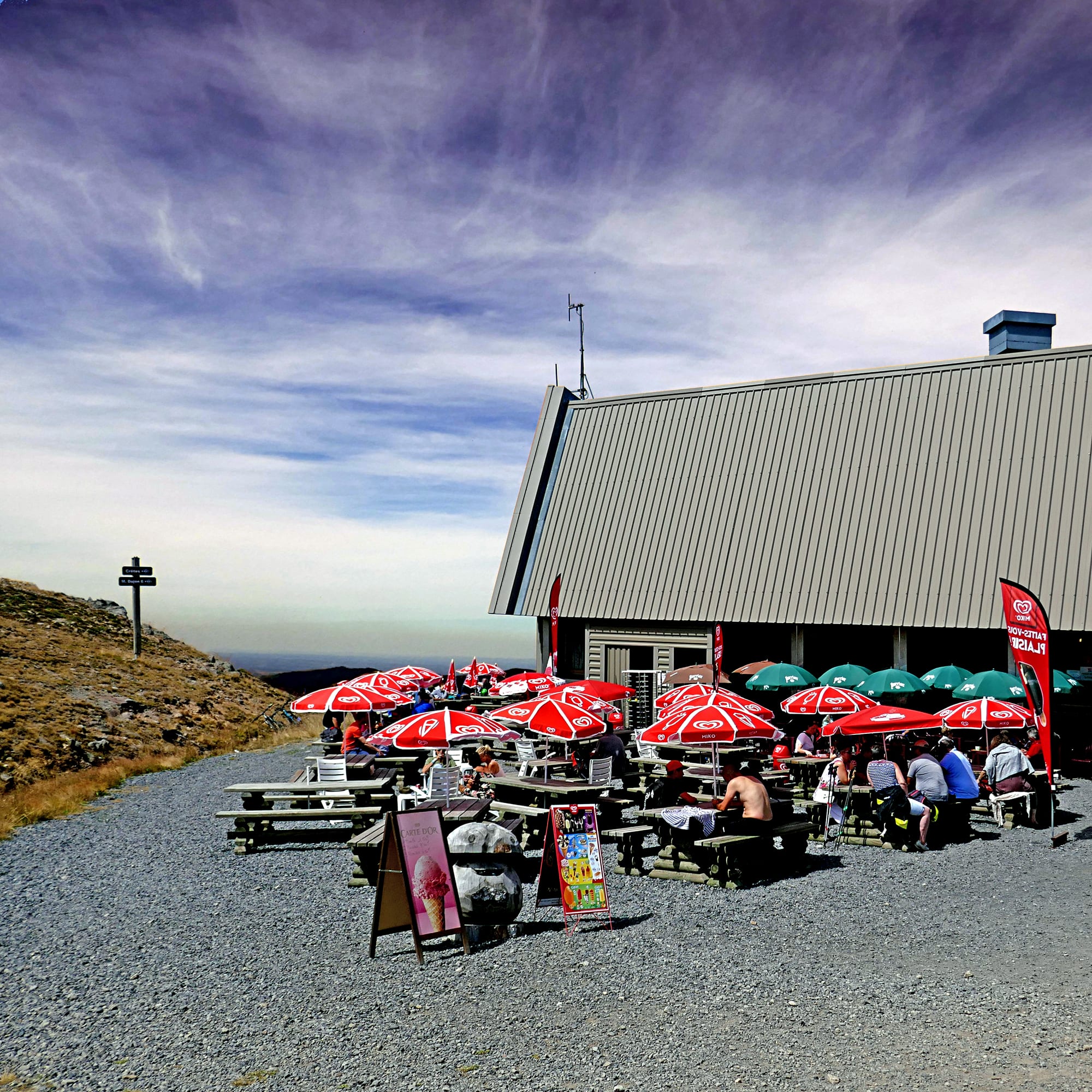
Context · the Cantal (Auvergne, France), where Cussac lies
Plomb du Cantal, Auvergne, France (32694286988).jpg · Wikimedia Commons · CC BY-SA 2.0 · open original
The night in question
On the morning of 29 August 1967, François Delpeuch, thirteen, and his sister Anne-Marie, nine, were tending the family's cattle beside a road in Cussac, in the rural department of Cantal, in central France. Accompanied by their dog Médor, they said they saw, beyond a wall, a bright sphere, intense silver in color (La Montagne, in 1967, described it as a craft four meters wide and two high; later accounts spoke of a sphere two to five meters across, depending on the source), and next to it four small figures 'completely black', with a glossy look François compared to silk. One of the figures seemed bent over something on the ground; another held a mirror-like object. In some versions of the account the sphere rested on legs or landing gear with rounded 'feet'; according to Mesnard and Pavy, who interviewed the children separately and unannounced in 1968, only Anne-Marie saw them, and François, who did not, thought his sister had taken the branches of the hedge for legs. The same investigators recorded that a neighbour, Mr Delcher, who was shifting hay in his barn, heard the whistling as the sphere rose.
According to the children's account to the gendarmerie, the figures suddenly rose and entered the sphere (one of them, they said, seemed to draw the others inside) and the object ascended spinning on itself with a sharp whistle, leaving behind a sulfurous smell. The children ran to raise the alarm, and their father, the village mayor, called the gendarmerie. Years later the rural constable said he had noticed a suffocating smell at the edge of the village more than ten hours later; according to the 2016 study of the GEPAN files, that smell did not bother the children, the mayor or the gendarmes who were on site that afternoon, although in 1968 investigators Joël Mesnard and Claude Pavy wrote that the gendarmerie confirmed to them that the officers who arrived at 4 p.m. had noticed the sulphurous smell, and that the children said the smell of sulphur, carried by the west wind, reached them.
The institutional response is what gives the case weight, and it is worth breaking down because it happens in two stages. First, gendarmes from the Saint-Flour and Neuvéglise brigades came to the site around four in the afternoon, made some brief checks and did not consider it necessary to draw up a report, although, according to GEPAN, they concluded the sighting was real and probably involved a foreign military craft; one of the gendarmes stated in 1978 that he had noticed a strong odor and a circular patch of yellowed grass, although the La Montagne correspondent said at the time that no traces were found, and GEPAN's own report notes that the low contrast of the colours that gendarme picked in the colour-chart test does not allow the 'trace' to be taken into account. Second, and more than a decade later, GEPAN (the official agency for the study of unidentified aerospace phenomena, part of CNES, the French space agency) reopened the case. Around 1978, GEPAN investigators interviewed François and Anne-Marie again, now adults, at their home and at the incident site, reformulating questions and cross-checking versions to test the account's consistency. The reconstruction found no major contradictions or signs of fabrication, and the internal report, kept confidential at the request of the agency's scientific council, concluded that the witnesses had seen 'the hasty departure of a completely unknown inhabited vehicle'. That assessment was later cited in the COMETA report, the 1999 document signed by former senior French officials.
It should be read, however, with due caution: it is two witnesses, and minors at the time of the event, in an encounter of clearly folkloric tone (the 'four black figures' were described in the local press as 'little devils'), with no sensor or instrumental record, and the consistency GEPAN verified is that of the account, not of the physical event. A narrative can be perfectly coherent and still not correspond to a real object: internal coherence measures the absence of contradiction, not truthfulness. But unlike a loose tale, it went through the gendarmerie the same day and had a later methodological review by the state agency, although it left no contemporary report.
The prosaic reading was put forward by Éric Maillot of the Cercle Zététique from 1996 onward and is developed in the 2016 study of the GEPAN files: the only craft known in 1967 with a comparable appearance, whistle, vertical take-off and flight behaviour is a helicopter, whose bubble canopy would have reflected the sun behind the children; according to the same study, the gendarmes at the time leaned towards a craft of that kind before concluding it was a piloted military vehicle, probably from a foreign power, and GEPAN itself wrote that the only phenomenon that seemed to explain every aspect, including the four occupants, would be a helicopter, although it ruled it out because of the object's shape, colour and brightness. GEPAN ruled it out in 1978, Claude Poher rejected it again in 2004, and Thierry Pinvidic, in the report he signed alone in 1993 on the counter-investigation he carried out with Méheust and Grangeon, judged it 'indefensible'; according to the 2016 study, the three did not agree on the nature of the event.
Why it matters
Cussac matters because it is a close encounter that passed through two French institutional filters. Gendarmes came the same day, although they drew up no report, and, more than a decade later, GEPAN, the official agency under CNES, re-examined it with a deliberate methodology (re-interview, on-site reconstruction, consistency check) and concluded that the children had seen an unknown vehicle. That official traceability is rare for a close encounter of the third kind: most accounts of humanoid figures never reach a state body, and this one passed through the gendarmerie and then a space agency.
But that filter also has a precise limit, and here is the case's lesson. What GEPAN verified was the internal coherence of the testimony, not the reality of the object; an account without contradictions, held for years by its two protagonists, is evidence of sincerity or of a firm memory, not that four black beings existed. The evidential core remains fragile: it is two witnesses, minors at the time of the event, in an account of strong folkloric tone ('little black devils') that connects with a rural cultural-religious imaginary, with no instrumental record and with suggestion, perceptual error and shared narrative construction always available as prosaic explanations. The smell (which the gendarmerie confirmed to two investigators in 1968) and the patch of grass described in 1978, the only physical traces claimed, were not preserved for analysis, and GEPAN did not accept the second. It is documented folklore with gendarmerie backing and a GEPAN review: its rarity is that of the file, not of the evidence, and it is valuable precisely as an example of how far institutional backing reaches and where it stops.
What's left on paper
Documented evidence
- Account by two witnesses (François and Anne-Marie Delpeuch) to the gendarmes who came the same day (29 Aug 1967), no report drawn up
- The gendarmes drew up no report; according to GEPAN, they leaned towards a piloted military craft, probably from a foreign power
- Circular patch of yellowed grass described by a gendarme in 1978; the La Montagne correspondent said in 1967 that no traces were found, and GEPAN did not take it into account because of the low contrast of the colours chosen
- GEPAN (CNES) reinvestigation (1978): confidential internal report concluding the witnesses saw 'a completely unknown inhabited vehicle'
- Encounter of two minor witnesses, no instrumental record; folkloric tone ('little black devils')
Show 3 more items
- Helicopter hypothesis (Éric Maillot, Cercle Zététique, 1996; 'Les OVNI du CNES', 2016), rejected by GEPAN, by Claude Poher and by Thierry Pinvidic (1993)
- Investigation by Joël Mesnard and Claude Pavy (Phénomènes Spatiaux, June 1968; translated in Flying Saucer Review, 1968): the gendarmerie confirmed to them the sulphurous smell noticed at 4 p.m.; a neighbour, Mr Delcher, heard the whistling; the children did not contradict themselves under separate questioning; François had watering eyes for several days
- Discrepancy between the children: only Anne-Marie saw legs under the sphere, and François thought they were the branches of the hedge
Sources
- GEPAN / CNES — Reexamen del expediente de gendarmería del caso de Cussac — Review by the official French agency; inconclusive conclusion, 'worthy of study'.
- UFO Evidence — 'Two children encounter UFO and small humanoid beings in Cussac, France (August 29, 1967)'
- Deguillaume, Maillot y Rossoni — 'Les OVNI du CNES: 30 ans d'études officielles 1977-2007', cap. 10 «Cussac» (2016) — Re-examination of the 1978 GEPAN file, with its conclusion and the helicopter hypothesis.
- Mesnard, Joël y Pavy, Claude — «Encounter with "Devils"», traducido de «Phénomènes Spatiaux» (junio de 1968) en Flying Saucer Review (1968), en «The Flying Saucer Review: Ultimate collection» (archive.org) — Contemporary field investigation: separate interviews with both children, the gendarmerie's confirmation of the sulphurous smell, the auditory witness Delcher and the discrepancies between the accounts.
Entity form (1)
Related cases
same object · same country · same period
Valensole
1965 · Tier A
same object · same period
Loring AFB overflights · SAC nuclear bases
1975 · Tier S
same explanation · same country
Air France 3532 · disc + military radar (GEIPAN)
1994 · Tier A
same object
Morón · the C-101 pilot and the crazed canopy (1995)
1995 · Tier A
Associated actors (2)