1955·Kelly, near Hopkinsville, Kentucky
United States.Kelly-Hopkinsville
On the night of 21 August 1955, the Sutton and Taylor families (eleven people) said they were besieged for hours at a farmhouse near Hopkinsville, Kentucky, by several small creatures with large heads and bright eyes that approached the house. They fired at them with no apparent effect and fled to the police station in terror. Police and state troopers investigated: they found no traces or landing marks, apart from a hole in a window screen and the shell casings from the shots. It is the most cited multi-witness encounter of its era and the origin of the phrase 'little green men'.
Tier B · IndicativeContacteeWhat do they mean? →
Limited evidence: a single witness, testimony gathered years later, or an account without contemporary primary documentation.
What it was
58%natural or human cause
Most likely explanation: bird
See the split across the six explanations
Natural or human cause
No known cause
Primary documents
Air Force correspondence on the Hopkinsville incident (1957)
Four pages filed in Blue Book. On 29 August 1957 the Air Technical Intelligence Center asked Campbell AFB for data on the all-night 'attack' by creatures on a family six miles north of Hopkinsville, writing that the incident 'has never been officially reported to the Air Force'. The base reply (1 October, 1st Lt Charles N. Kirk) reports that no official investigation was ever ordered and that neither the sheriff nor the police held a report. It encloses Capt Robert J. Hertell's letter (17 September), who believed some officers went on their own and relayed that, according to local authorities, the farmer charged a dollar a head 'to see where the Mars-Men landed'.
Project Blue Book · 1955-08-6972585-OLDGREENWICH-CONNECTICUT, pp. 72, 61, 71 y 70 (NARA, espejo en archive.org) · Public domain (US Government work) · open original
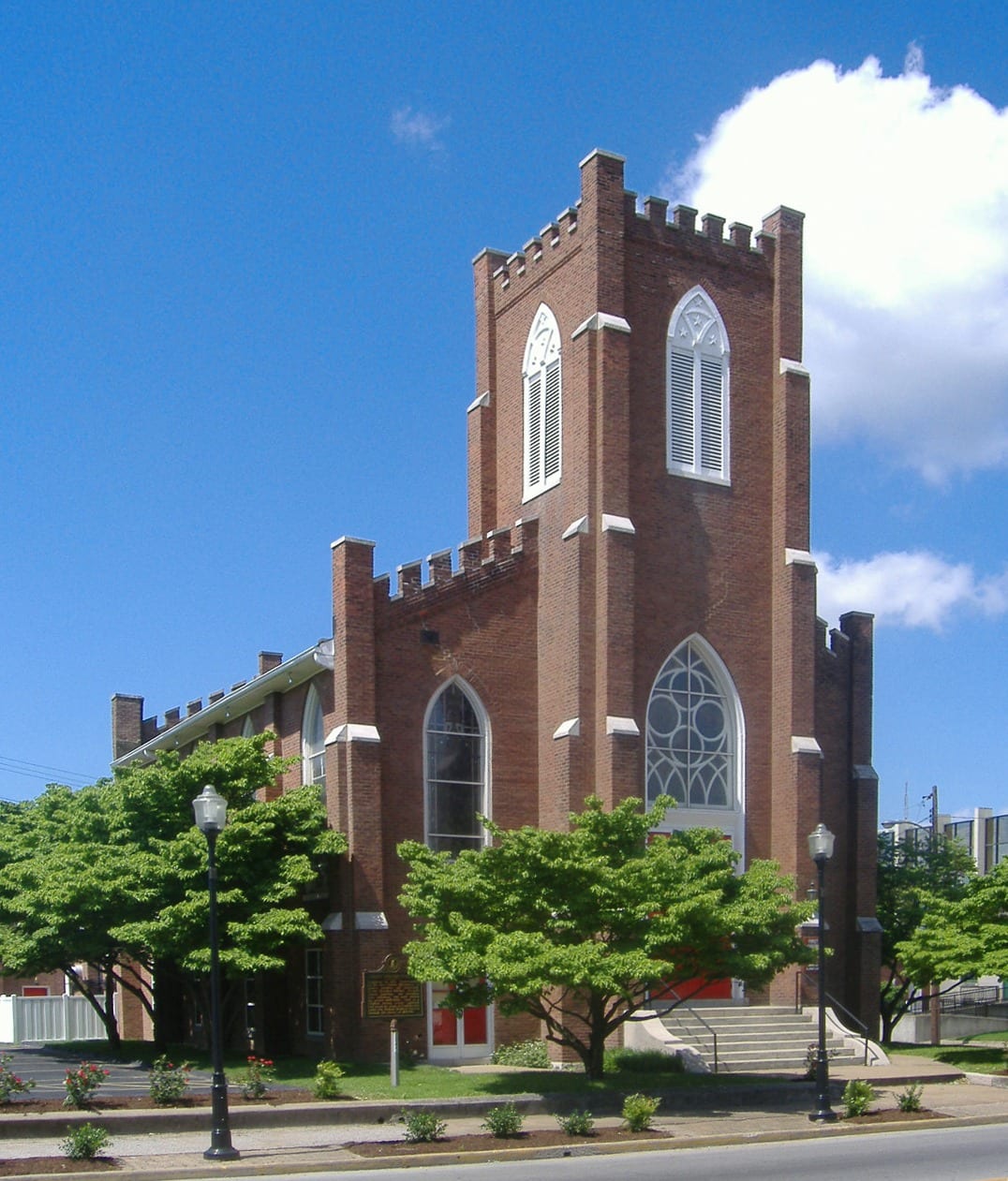
Context · Hopkinsville (Kentucky), near the farm of the famous 'siege'
Hopkinsville First Presbyterian.JPG · Wikimedia Commons · Public domain · open original
The night in question
Around seven in the evening on 21 August 1955, at a farmhouse in the hamlet of Kelly, near Hopkinsville, in Christian County (Kentucky), Billy Ray Taylor went out to the yard to draw water from the well and (as he told it) saw a bright light cross the sky and settle in the field beyond the trees. No one took him very seriously at the time. Shortly after, however, the Sutton and Taylor families, a group of some eleven people gathered in the house, said they saw small figures approaching, about a meter tall, with large, disproportionate heads, big luminous eyes, long thin arms ending in claws, and an almost floating way of moving, as if barely touching the ground.
What followed, according to the account convergently held by all present, was a siege of several hours; the witnesses spoke of nearly four. The creatures appeared at the windows, climbed onto the roof and approached the door; the men of the house, Elmer 'Lucky' Sutton and Billy Ray Taylor, fired at them with shotgun and .22 rifle at close range, and described the rounds seeming to bounce off or have no effect, accompanied by a metallic sound, as of an impact on a bucket. The figures would withdraw when hit and return shortly after. Around eleven at night, unable to drive them off and seized by panic, the two families crowded into two cars, drove to the Hopkinsville police station and rushed in, visibly terrified, to report that their house was being attacked by small beings.
The institutional response was immediate and is what anchors the case: Hopkinsville police and Kentucky state troopers (more than a dozen officers, plus at least four military policemen from Fort Campbell on duty in Hopkinsville) went to the farm that same night. They found no traces of 'little men', no landing marks, nothing anomalous on the ground; according to Joe Nickell the search yielded nothing apart from a hole in a window screen, and according to History the officers found the shell casings from the shots, consistent with the witnesses having indeed fired at 'something'. According to the investigation by Isabel Davis and Ted Bloecher (1978), police chief Russell Greenwell quietly looked for signs of drinking and neither he nor other officers found any (the next day Bud Ledwith noticed a few beer cans in a rubbish basket); several men, Greenwell among them, saw a luminous patch on the grass by the fence that showed nothing at close range, and one policeman reported a greenish light in the woods that was not confirmed. Another officer who saw noisy objects, brighter than the Perseids, pass from the southwest that night first said they were not ordinary meteors and later said they were. Blue Book documents, public since 1975, say the incident was "never officially reported to the Air Force" and that no official investigation was made, although the Evansville Press of August 22 reported that Fort Campbell had sent a major to the scene. A later memorandum filed in Blue Book noted a rumour, which could not be confirmed, of a circus train near town a day or two before, and added that in the opinion of J. Allen Hynek and its author, if so, some monkeys or apes might have escaped. The officers described the families as genuinely frightened people, not drunk or, in their reading, seeking notoriety (they saw no money or publicity to be gained; two years later a captain at Campbell AFB wrote to Blue Book that, as several local authorities had told him, the farmer put up signs and was charging a dollar a head "to see where the Mars-Men landed"). After the police left, the families said the creatures reappeared in the early hours.
The case passed into folklore with a famous imprecision: the press, starting from the description of small figures of a silvery or greyish hue, popularized them as 'little green men', coining the expression that has colloquially designated extraterrestrials ever since. The most cited skeptical explanation, associated with investigator Joe Nickell (Committee for Skeptical Inquiry), combines two elements: the initial light in the sky would fit meteor reports from that night, and the 'creatures' would have been great horned owls (large, nocturnal, territorial, silent-flying, with reflective yellow eyes, aggressively defending their nest) magnified by darkness, fear and possibly alcohol, although the police found no sign of drinking in the house. This hypothesis explains much of the reported traits, but was never conclusively confirmed or refuted.
Why it matters
Kelly-Hopkinsville matters for a combination rare in such an extraordinary account: eleven witnesses, several hours' duration, proximity of a few meters and an immediate, documented police response that same night. It is the archetypal multi-witness encounter of the 1950s (the case much of the later 'little greys' culture traces back to) and the literal origin of the phrase 'little green men'. That testimonial and institutional density is what sets it apart from most creature accounts, almost always single-witness and with no official trace.
But its own evidence imposes caution, and the case is valuable precisely as a lesson on the limits of multiple testimony. Despite eleven witnesses, not a single physical trace of the creatures remained: the only material thing the police documented were a hole in a screen and the casings, which prove the families fired at something, not what that something was. A four-hour siege that leaves no traces, feathers, blood, footprints or bodies (despite dozens of close-range shots) is hard to reconcile with physical, easily wounded creatures and easy to reconcile with a misperception. Joe Nickell's prosaic explanation (territorial great horned owls plus an initial meteor, amplified by nighttime fear; Nickell adds alcohol, of which the police found no sign) remains competitive precisely because it accounts for the short stature, luminous eyes, long arms, floating movement and apparent immunity to the shots (erratic aim in the dark). The witness count does not rescue the case: fear is contagious, and a frightened group can converge on the same mistaken interpretation of real but mundane stimuli. It is documented folklore with police backing: valuable as a cultural milestone and a textbook case of how collective fear, darkness and a territorial animal may, or may not, suffice to explain a siege. The institutional backing certifies the fright, not the creatures.
What's left on paper
Documented evidence
- Convergent account of eleven witnesses from the Sutton and Taylor families (Kelly, Kentucky, 21 Aug 1955)
- Immediate response by Hopkinsville police and state troopers that same night (>12 officers)
- A hole in a window screen (Nickell) and shell casings from the shots (History): the witnesses did fire
- Total absence of physical traces of the creatures or landing marks
- Recurring skeptical explanation (great horned owls) never conclusively confirmed or refuted
Show 3 more items
- 1955 wire story filed in Blue Book: deputy sheriff George Batts and two state troopers found no trace of the beings or the craft, and the officers said there had been no drinking at the house
- Luminous patch on the grass seen by several officers, police chief Russell Greenwell among them, and an unconfirmed greenish light in the woods (Davis and Bloecher, 1978)
- Memorandum filed in Blue Book: unconfirmed rumour of a circus train and the conjecture by Hynek and the author of escaped monkeys or apes
Sources
- HISTORY — 'How the Little Green Men Phenomenon Began on a Kentucky Farm'
- Center for Inquiry / Skeptical Inquirer — 'Siege of the Little Green Men: The 1955 Kelly, Kentucky, Incident'
- Project Blue Book — expediente 1955-08-6972585 (Old Greenwich, Connecticut), que incluye material sobre el caso de Hopkinsville (archive.org) — Primary source: August 1955 wire story on the police search and a memorandum saying the case was not officially reported to the Air Force and recording the escaped-circus-animals hypothesis.
- Davis, Isabel y Bloecher, Ted — «Close Encounter at Kelly and Others of 1955» (CUFOS, 1978) (archive.org) — Investigation with Bud Ledwith's 1955 interviews and police chief Russell Greenwell's account: timeline, search, no drinking, luminous patch and the Air Force's role.
Entity form (1)
Related cases
same object · same country · same period
Tremonton film · Navy photographer footage (Utah)
1952 · Tier A
same object · same country · same period
Flatwoods Monster · Braxton County
1952 · Tier B
same object · same country · same period
Lubbock Lights · photographed formation over Texas (USA, 1951)
1951 · Tier A
same object · same country
Mothman · Point Pleasant
1966 · Tier B
Associated actors (1)
.jpg?width=400)