1966–1967·Point Pleasant, West Virginia
United States.Mothman · Point Pleasant
Between November 1966 and December 1967, residents of Point Pleasant (West Virginia) reported a large winged creature with red eyes near the former 'TNT Area' explosives site. On 15 December 1967, the Silver Bridge collapsed, killing 46 people; the temporal coincidence fused both events into the 'Mothman' legend.
Tier B · IndicativeWhat do they mean? →
Limited evidence: a single witness, testimony gathered years later, or an account without contemporary primary documentation.
What it was
78%natural or human cause
Most likely explanation: bird
See the split across the six explanations
Natural or human cause
No known cause
Read the full reasoning
Joe Nickell attributes it to a barred owl, whose eye reflects an intense red, and Audubon objects to the crane that the species isn't native to West Virginia; Daniel Reed proposes a great blue heron where no eyeshine was seen. Against the snowy owl a farmer shot in 1966 stands Keel's report that the witnesses who went to see it said it looked nothing like what they had seen.Primary documents
NTSB-HAR-71-1 · the Silver Bridge collapse report (extract)
Highway accident report by the U.S. National Transportation Safety Board on the collapse of the US-35 bridge between Point Pleasant (West Virginia) and Kanauga (Ohio), adopted on December 16, 1970. The extract gathers the cover, the synopsis (p. 9) and the cause section (p. 126). It establishes that the bridge fell at about 5 p.m. on December 15, 1967, with 46 dead; that 31 of the 37 vehicles fell with it, 24 into the Ohio River and 7 onto the Ohio shore; and that the cause was a cleavage fracture in the eye of eyebar 330 from the joint action of stress corrosion and corrosion fatigue, a flaw inaccessible to visual inspection. It does not mention any sightings.
National Transportation Safety Board, NTSB-HAR-71-1 (1970), ntsb.gov · Public domain (US Government work) · open original
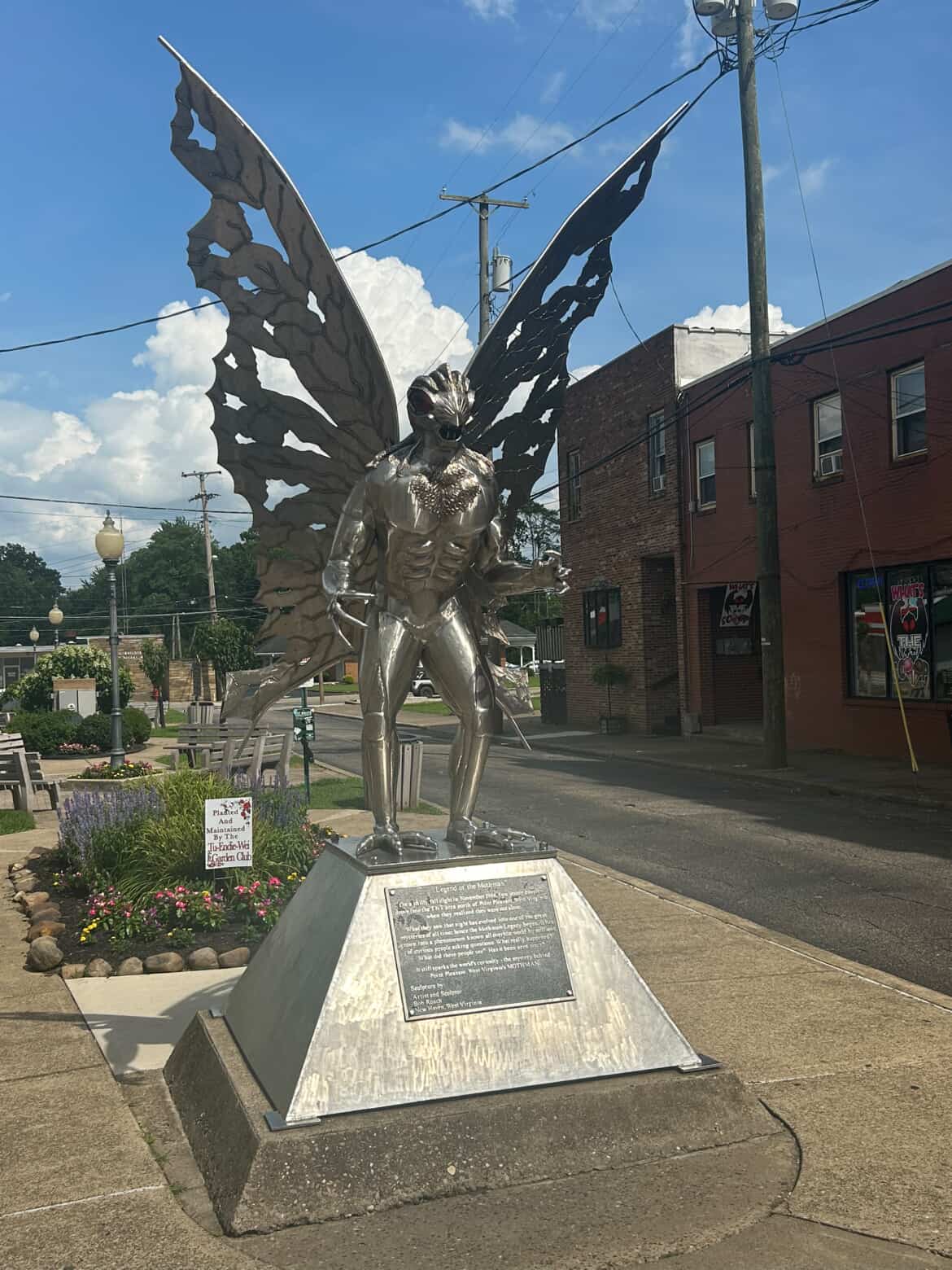
Context · the Mothman statue in Point Pleasant (West Virginia)
Mothman Statue 2025.jpg · Wikimedia Commons · CC BY-SA 4.0 · open original
John A. Keel, 'West Virginia's Enigmatic "Bird"' · Flying Saucer Review 14(4), 1968
Special report by John A. Keel in Flying Saucer Review (vol. 14, no. 4, July-August 1968; file 80.FSR in the collection), written after five visits to Point Pleasant from December 1966. It tabulates 26 sightings between November 1966 and November 1967, ten of them near the 'TNT Area', and recounts the Scarberry and Mallette case of November 15, 1966, Deputy Halstead's radio and Thomas Ury's sighting of November 25. It concedes that in three cases (nos. 7, 11 and 15) the witnesses may have seen a large bird, and says the witnesses denied any resemblance to the snowy owl shot at Gallipolis Ferry. Keel ties it to UFOs and the 'Men in Black'.
Flying Saucer Review 14(4), julio-agosto de 1968 (archive.org) · view source
The years in question
The wave began in November 1966 around Point Pleasant, a small West Virginia town on the banks of the Ohio River. According to reports gathered by the local press and county police, several witnesses described a grey winged figure as tall as a man ("about six feet tall", in Mary Hyre's first report), with large widely-spaced red eyes and a considerable wingspan, able to rise almost vertically and to follow a car at high speed. According to John Keel, who interviewed the witnesses from December 1966 and gathered 26 sightings between November 1966 and November 1967, ten of them by the "TNT Area", all agreed that it did not flap its wings; one of them, Thomas Ury, described it on 25 November as about six feet long with an eight-to-ten-foot wingspan. Keel also recorded that in December 1966 a Gallipolis Ferry farmer shot a snowy owl two feet tall with a five-foot wingspan and that the witnesses who went to see it said it in no way resembled what they had seen, though he granted that in three of his cases the witnesses may have seen a large bird. The sighting focus concentrated around the 'TNT Area', a former World War II explosives manufacturing and storage complex, full of abandoned bunkers and surrounded by woods and marshland now a wildlife reserve.
The most cited episode occurred on 15 November 1966, when two young couples driving through the area claimed to have seen a winged creature standing beside the road and to have been chased by it. According to the report by Mary Hyre, the Point Pleasant correspondent, the four said they fled toward Point Pleasant along Route 62 at 100 miles an hour with the creature behind them; according to Keel, they reported it to the police, and deputy Millard Halstead went back to the spot with them without finding it, although his radio then gave out, he said later, a strange sound "like a speeded-up phonograph". The testimony, reported by name in the press, triggered a cascade of reports in the following weeks and drew the attention of paranormal investigators, among them John Keel, whose book 'The Mothman Prophecies' (1975) turned the episode into a national myth by weaving it together with sightings of lights, 'men in black' and omens.
On 15 December 1967, a little over a year after the first sighting, the Silver Bridge, a chain suspension bridge linking Point Pleasant with Kanauga (Ohio), collapsed without warning during rush hour: 31 of the 37 vehicles on it fell, 24 into the Ohio River and seven onto the Ohio shore, and 46 people died. The official investigation determined a strictly structural cause: the fracture of a single link (the 'eyebar 330') by stress-corrosion cracking, an internal defect undetectable in the routine inspections of the era. The National Transportation Safety Board (NTSB) report, adopted on 16 December 1970, attributes the collapse to the fracture of that eyebar.
Even so, the temporal proximity between the creature wave and the bridge tragedy crystallized in popular culture as a relationship of cause or omen: Mothman came to be interpreted retrospectively as a 'harbinger' that had foretold the disaster. Point Pleasant today raises a statue and a museum devoted to the figure, sustaining a local tourist industry. The sources consulted record no verifiable photographic or physical record of the creature; the documentary base is the testimony of the era and the press coverage.
Why it matters
Mothman matters not as evidence of a creature, but as the cleanest case study of how a harbinger narrative is manufactured from a coincidence. Its value is methodological and cultural: it shows the mechanism by which a wave of diffuse sightings, a real and independent tragedy and an influential book retrospectively fuse into a causal relationship the official investigation never supported. The Silver Bridge collapse has a closed engineering explanation: the fracture of eyebar 330 by stress-corrosion cracking; linking it to the creature is an artifact of the human mind seeking meaning in juxtaposition, not a datum of the record.
The strongest explanation of the sightings is the misidentification of a large bird (a sandhill crane, as biologist Robert L. Smith proposed in 1966, or a barred owl, as Joe Nickell argues, whose eyes reflect headlight red and whose wingspan, seen at night beside a wooded area, can look enormous), amplified by the social contagion of reports once the first story reached the press. Added to that is the perfect setting of the 'TNT Area': bunkers, darkness and wildlife. The case is the folkloric counterpart to the Wow! Signal: if the latter teaches the discipline of demanding repetition, Mothman teaches the discipline of not confusing temporal sequence with causality. The original testimonies survive only in the press of the time and in Keel's interviews. It shows how to treat the narrative layer that grows over facts.
What's left on paper
Documented evidence
- Local press reports and statements to Mason County police (Nov 1966 - Dec 1967)
- Dated 15 November 1966 testimony of two couples claiming to be chased by the creature near the 'TNT Area'
- Documented collapse of the Silver Bridge on 15 December 1967, with 46 fatalities
- Official report attributing the collapse to the fracture of 'eyebar 330' by stress-corrosion cracking (unrelated to sightings)
- John Keel's book 'The Mothman Prophecies' (1975), which cemented the harbinger-disaster association
- The sources consulted record no verifiable photographic or physical record of the creature
Sources
- Wikipedia — Mothman
- Wikipedia — Silver Bridge (collapse and eyebar-330 investigation)
- NTSB Safety Compass — 'The Silver Bridge Collapse: Don't Blame the Mothman!' (2017)
- Asher Elbein, «Is the Mothman of West Virginia an Owl?», Audubon (26 oct 2018) — Covers Joe Nickell's barred-owl hypothesis and Robert L. Smith's sandhill-crane hypothesis (1966).
- AP, 'Monster Bird With Red Eyes May Be Crane', Gettysburg Times (Dec 1, 1966) — Biologist Robert L. Smith's sandhill-crane hypothesis.
- Daniel Reed, 'The Mothman and the Crane: A Contemporary Perspective', Skeptical Inquirer 46(4), Jul-Aug 2022, pp. 52-56 — Proposes a great blue heron where no eyeshine was seen.
- NTSB — Highway Accident Report «Collapse of U.S. 35 Highway Bridge, Point Pleasant, West Virginia, December 15, 1967» (NTSB-HAR-71-1, 1970) — Final report: fracture of eyebar 330 from internal cracks undetectable without disassembly.
- John A. Keel, «West Virginia's Enigmatic "Bird"», Flying Saucer Review 14(4), julio-agosto 1968 — Contemporary field report: witness interviews and a table of 26 sightings between November 1966 and November 1967.
- Mary Hyre, «Winged, Red-Eyed 'Thing' Chases Point Couples Across Countryside» (noviembre de 1966), recorte reproducido en Fortean Times 156 (marzo 2002) — Press clipping of the time: «about six feet tall with wings», red eyes and a 100 mph chase along Route 62.
Entity form (1)
Related cases
same object · same country
Kelly-Hopkinsville
1955 · Tier B
same object · same country
Tremonton film · Navy photographer footage (Utah)
1952 · Tier A
same object · same country
Flatwoods Monster · Braxton County
1952 · Tier B
same object · same country
Lubbock Lights · photographed formation over Texas (USA, 1951)
1951 · Tier A