1994·Near Coulommiers, Paris region
France.Air France 3532 · disc + military radar (GEIPAN)
On January 28, 1994, the crew of Air France flight 3532's Airbus A320 (Capt. Jean-Charles Duboc) observed near Coulommiers a brown-red disc or lens that the steward and co-pilot first took for a sounding balloon; Duboc placed it about 25 miles away and reckoned it nearly 1,000 m across, a figure the official investigation cut to about 200 m. Military radar recorded for about 50 seconds an echo with no flight plan near the aircraft's path, though at a distance and position that do not fully match what the crew saw. GEIPAN classifies the case as "unexplained".
Tier A · AcceptableWhat do they mean? →
Institutional evidence: several identified independent witnesses, or contemporary official documentation, without an instrumental record to corroborate them.
What it was
60%natural or human cause
Most likely explanation: balloon
See the split across the six explanations
Natural or human cause
No known cause
Quote in the original language
«Le steward et le copilote identifient, d'emblée, l'objet comme étant un ballon sonde»Primary documents
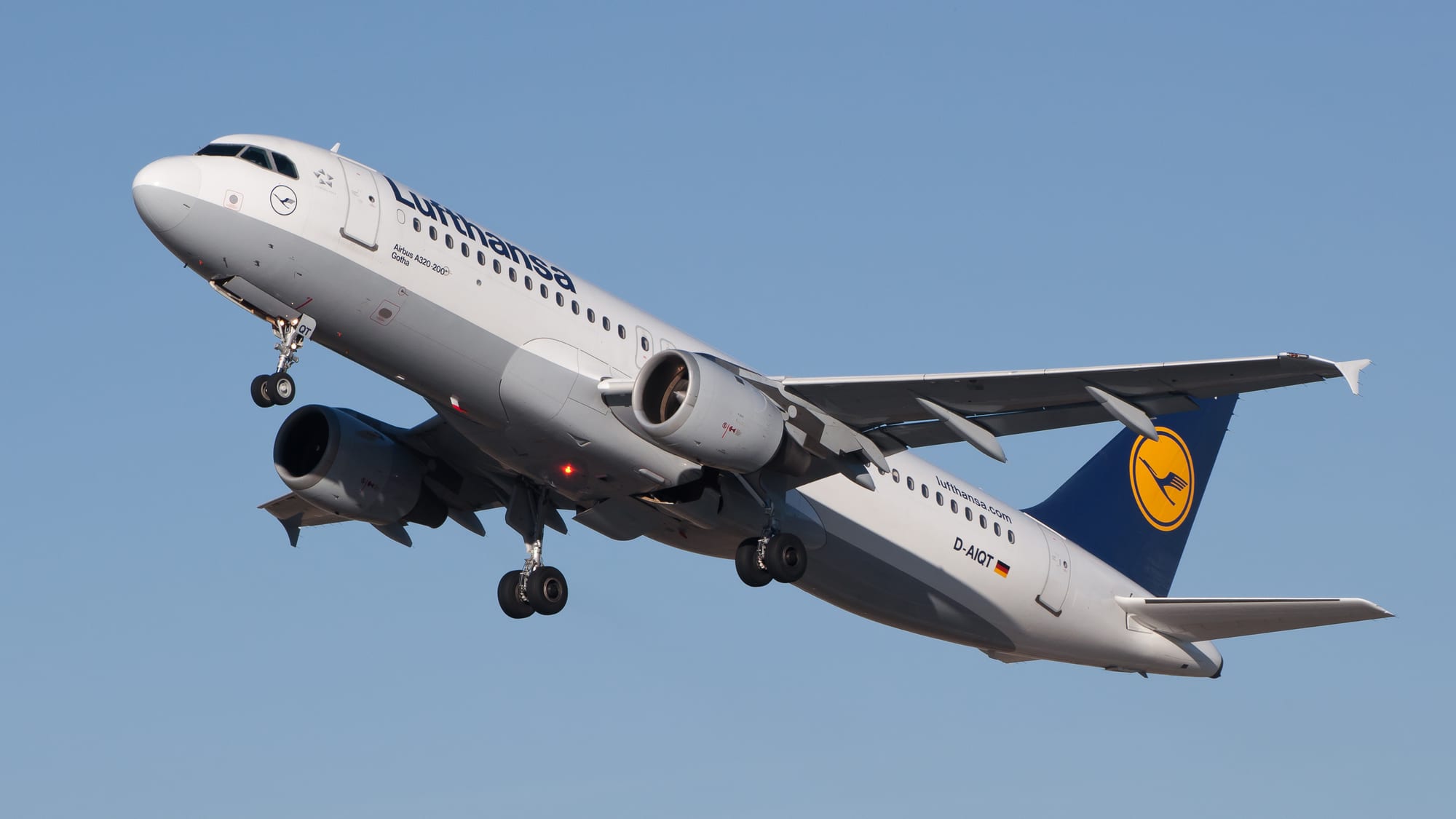
Context · an Airbus A320, the aircraft type of Air France flight 3532
Lufthansa Airbus A320-211 D-AIQT 01.jpg · Wikimedia Commons · CC BY 4.0 · open original
'UFO's and Defense: What Should We Prepare For' — COMETA report (1999) + Carol Rosin letter
'Les OVNI et la Défense: à quoi doit-on se préparer?' is the roughly 90-page report published in July 1999 by COMETA, a private committee of retired French generals and senior officers and aerospace experts, chaired by General Denis Letty and including several former IHEDN auditors. It reviewed cases with radar, interceptions and qualified witnesses, among them Air France 3532 and Bariloche, and concluded that for a residue of about 5% the extraterrestrial hypothesis was the most rational. It is not a document of the French government or the Ministry of Defence, and its conclusion is an argument by elimination over already known cases, not new evidence. The copy embedded here includes a letter from Carol Rosin.
NASA (PURSUE Release 01) · Public domain · US Government work · open original
The night in question
On January 28, 1994, Air France flight 3532 (from Nice toward London) was flying over the Paris region in an Airbus A320. Around 13:13, cruising at about 11,700 m with excellent visibility and a layer of altocumulus over the Paris region, three people in the cockpit (Captain Jean-Charles Duboc, co-pilot Valérie Chauffour and a steward) saw an object in the sky. According to Duboc's own account, the steward saw it first and exclaimed "A sounding balloon!"; the co-pilot also took it at first for a sounding balloon, and Duboc for an aircraft banking at 45 degrees. Duboc placed it at about 10 o'clock, some 25 nautical miles (46 km) away and at about 10,500 m, almost directly above Paris: a brownish-red disc with slightly fuzzy edges, no wings or engines, which he estimated at nearly 1,000 m across and 100 m thick, and which they could see from several angles for almost a minute. As they left it behind on the left, he said, it "became transparent and disappeared without moving". The co-pilot saw it blur and turn into a "chevron" shape, and unlike Duboc, who thought it almost stationary, she felt it moved at the aircraft's speed, always on the left. The crew radioed the Reims regional control centre to ask for radar data; they filed no report at the time, and Air Defence unsuccessfully asked the captain to make a statement to the gendarmerie.
The Air Defence operations centre at Taverny kept a radar track initiated by the Cinq-Mars-la-Pile detection centre, with no flight plan, near the A320's path, which only became public in 1997 through Paris-Match; that article finally led Duboc to write his report. Investigating the case from 1999, SEPRA (GEPAN's successor) found that the echo had been picked up by the azimuth radar but not the height-finder, that it moved at about 200 km/h, then 150 and then zero, that its size was estimated at 200 to 300 m, and that it vanished after about 50 seconds, not reappearing on the radar's next sweep, coinciding with the moment the crew said the object disappeared. According to Jean-Jacques Velasco, these checks ruled out a sounding balloon. The same analysis reduced the size: the apparent diameter Duboc gave, half the Moon's, amounts to about 200 m at 25 miles and about 90 m at 11.
GEIPAN, the CNES's official unit for unidentified aerospace phenomena, keeps the case in its inventory classified as 'unexplained' (file 1994-01-01345). The COMETA report (written by former senior French officers and experts and published in 1999) highlighted it as an example of extraordinary maneuvers and speeds.
The visual-radar correlation is not perfect: Duboc's own diagram places the visual object 25 miles away and the radar track one mile from the aircraft, some published diagrams put the track on the right while the crew saw the object on the left, and the geometry Duboc described (from 10 to 8 o'clock while the aircraft covered 11 miles) implies the object was about 11 miles away or moving at about 420 knots, which does not match the echo's 180 km/h. All this casts doubt on whether the echo and the visual object are the same thing. Skeptic Éric Maillot, relying on the fact that the steward and co-pilot identified it at once as a sounding balloon, proposed a sunlit balloon that stops reflecting once the aircraft passes it: it would explain the diffuse lenticular mass and the apparent 'disappearance' through a change in illumination angle, though it fits the reported shape change less well.
Why it matters
The distance and side discrepancies between the radar echo and the visual position weaken the claim that both record the same object; and a balloon, which two of the three witnesses named first and which SEPRA considered excluded, remains on the table. That GEIPAN keeps it as 'unexplained' does not mean 'inexplicable': it means the agency found no conventional attribution covering all elements.
It is also a useful corrective to a common error: treating 'radar-confirmed' as a binary seal of authenticity. Radar returns are themselves interpretive artifacts (they can register weather, chaff, anomalous propagation or genuine traffic) and a temporal coincidence with a visual event is suggestive but not proof of identity, especially when the geometry does not line up. What is on record is that a professional crew saw something they could not identify, an independent military system recorded an echo that ended when the sighting did, and a state agency, after due review, declined to attribute it.
What's left on paper
Documented evidence
- A320 crew (Capt. Jean-Charles Duboc): brown-red disc or lens; the steward and co-pilot first took it for a sounding balloon; Duboc estimated nearly 1,000 m, SEPRA about 200 m.
- Military radar track of about 50 s (initiated at Cinq-Mars-la-Pile, kept at Taverny), azimuth only, no height; Duboc placed the visual object at 25 miles and the track passed at one mile.
- GEIPAN (CNES) classifies the case as 'unexplained' (file 1994-01-01345).
- Cited as a prime example in the COMETA report.
Sources
- GEIPAN / CNES — inventario oficial (caso 1994-01-01345, Coulommiers)
- Air France 3532 (28 ene 1994) — track de radar (documentación ufológica) — Secondary source: compares the published diagrams of the radar track and their discrepancy with the visual object's position
- GEIPAN (CNES) — case file 1994-01-01345, with the SEPRA investigation report, the gendarmerie statement and the air-defence centre's chronology — The official French file; link only (© CNES).
- RR0 — Duboc dossier: interview with Captain Duboc (UFOCom, 22 Nov 1999) and SEPRA investigation according to Velasco (2004) — The pilot's first-person account and SEPRA's radar and size data
- Maillot, É. — «OVNI : Quand des scientifiques trompent le public» (VSD dossier), Cercle Zététique (in French)
- Informe COMETA 'Les OVNI et la Défense' (1999), traducción inglesa «UFOs and Defense: What Should We Prepare For?» — copia de archive.org (sustituye a la de CUFOS, retirada en oct 2026) — Primary document (complete English translation, 83 pp.).
Related cases