2013·Aguadilla, Puerto Rico
Puerto Rico, U.S..Aguadilla · a customs plane films an object on infrared
On the night of April 25, 2013, a U.S. Customs and Border Protection plane filmed with its infrared camera, for nearly three minutes, a small object that appears to cross Aguadilla airport, enter and leave the sea and split in two. A 2015 civilian analysis called it unexplained; the Argentine Air Force and the Pentagon's UFO office (AARO) concluded they were two small wind-borne objects whose apparent speed came from perspective, and according to AARO they never entered the water. As of April 2025, AARO had not answered the technical questions the civilian coalition sent it.
Tier S · SolidWhat do they mean? →
Strong evidence: a contemporary instrumental record (radar, sensor, film or photo of known provenance) that corroborates several independent witnesses.
What it was
73%natural or human cause
Most likely explanation: balloon
See the split across the six explanations
Natural or human cause
No known cause
Record of the event
'Puerto Rico Objects' — original CBP FLIR footage: air-water crossing and split into two objects (Apr 26, 2013)
US Customs and Border Protection, vía DVIDS · Public domain · US Government work · open original
What happened
On the night of April 25, 2013 (the 26th in UTC, the date AARO uses), a US Customs and Border Protection (CBP) DHC-8 carrying a Wescam MX-15D thermal camera for maritime patrol took off at 21:16 from Rafael Hernández Airport in Aguadilla, on the far northwest tip of Puerto Rico. According to the account in the civilian report by the Scientific Coalition for Ufology (SCU) (relayed by a secondary witness, because the pilot would not speak to the authors directly) the pilot saw a pinkish or reddish light over the sea to the northwest moving toward the airport; he checked with the tower, which confirmed seeing it without knowing what it was, and as the light neared the coast it went out. From then on the object was followed only with the infrared camera; the onboard radar, per the same witness, did not pick it up. The same report records, secondhand, that another CBP pilot had seen a formation of pinkish or red lights very low over the airfield 15 to 30 minutes earlier.
The video runs 3 minutes 54 seconds, 2 minutes 56 of which show the object. In the SCU's reading, it arrives from the ocean, crosses the airport's airspace twice, returns to the Atlantic, appears to submerge and re-emerge several times and at one point splits into two parts that travel together. In the image, in black-hot mode, the object appears warmer than the surrounding air, though less so than the engines of vehicles in the video. That night the wind was from the east at 8–13 mph at the surface and from the east-northeast at 12–18 mph between 400 and 3,200 feet, according to the data the SCU report itself cites.
A researcher connected to the team received a copy of the original file on October 20 or 21, 2013 from an acquaintance of the crew. The SCU report, signed by Robert Powell, Morgan Beall, Daina Chaviano, Larry Cates, Carl Paulson and Richard Hoffman and dated 2015, split the video into 7,027 frames and estimated a size of three to five feet, airborne speeds of 40 to 120 mph (median about 80 mph) and an average of 82.8 mph under water with no appreciable deceleration on entry. Using FAA radar data obtained under FOIA from the Air Force's 84th RADES squadron, it validated the aircraft's track and found returns without transponders over the sea two to three miles north and northwest of the airport. The military radar at Punta Borinquen, beside the runway, was denied under FOIA, and according to the tower manager the recordings and logs are destroyed after 90 days. The report concluded that no bird, balloon, aircraft or known drone had those capabilities. For eleven years the video circulated with no official version; AARO published it on DVIDS in November 2024 together with its own resolution.
Why it matters
For a decade it was cited as an example of an unidentified submerged object (USO): a long government-origin infrared video, with on-screen position metadata, that seemed to show an air-to-water transition and a split into two. Three different teams (one civilian, one from a foreign air force and one from the U.S. government) reconstructed it quantitatively with explicit methods, something very few UAP videos have, and one can compare where they diverge, whichever reading is right.
The first official counter-analysis was signed by Commodore (ret.) Rubén Lianza, of the Argentine Air Force's aerospace phenomena commission (CEFAE, now CIAE), in its 2017 annual report, with an annex by engineer François Louange (IPACO software). It holds that the object is two heart-shaped hot-air lanterns tied together, carried by the east-northeast wind, that the "submersion" is an illusion of perspective and signal loss (the object also fades over land with no trees in front of it) and that at the end the lanterns burned out and fell into the sea. It identified as a possible origin the weddings on the beach at Villa Montana, upwind; its manager confirmed such lanterns were released there until 2015, though he could not confirm the date. There is a weak point in its own file: Louange's annex warns that transverse velocity "can by no means be assessed" without assuming the object was close to the ground, and the 3.9-nautical-mile distance that places it over land in frame 01:24:44 is obtained by assuming a one-meter lantern. The CIAE's 2025 report extended the analysis (four lobes visible in one frame, two balloons from the start) and classed it as a "Type B" case on the GEIPAN scale: explained with solid grounds, without absolute proof.
AARO reached the same conclusion on its own. According to the slides its director presented to the Senate in November 2024 and the DVIDS release notes, the office, with Intelligence Community partners, assesses "with high confidence" that the object showed no anomalous speeds or behavior: they were two objects flying together, not one splitting; the apparent split comes from the changing view angle of the sensor; the apparent speed from motion parallax; the fading from thermal crossover; and the trajectory reconstruction shows they travelled in a straight line to the southwest at about 3.6 meters per second, the speed of the 7-knot east-northeast wind, descending to about 200 meters, over land for the whole observation and never entering the water. It is, in essence, the Argentine thesis, with the aircraft's own trajectory data; it differs on the ending, since Lianza has the lanterns fall into the sea while AARO keeps them over land to the end.
The disagreement is not entirely closed. Before April 2025 the SCU sent AARO specific technical questions about what it calls its "sky lantern hypothesis" (the three-dimensional reconstruction with coordinates and error margins, the source of the cloud layer at 3,000 feet, whether tower logs or military radar data existed, the pixel analysis of the pass beside a utility pole), and AARO replied that it was not currently prepared to answer them, though it might address them in a future follow-up report; as of April 2025, AARO had not answered them. Its original report also holds that the object briefly disappears behind a tree, which would put it below 40 feet, and the transponder-less radar returns north of the airport have not been explained by anyone. But the weight of evidence has shifted: two independent reconstructions, one using the aircraft's geometry, agree on passive objects drifting with the wind, and a pinkish light that goes out as it nears the coast is what one would expect of a lantern. Except that the secondhand account (SCU 2015 report, p. 8) places it over the sea to the northwest, heading south toward the airport and higher than the aircraft, which was flying at 1,600 to 2,100 feet, and that does not sit naturally with a lantern drifting from Villa Montana, to the east-northeast, on an east-northeast wind. What AARO has not documented in public remains open.
Documents and sources
Primary documents
Digital reconstruction (Systems Toolkit) of the flight path supporting AARO's resolution
AARO / socio de la comunidad de inteligencia, vía DVIDS · Public domain · US Government work · open original
Documented evidence
- Infrared video from the Wescam MX-15D camera of a CBP DHC-8, 3 min 54 s (2 min 56 s showing the object), 25 Apr 2013 local time; published by AARO on DVIDS in 2024
- Pilot's account, relayed by a secondary witness: a pinkish or reddish light over the sea that the tower also saw and that went out as it neared the coast; the onboard radar did not pick it up
- FAA radar data (84th RADES, via FOIA): transponder-less returns two to three miles north and northwest of the airport; the Punta Borinquen military radar was denied
- SCU report (Powell and five other authors, 2015): three to five feet, 40–120 mph airborne, apparent submersion and split; concludes it is unexplained
- CEFAE 2017 and CIAE 2025 (Argentine Air Force): two heart-shaped lanterns carried by the wind that end up falling into the sea, "Type B" case; the distance that places it over land assumes a one-meter object
- AARO 2024, "high confidence": two objects at wind speed (3.6 m/s) in a straight line, over land, never entering the water; as of April 2025 it had not answered the SCU's technical questions
Sources
- Scientific Coalition for Ufology — '2013 Aguadilla Puerto Rico UAP' (Powell, Beall, Chaviano, Cates, Paulson and Hoffman, 2015) — Full civilian analysis, 162 pages: witness accounts, RADES radar data obtained under FOIA, size and speed calculations. Not a peer-reviewed publication.
- DVIDS — 'Puerto Rico Objects', original CBP FLIR footage — Video embedded in this case's viewer, published by AARO on 19 Nov 2024 with its summary of findings.
- DVIDS — digital trajectory reconstruction (Systems Toolkit) — Video embedded in this case's viewer; supports AARO's resolution.
- AARO — slides presented to the Senate Emerging Threats Subcommittee (19 Nov 2024), 'The Puerto Rico Object' — Findings with "high confidence", 3.6 m/s speed, 7-knot wind, descent to ~200 m and 50% cloud at 3,000 feet.
- AARO — Puerto Rico UAP Case Resolution (informe oficial de resolución de caso) — Full report; the aaro.mil domain is not reachable from the review environment, so this record's figures come from the Senate slides and DVIDS.
- Scientific Coalition for UAP Studies — announcement on AARO's investigation of the Aguadilla video (28 Apr 2025) — Announcement of 28 Apr 2025: lists the five technical questions sent to AARO about its "sky lantern hypothesis" and its reply that it is not currently prepared to answer them, though it may in a future follow-up report.
- Argentine Air Force, CEFAE — 2017 annual case-resolution report (Aguadilla case, pp. 52-67, with F. Louange's IPACO annex) — Official analysis by Commodore (ret.) Rubén Lianza; concludes that the lanterns burn out and fall into the sea (p. 64). CC BY 4.0 license.
- Argentine Air Force, CIAE — 2025 annual report (updated Aguadilla case, p. 104 ff.) — Two hot-air balloons and a parallax illusion; "Type B" conclusion.
Context (not images of the event)
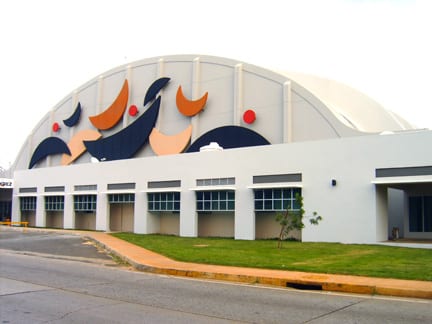
Context · Aguadilla Airport (Puerto Rico), where a CBP camera filmed the object
Aguadilla airport.jpg · Wikimedia Commons · Public domain · open original
Referenced by 1 case
Related cases
same object · same period
Al Taqaddum · a surveillance blimp films something floating
2017 · Tier A
same object · same period
Etna · a drone films something that seems to cross the plume
2018 · Tier A
same object · same period
Atlantic · the crew likens the object to a balloon
2020 · Tier A
same object · same period
Northeastern U.S. · residents film spherical lights at night
2021 · Tier A
Associated actors (1)