1979·Treviso · 14° Gruppo, 2° Stormo
Italy.Cecconi G-91R · Treviso
On the morning of 18 June 1979, Warrant Officer Giancarlo Cecconi, flying a Fiat G-91R reconnaissance jet of the 2nd Stormo, was sent, by his 1994–95 account, to identify an object the Istrana radar had detected near Treviso-Sant'Angelo, and photographed it: a dull black cylinder five to eight metres long.
Read the rest of the summary
In 1984 the Ministry of Defence wrote to ufologist Antonio Chiumiento that its photo-interpreters had identified it as a cylindrical balloon of black plastic bags; but in 1986 the official extract by the Aeronautica's General Staff listed it as "unidentified", and the 2023 catalogue records it under the generic label O.V.N.I.
Tier S · SolidWhat do they mean? →
Strong evidence: a contemporary instrumental record (radar, sensor, film or photo of known provenance) that corroborates several independent witnesses.
What it was
62%natural or human cause
Most likely explanation: balloon
See the split across the six explanations
Natural or human cause
No known cause
Quote in the original language
«inequivocabilmente identificato dal personale fotointerprete in un pallone di forma cilindrica realizzato con sacchi di plastica nera»Primary documents
Italian Air Force — the 18 June 1979 entry in the 1972–1990 sightings catalogue (2 pp.)
Extract (pp. 98 and 106 of 227) of the catalogue 'Avvistamenti oggetti volanti non identificati' of the Italian Air Staff, General Security Department, published in 2023 on aeronautica.difesa.it: the 1979 title page and June's entry no. 8. The entry records Treviso, 18/06/1979, 'mattina, non precisato' (morning, time not specified); cylindrical shape, black colour; speed and direction not stated; altitude about 3,000 m; clear sky; reported by Aeronautica Militare personnel. Under 'riscontri' it says that, after reviewing the archived data, the event was catalogued as a UFO. It does not name the pilot or mention photographs or radar.
Aeronautica Militare (aeronautica.difesa.it) — Archivio OVNI, periodo 1972–1990 · Official act of the Italian public administration, excluded from copyright (Law 633/1941, art. 5) · open original
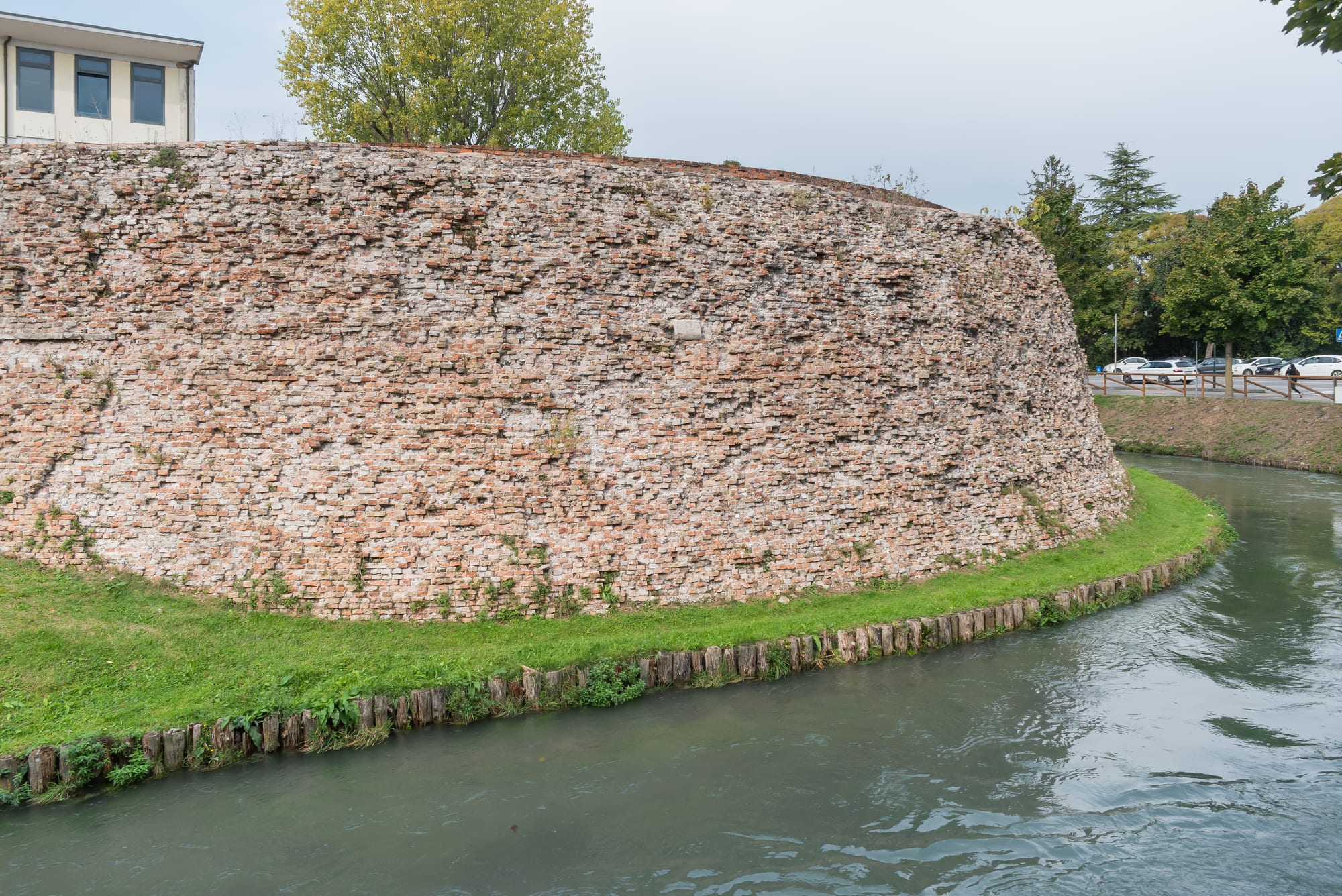
Context · Treviso (Italy), base of the 2° Stormo whose pilot chased the object
Walls of Treviso (1).jpg · Wikimedia Commons · CC BY-SA 4.0 · open original
The night in question
On 18 June 1979, around 11:30 in the morning according to later accounts, Warrant Officer (Maresciallo) Giancarlo Cecconi, of the 14th Gruppo of the 2nd Stormo of the Italian Air Force, was returning to his base at Treviso-Sant'Angelo after a photo-reconnaissance mission when the tower asked him to contact the Istrana radar centre, which had detected an object over the airfield area. Cecconi was flying a Fiat G-91R reconnaissance aircraft with four VINTEN cameras (one forward, two lateral and one ventral), the same ones he had used on his mission, and he still had film left.
The official record from the time that is public today is minimal. The 1972–1990 sighting catalogue that the Aeronautica Militare published in 2023 devotes a single entry to the case: Treviso, 18/06/1979, "morning, not specified", shape "cylindrical", colour "black", speed and direction "not indicated", altitude "about 3,000 m", clear sky, reported by Aeronautica Militare personnel. Everything else comes from Cecconi's testimony, first gathered by ufologist Antonio Chiumiento of the Centro Ufologico Nazionale and published in Flying Saucer Review in 1988, and in interviews in 1994 and 1995. The most detailed reconstruction is Marco Orlandi's for the CISU's AIRCAT project, based on in-person interviews with Cecconi in September 1994 and a telephone conversation on 2 August 1995. According to it, Cecconi switched on all four cameras and flew past the object at about 300 knots, as close as 70 to 80 metres: he made seven or eight passes and collected 82 frames. When he began, the object was at about 7,000 feet (some 2,100 metres); it then climbed and descended in steps of about a thousand feet until it reached roughly 13,000 (some 3,900 metres). Relative to his passes it seemed practically motionless, but the Istrana radar centre told him it was in fact moving "on a definite course and at a definite speed", and the pilot had the impression that it turned so as never to show him its side. The Treviso tower, whose staff were following it through binoculars, radioed that a "bluish trail" was coming from the object, which he, although so close, did not see. He described it as a dull black "fuel tank", about 8 metres long and 2.5 or at most 3 in diameter, with a kind of whitish "cupoletta", more a fairing than a dome, on its slightly flattened top; other versions, such as the 1995 interview, give about five metres by one and a half. He insisted that it did not shake as the jet passed beside it and that it "was not plastic and did not look like an inflatable balloon". As he turned for another pass, Istrana told him the return had vanished from the screen between two sweeps, and a few seconds later the tower reported it could no longer see it. The passes, the climbs and the trail are therefore not late embellishments: they are in the account Cecconi himself gave his interviewers, with the trail attributed to the tower rather than to him.
The official explanation came in 1984 and should be quoted precisely. Deputy Giancarlo Abete filed a parliamentary question on 13 July 1984 (the date given by the Centro Ufologico Nazionale letter of 24 August that cites it; Orlandi's text says 10 July), and in its answer Defence stated that UFO data could be consulted through the minister's Cabinet office. On the strength of that answer, Chiumiento asked on 24 August for Cecconi's photos and for the ministry's opinion on the case, which the magazine Domenica del Corriere published in its 1 September issue. The ministry's reply, dated 2 November 1984, stated that the object had been photographed edge-on and "unequivocally" identified by the photo-interpretation staff as a cylindrical balloon made of black plastic bags. In April 1985 the weekly Epoca (Remo Guerrini, "UFO rapporto segreto") was allowed to see the Aeronautica dossier and published frames. On 17 February 1986, however, the Aeronautica's General Staff released an "Estratto degli avvistamenti degli oggetti volanti non identificati" covering March 1979 to April 1985, and in it the case was listed as "unidentified", despite the "unequivocal" identification of two years earlier. One of the photos, released in 1995 by the newspaper La Tribuna di Treviso, shows a dark cylinder with blunt ends hanging above the airfield runway.
The prosaic reading is serious, though less settled than the 1984 letter suggests. In 1979 "UFO solari" were sold in Italy: toy balloons shaped like a black plastic tube several metres long, filled with air, which rise when the sun warms them. Cecconi himself said that his first thought was that it was one of them, before he ruled it out. The cylindrical shape, the dull black colour, the apparent stillness relative to the jet's passes and a movement on a constant course and speed, like something drifting with the wind, fit that kind of balloon. Against it stand the judgement of an experienced pilot who had it 70 to 80 metres away, his insistence on the object's rigidity and the small white dome he described, and the fact that the original dossier and most of the frames have never been published. Orlandi's reconstruction adds concrete objections: the period "UFO Solar" measured about 3 metres by 70 centimetres and carried its name in large letters on its side, against the 8 by 3 metres and the absence of lettering Cecconi reported; a very thin plastic balloon hardly gives a radar return; the wake of a jet at 80 metres did not disturb it; and the thousand-foot climbs and descents up to 13,000 feet fit a drifting balloon less well. The 2023 catalogue entry does not mention the 1984 identification and classifies the event as O.V.N.I.; but the same label covers 201 of the catalogue's 208 events, so it means the archive holds no explanation, not that the Aeronautica has withdrawn the 1984 one; though the 1986 extract shows that its own record already treated it as unidentified back then.
Why it matters
It brings together military camera photography and an object seen at close range by a named pilot; the radar return is known only from what the pilot said in 1994 and 1995. What the published official record supports is little and also contradictory: one line in the Aeronautica catalogue (a black cylinder at about 3,000 metres, with no speed or direction), a 1984 ministerial identification as a plastic balloon and a 1986 General Staff extract that lists it as unidentified. What supports the anomalous version is the pilot's testimony, gathered in person by Orlandi, with seven or eight passes, climbs from 7,000 to about 13,000 feet and a radar giving him a definite course and speed, set against a photo that, seen today, looks very much like a black tube solar balloon.
Cecconi matters above all as a methodological test case. It shows how a concrete but terse official explanation, without publication of the photo-interpretation behind it, leaves room for doubt, especially when another document from the same administration lists the case as unidentified. It also illustrates a limit of official catalogues: the O.V.N.I. label in the Aeronautica archive is applied to almost everything, so it cannot be read as a verdict of anomaly. The open question is testable: if the Aeronautica released the 80 frames and the photo-interpretation report, the object's shape, seams and behaviour would confirm or rule out the balloon. Until then, the black plastic balloon hypothesis remains the leading one, but with a wide margin of uncertainty owing to the pilot's testimony, the radar and the 1986 classification.
What's left on paper
Documented evidence
- Entry no. 8 for June 1979 in the Aeronautica Militare's 1972–1990 catalogue: Treviso, 18/06/1979, morning, cylindrical, black, speed and direction not indicated, about 3,000 m, clear sky, reported by military personnel; labelled O.V.N.I. (the same label given to 201 of the catalogue's 208 events)
- Deputy Giancarlo Abete's parliamentary question (13 Jul 1984, per the CUN letter of 24 Aug 1984) and the Ministry of Defence letter to Antonio Chiumiento (2 Nov 1984): object "unequivocally" identified by photo-interpreters as a cylindrical balloon made of black plastic bags
- About 80 photos (82 frames by the most cited figure) from the G-91R's VINTEN cameras; Epoca saw the dossier and published frames in April 1985; one photo, released by La Tribuna di Treviso in 1995, shows a dark blunt-ended cylinder above the runway
- Cecconi's testimony as reconstructed by Marco Orlandi (CISU/AIRCAT, interviews of Sep 1994 and Aug 1995): seven or eight passes at 70–80 m, 82 frames, an object about 8 m by 2.5–3 m with a small whitish "cupoletta", which climbed from about 7,000 to about 13,000 feet; it seemed still relative to his passes, but the Istrana radar told him it was moving "on a definite course and at a definite speed"; the return vanished between two sweeps
- The Treviso tower, not the pilot, reported a "bluish trail"; Cecconi himself first thought of a "UFO solare", a black plastic tube toy balloon sold at the time, which according to Orlandi measured about 3 m by 70 cm and carried its name printed on its side
- Aeronautica General Staff, "Estratto degli avvistamenti degli oggetti volanti non identificati" (March 1979–April 1985), released on 17 Feb 1986: the case is listed as "unidentified", after the 1984 ministerial identification
Sources
- Aeronautica Militare — OVNI Archive, 1972–1990 (catalogue published 2023), June 1979 entry — Official primary source: the case's only public entry (p. 106 of the PDF). Cylindrical, black, about 3,000 m, labelled O.V.N.I.
- Aeronautica Militare — OVNI sightings page — Explains that after the 1978 wave the Andreotti government assigned the reports to the Aeronautica, now to the Reparto Generale Sicurezza, and hosts the yearly catalogues.
- Silverland — 'Il caso Cecconi' (reprints Marco Orlandi's CISU/AIRCAT reconstruction and scans of La Tribuna di Treviso, 19 Aug 1995; Epoca, 19 Apr 1985; CUN letter to the Ministry, 24 Aug 1984) — Secondary source with period documents: Orlandi's reconstruction, based on in-person interviews with Cecconi (Sep 1994, Aug 1995), gives the seven or eight passes, the climb from 7,000 to about 13,000 feet, the trail seen from the tower, the radar reporting a definite course and speed, the ministry letter of 2 Nov 1984 and the 1986 General Staff extract listing it as unidentified; the CUN letter cites Abete's question (13 Jul 1984).
- The Black Vault — Cecconi 1979 case file — Secondary source: translation of Noi e gli extraterrestri and UFO Casebook; includes the 1984 ministry quote and the manoeuvres.
- Chiumiento, A. — 'An Italian Pilot's Sighting: And Another Italian Government Cover-Up?', Flying Saucer Review 33 (1), March 1988 — First publication of Cecconi's testimony; not located online.
Related cases
same object · same country
The object that appeared to cross an erupting volcano's plume
2018 · Tier A
same object · same period
Falconbridge · NORAD radar and the Northern Tier wave
1975 · Tier S
same object · same period
Burgos 1970 · the motionless object photographed from the FOAT light aircraft
1970 · Tier A
same object
Cluj · the Emil Barnea photographs
1968 · Tier A