Case No. 404·Chile
2018·Chacalluta International Airport, Arica (Arica y Parinacota region)
Chile.Arica · the light chased by the Carabineros aircraft
On 20 February 2018, at 20:35, the controllers in the tower at Chacalluta airport, in Arica, saw an intense white light over the airfield that matched no traffic. They radioed the Carabineros aircraft C52, which was patrolling the border with Peru; its pilot saw it, turned to close in and lost it. There was no radar echo or transponder. SEFAA, Chile's official office, investigated it and closed it in 2025 as a 'Report' for lack of images, with a drone as its main hypothesis.
Year
2018
Tier
B
Probability
30%
Category
Incident
Limited evidence: single-witness, local or without primary verification. Three independent axes: the «tier» measures the strength of the evidence; the «probability» estimates how genuinely unexplained the case is —a natural phenomenon can remain unexplained, so it does not equal «non-prosaic»—; and the partition of explanations (below) says what it most plausibly was. So a well-documented case can have a possible hoax as its most plausible cause, and a Tier B is not, for that reason, a hoax.
Primary documents · viewer
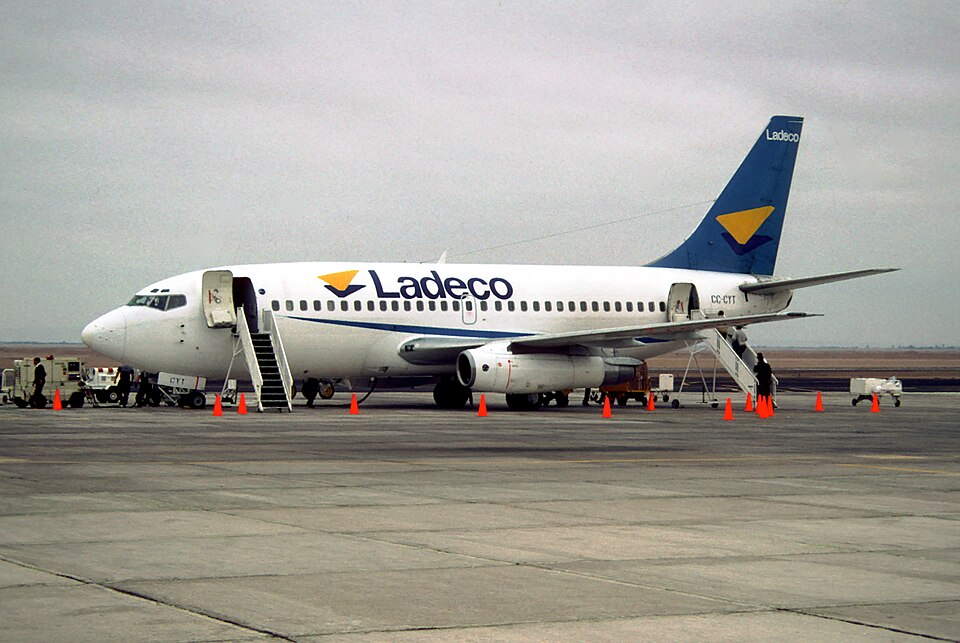
Context · the apron at Chacalluta airport, Arica, in 2000
109ae - Ladeco Airlines Boeing 737-2E1; CC-CYT@ARI;14.09.2000 (5398325424).jpg · Wikimedia Commons · CC BY-SA 2.0 · open original
Part 01
The night in question
On the evening of 20 February 2018 the sky over Arica, in Chile's far north, was clear: the Chacalluta aerodrome's weather reports record a light breeze, no fog or camanchaca and full visibility. At about 20:35 local time, with the Sun already below the horizon, a controller climbing up to the tower saw a light directly over the airport. His colleague at the control position thought it was the Carabineros aircraft patrolling the border area, the C52, visible on the tower's traffic display, which is not a radar. They asked for its position: it was not the aircraft. Chacalluta had no other traffic; commercial flights arrive from the south and, according to the controller, there is usually nothing overhead except the occasional overflight announced from Tacna, in Peru.
The tower then called C52, which had been patrolling the political border with Peru, near boundary marker 10, and was descending from 8,000 feet. The audio, preserved and transcribed by SEFAA, is short. The tower asks for the radial it is crossing; the crew member answers '075'. Then: 'Carabineros 52, I have an unidentified flying object to the left of your position. Are you by any chance able to observe it?'. The pilot replies that he has it in sight, announces a turn to close in and, shortly after, reports that the object moved away and disappeared: 'it was a white light… it could not be identified from this position what it was'. The tower closes: 'yes, we observed it from this position'. The controller would later recall that the light moved slowly from overhead towards the east, towards the mountains, and that when the aircraft turned it lost it 'very fast'. They checked with Iquique control: it did not have it on radar either.
The former CEFAA, now SEFAA, interviewed the witnesses. The C52 pilot, a Carabineros captain who had been his institution's representative to CEFAA itself, gave the most vivid account: a yellowish-white light, large and strong, 'five, six, seven times Venus', which his co-pilot told him to chase and film; while he was reaching for his phone, the light faded or moved off into the sky. He called himself sceptical, but firmly ruled out an aircraft and a flare, and said he did not feel he was getting closer during the chase. He offered the phone video and the flight log, which the investigation never received.
SEFAA published its report in October 2025. It established that the Sun was 6° below the horizon and that Venus, very bright, was almost touching it in the west, at 2.9°, so it could not be what was seen. It noted inconsistencies between the accounts regarding the appearance, the movement and the aircraft's position. Its conclusion is that what was reported could be consistent with an aircraft able to hover, with no transponder and no echo on the Iquique radar, that is, with a small unmanned aircraft or drone; to a lesser extent, with a space phenomenon. With no images to set against the testimony, it closed the case as a 'Report' and added that there had been no danger to air operations.
Part 02
Why this case moved the needle
The Arica case is valuable for its documentation more than for its phenomenon. It has what few recent cases have: a recording of the conversation between the tower and an aircraft in flight, with the word 'UFO' spoken by an on-duty controller; an entry in the tower's log; three professional witnesses —two controllers and a police aircrew— and a published official investigation with transcripts, weather conditions and an astronomical check. All of it was produced and is published by SEFAA, the section of Chile's civil aviation authority that succeeded CEFAA and has been putting its files online since 2024.
It is also a good example of how a serious office handles a case it cannot close. SEFAA does not declare it inexplicable or attribute it to an extraordinary origin: it rules out what it can —Venus, the Sun, known traffic—, notes the contradictions between witnesses, proposes the hypothesis that fits best —a drone without a transponder, invisible to radar— and admits that without images it cannot go further without bias. The 'Report' category means exactly that: there is consistent testimony, but no instrumental evidence to confirm it. The video on the pilot's phone, which never reached the investigation, is the missing link.
For the corpus, the case covers Chile's northern border and joins the long series of airmen's sightings over the Atacama desert that SEFAA itself has resolved, from satellite launches to the lights of squid-fishing fleets. Its partition splits the main weight between a conventional misidentification and an unidentified human device —a drone on the border with Peru, one's own or another's— and leaves a broad undetermined share, because the official hypothesis is plausible but not proven.
Part 03
What's left on paper
Documented evidence
- Transcript of the tower–C52 audio: 'Carabineros 52, I have an unidentified flying object to the left of your position'; the pilot sees it, turns and loses it
- Entry in the Chacalluta tower's log and the air traffic service report
- SEFAA interviews with a controller and the C52 pilot: an intense white light that moved east and was lost when the aircraft turned
- No transponder signal at Arica and no echo on the Iquique radar; clear sky and full visibility
- Astronomical check: Sun 6° below the horizon and Venus at 2.9°, ruled out; closed as a 'Report' with a drone as the main hypothesis
Sources
- SEFAA (Chilean Directorate General of Civil Aviation) — 'Case No. 794', Chacalluta, 20 Feb 2018 (report published 28 Oct 2025) — Primary source: transcript of the tower-aircraft audio, interviews, weather, astronomical analysis and official conclusion.
- SEFAA — Anomalous Aerial Phenomena Study Section (DGAC), official site — Catalogue of cases published by the Chilean office.
Location
Chacalluta International Airport, Arica (Arica y Parinacota region) · -18.35°, -70.34°
Distribution of explanations
This case is classified among the model's hypotheses: the bar splits 100% by how much each explanation weighs (the uncertainty is spread across the hypotheses the case supports). Summed across the corpus they produce the comparable partition. It is a different question from the Probability above: that one estimates how likely the case is a genuinely unexplained phenomenon; this one splits which the explanation would be.
Modal hypothesis: Misidentification 59% · sums to 100%
Confused with: Aircraft
Structured analytical judgment, not a calibrated frequency. Forced classification: the mass the evidence cannot assign is spread across the hypotheses the case does support.
Related cases