Case No. 403·France
1951·Orange-Caritat Air Base 115 (Vaucluse) and the sky over the Hautes-Alpes
France.Orange-Caritat · the silver object chased by two Vampires
On 15 June 1951, at about 11:30, two fighter pilots of the 5th Fighter Wing, on a training flight in Vampires from Orange-Caritat air base, saw a silver, very bright and apparently motionless object towards the Pelvoux massif. As they closed in, it turned oblong and moved off to the east while climbing, faster than their aircraft, until it was lost after a six-minute chase. The base's colonel reported to command with both pilots' accounts. GEIPAN classes it 'D': unidentified.
Year
1951
Tier
A
Probability
45%
Category
Incident
Institutional evidence: multiple verifiable witnesses or official documentation. Three independent axes: the «tier» measures the strength of the evidence; the «probability» estimates how genuinely unexplained the case is —a natural phenomenon can remain unexplained, so it does not equal «non-prosaic»—; and the partition of explanations (below) says what it most plausibly was. So a well-documented case can have a possible hoax as its most plausible cause, and a Tier B is not, for that reason, a hoax.
Primary documents · viewer
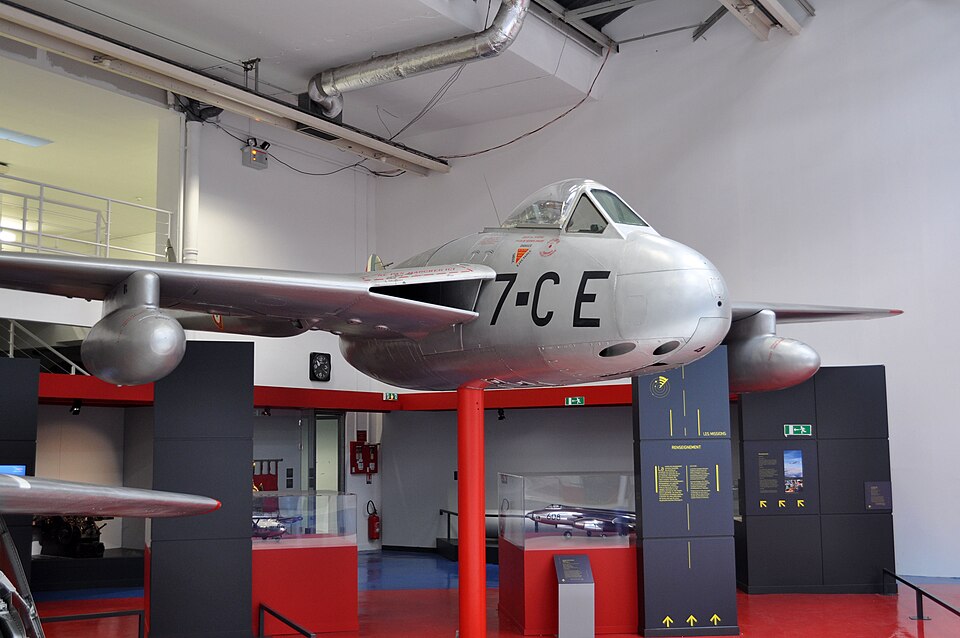
Context · an SE.535 Mistral, the French-built version of the de Havilland Vampire flown by the 5th Fighter Wing
S.N.C.A.S.E. SE.535 Mistral (28479693102).jpg · Wikimedia Commons · CC BY-SA 2.0 · open original
Part 01
The night in question
On the morning of 15 June 1951, a patrol of the 5th Fighter Wing took off southwards from Air Base 115 at Orange-Caritat, in the Vaucluse, for a training flight in de Havilland Vampire jet fighters. The tower logged the take-off at 10:23 universal time. A few minutes later one of the aircraft reported that the green light for its left landing gear was still on: the door had not closed. While the patrol leader ordered it back, the other two pilots —a lieutenant commanding the flight and a sergeant-chef— flew S-turns around it so as not to lose sight of it, at about 6,000 feet and north of the airfield.
In one of those turns the sergeant-chef saw, to his right and somewhat higher, something he took for an aircraft. Looking more carefully he saw it was not moving: it seemed circular or spherical, silver in colour and very bright, with no visible relief. He alerted the lieutenant, who took the lead of the patrol and set course towards the object, on 080, while continuing to climb. For about two minutes the object did not seem to move; as they closed in its round shape was confirmed and its brightness made them take off their sunglasses. At about 10,000 feet the lieutenant had the impression of being level with it: the object stood out south of the Pelvoux massif, at the height of its snowy summits.
Then it changed. In the reports, the object abruptly took an elongated shape and began to move away to the east, climbing at a shallow angle. The pilots chased it on the same heading, at a speed that never fell below 250 knots and climbing to 16,000 feet. The object grew ever smaller; they lost it, it reappeared as a dot on the horizon and vanished completely after some six minutes of pursuit, when the aircraft were over Serres, in the Petit Buëch valley. The lieutenant noted that he never had to change heading from the moment the object began to move.
The colonel commanding the base questioned the two pilots an hour and a half later and, on 19 June, sent their reports to the commanders of the 1st Air Division and the 4th Air Region. He described them as experienced, level-headed airmen without an overactive imagination, and stressed that their accounts were identical. He summarised the observations: an object first motionless and spherical at about 10,000 feet over the Serres-Veynes-Aspres area, then oblong and moving east, with a rate of climb and a horizontal speed greater than the Vampires'. He asked the Hautes-Alpes Gendarmerie to find out whether it had been seen from the ground. On 25 June the general of the 4th Region forwarded the file to the General Staff in Paris under the subject 'strange craft moving in the airspace of Orange-Caritat air base'. The file was retrieved in 1959 from the General Staff archives and is now published by GEIPAN, the French space agency's aerial-phenomena study unit, with the classification 'D': strange and consistent phenomenon, unidentified.
Part 02
Why this case moved the needle
Orange-Caritat is one of the earliest documented French military cases, and it has the advantage of having survived almost intact. The file keeps the two individual accounts, written the same day and before the pilots could compare them in writing, and the synthesis by the colonel who questioned them. The accounts agree on the essentials and differ in reasonable details —who saw it first, at what height each was—, which is what one expects of two real witnesses. Moreover, the case was not manufactured for the press: it moved up the chain of command, from base to region to General Staff, labelled as a technical matter.
The most natural explanation for a silver, bright and apparently motionless object in broad daylight in 1951 is a high-altitude stratospheric balloon: in those years plastic balloons were being launched that, lit by the Sun, look like silver spheres and seem still. Aircraft climbing towards them often have the impression of closing in and then of seeing them move away, because the balloon is much higher and farther than it looks. GEIPAN itself acknowledges that several descriptions suggest a balloon seen from afar, but rejects the hypothesis because one of the pilots describes a rapid departure when he tried to close in. To that must be added the change to an elongated shape and the steady departure eastwards, which a balloon would only reproduce with a strong wind and a perspective effect.
That is why the case enters the corpus with an open partition. A conventional misidentification —a balloon, with the illusion of distance typical of these chases— carries real weight; so does the possibility of an experimental craft, at a time when France and its allies were testing high-altitude balloons and vehicles. But the official French classification is 'unidentified', and the corpus respects it by leaving a broad undetermined share. The case also serves to compare the culture of GEPAN and GEIPAN with that of other bodies: it publishes the full file, explains which hypothesis it evaluated and why it rejects it.
Part 03
What's left on paper
Documented evidence
- Report by the colonel commanding Air Base 115 (19 Jun 1951) to the 1st Air Division and the 4th Air Region, with the synthesis of the observations
- Signed accounts by the lieutenant commanding the flight and the sergeant-chef of fighter squadron I/5 'Vendée' (15 Jun 1951)
- A silver, very bright, spherical object, apparently motionless at about 10,000 feet; then oblong and moving away to the east while climbing
- A chase of about six minutes on heading 080, at no less than 250 knots and up to 16,000 feet, until it was lost over Serres
- Forwarding to the General Staff in Paris (25 Jun 1951); GEIPAN classification 'D', with the stratospheric-balloon hypothesis evaluated and rejected
Sources
- GEIPAN (CNES) — case file '[AERO MIL] Orange (84) 15.06.1951', classification D — Official summary, classification and evaluation of the balloon hypothesis; link only (© CNES).
- GEIPAN (CNES) — file 'PV AERO (1951208633)': General Staff covering note, the BA 115 colonel's report and the two pilots' accounts (9 pp.) — Scanned primary source; the pilots' names are redacted.
Patterns it exhibits (1)
Location
Orange-Caritat Air Base 115 (Vaucluse) and the sky over the Hautes-Alpes · 44.14°, 4.87°
Distribution of explanations
This case is classified among the model's hypotheses: the bar splits 100% by how much each explanation weighs (the uncertainty is spread across the hypotheses the case supports). Summed across the corpus they produce the comparable partition. It is a different question from the Probability above: that one estimates how likely the case is a genuinely unexplained phenomenon; this one splits which the explanation would be.
Modal hypothesis: Misidentification 59% · sums to 100%
Confused with: Aircraft
Structured analytical judgment, not a calibrated frequency. Forced classification: the mass the evidence cannot assign is spread across the hypotheses the case does support.
Related cases