1954·Quarouble, Nord, France
France.Quarouble · Gendarmerie investigation (France)
On September 10, 1954, during that year's great French wave, metalworker Marius Dewilde reported a dark object resting on the railway tracks near Quarouble and two small figures; he said a very bright light dazzled him and, according to other reports of those days, a beam with green glints paralyzed him. The air police went to the site: according to the press of those days, it first found no clue and then described marks at five points on the wooden sleepers and friable ballast, which it sampled.
Tier B · IndicativeWhat do they mean? →
Limited evidence: a single witness, testimony gathered years later, or an account without contemporary primary documentation.
What it was
51%natural or human cause
Most likely explanation: psychological, medical or social cause
See the split across the six explanations
Natural or human cause
No known cause
Primary documents
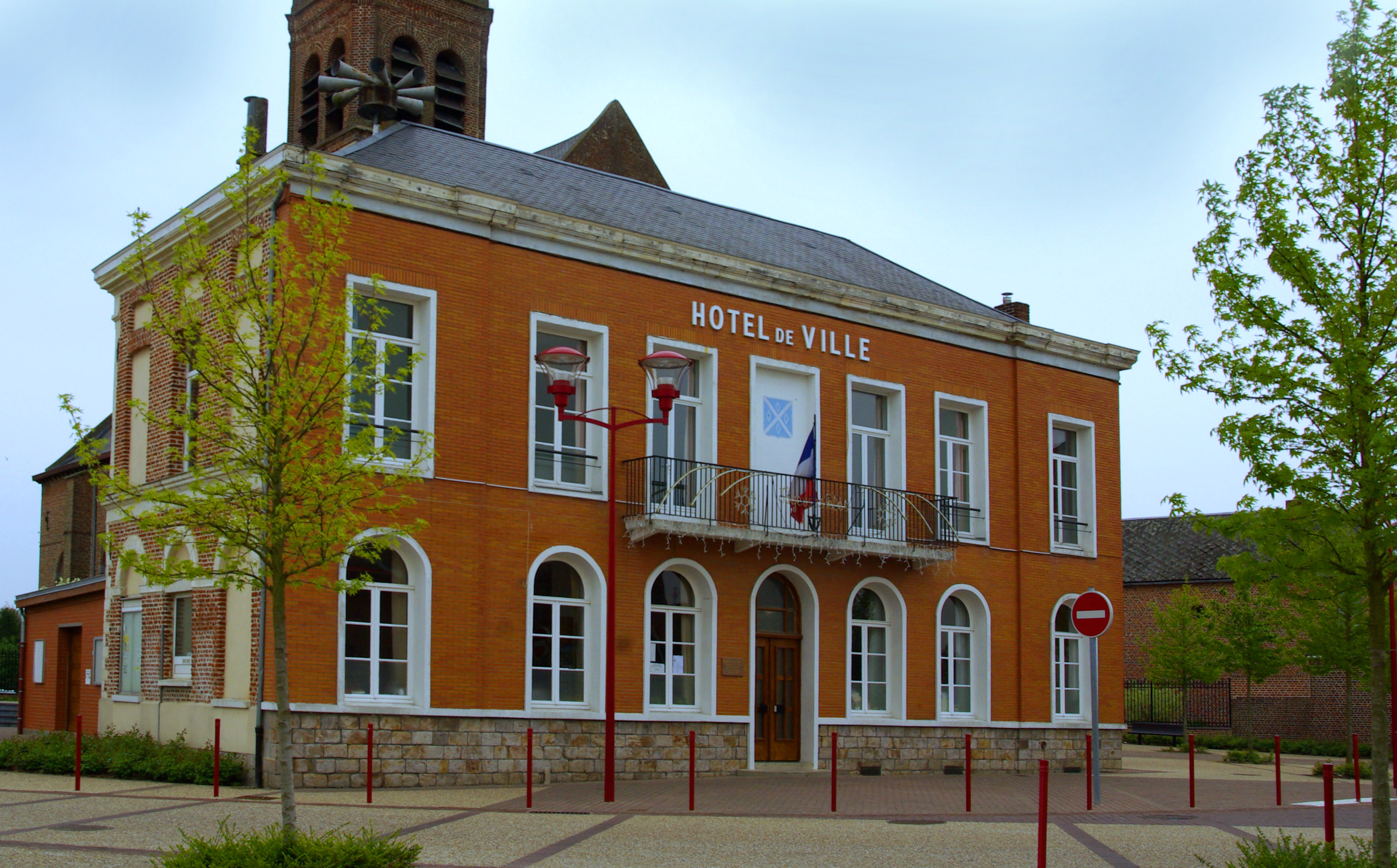
Context · Quarouble (Nord, France)
MairieQuarouble.jpg · Wikimedia Commons · CC BY-SA 3.0 · open original
Regional press of September 1954 on Quarouble (La Croix du Nord, Nord-Matin and others), transcribed by Patrick Gross
The reports of the following days, transcribed from print. La Croix du Nord quotes Marius Dewilde, 34, who lived in the house at level crossing 79: around 10:30 p.m. his dog howled, he went out with a torch, saw a dark shape six metres away that he took for a cart, and two small beings, no more than a metre tall and wearing a kind of diving suit, running towards the craft; it rose after a light 'like a magnesium flash' and left westwards. Dewilde went to the Onnaing police station. The air police, on Saturday afternoon, found no clue giving substance to the story, though a freshly disturbed patch of ballast caught their attention. Nord-Matin prints a photo of Dewilde's wife showing the spot to Commissioner Fouchet. Press under copyright, so it is given as a link.
Patrick Gross, «Les OVNIS vus de près» (ufologie.patrickgross.org) · view source
The night in question
On the night of September 10, 1954, around 10:30 p.m., Marius Dewilde, a metalworker about 34 years old, stepped out of his home in Quarouble (Nord department, near Valenciennes and the Belgian border) upon hearing his dog barking insistently. Flashlight in hand, thinking of a prowler, he went out and, less than six meters from his door, made out a dark mass resting on the track by level crossing 79, which he first took for an abandoned farm cart. According to what he told the press of those days, two short, stocky figures under a meter tall, with an enormous head protected by a kind of glass or plastic helmet, ran past him toward the craft; a door opened, a very bright light dazzled him "like a magnesium flash" and he was "paralyzed by fear"; the craft, some six meters across and three high, oscillated, rose about ten meters and shot off west toward Anzin like a ball of fire. The first reports do not agree: some speak of a light that dazzled him "like a magnesium flash" and left him "paralyzed by fear"; others, such as France-Soir of 13 September, quote Dewilde describing a searchlight with "green glints" whose beam paralyzed him and kept him from shouting. The episode occurred at the start of the great sighting wave that swept France in the autumn of 1954, one of the most intense in the European history of the phenomenon.
Dewilde woke his wife and a neighbor and went to the Onnaing police station, arriving around midnight; according to a later account, the commissioner found a man trembling and suffering intestinal contractions, and ruled out play-acting. The next day an air police commissioner and an inspector went to the site; some papers then said they found no clue supporting his claims. Air gendarmes and, according to the sources, personnel linked to the Air Force and the DST (territorial security) came to the site and took samples. They documented physical marks at the location: depressions and regular marks (described in some reports as a kind of symmetrical 'claws') in the wooden sleepers of the track and disturbances in the ballast, plus stones that appeared charred at the point of the alleged landing. According to the Onnaing police station, the wood had deep impressions at five points which the investigators thought the landing could have made, and ballast samples were taken. The figure of some thirty tons of pressure repeated ever since comes from later accounts, such as Aimé Michel's book. According to a later account, two Onnaing residents, Edmond Auverlotte and a retiree named Hublard, saw around 22:30, the time Dewilde gave, a red glow turning light pink and then white moving across the sky, and three young people leaving a dance saw it from Vicq. The press of those days disagreed about them: one paper noted that the blows could have been made by track workers fitting sleeper screws and that the ballast was a naturally friable clinker, while Franc-Tireur stated that the workers' usual tools could not have made the marks; the police first thought of a smugglers' helicopter, and no footprints were found.
The case has two planes. The narrative core (the object, the two figures, the paralyzing beam) rests on a single witness and belongs to the folkloric/contactee record so characteristic of 1954, without independent corroboration; a skeptic can read it as confabulation, suggestion or invention within a wave of media hysteria. What is anchored by the institutional chain are the marks: the official investigation did happen and documented physical alterations to the track whose cause was not closed. The case is defined by that asymmetry: an institutional anchor (the air police) and a recorded physical trace, over a central account from a single observer.
Why it matters
It helped set off the French wave of 1954 and is an early example of an official investigation, by the air police, with assessment of physical traces, the institutional lineage that would later, through the French gendarmerie's report-taking culture, lead to state bodies such as GEPAN/GEIPAN within CNES. That the French state took a laborer's report seriously enough to send inspectors and collect samples prefigures the (globally uncommon) model of treating sightings as a matter of public record rather than mere folklore.
Its value is precisely that official anchor and the documented marks; its limit, equally important, is that the heart of the account (object + two entities + paralysis) rests on a single witness within the most mediatized wave of the century, when cultural contagion produced dozens of similar reports a week. One must hold both at once: the physical traces exceed a simple optical illusion, but they cannot be conclusively tied to the account that explains them, and the cause of the marks (the real weight of an object versus prior track damage, tampering or coincidence) was never closed. Hence its role as a record rather than a calibration contribution: a historically foundational, institutionally serious, evidentially bounded episode.
What's left on paper
Documented evidence
- Marius Dewilde's report and air police inspection, Sep 10, 1954
- Marks described in the period press: impressions at five points on the wooden sleepers and friable ballast, which was sampled; some papers said the air police found no clue
- The estimate of some 30 tons of pressure comes from later accounts (Aimé Michel), not the 1954 press
- Trigger case of the massive French wave of autumn 1954
- Testimonial core (object + two figures + paralysis) from a single observer
Sources
- Wikipedia — Marius Dewilde (síntesis del caso) — Secondary source (encyclopedia).
- Patrick Gross — «Les OVNIS vus de près: 10 septembre 1954, Quarouble, Nord» (prensa de la época) — Transcribes the French press of September 1954 (La Croix du Nord, Courrier Picard, Franc-Tireur and others).
Entity form (1)
Related cases
same explanation · same country
L'Amarante · the object over a biologist's garden in Nancy
1982 · Tier A
same country · same period
Vernon mother ship · France
1954 · Tier B
same country · same period
Oloron / Gaillac · Angel Hair
1952 · Tier B
same country · same period
Orange-Caritat · the silver object chased by two Vampires
1951 · Tier A
Associated actors (1)