1965·Deception Island, South Shetland Islands (Antarctica)
Antarctica · Deception Island (AR/CL/UK bases).Deception Island · lights over the Antarctic bases (1965)
On July 3, 1965 the Chilean base Aguirre Cerda and the Argentine naval base Decepción, on the same island, reported a multicolored light that moved and stopped; that day, at the Argentine base in the South Orkneys, two meteorologists saw a bluish-white body for 15 seconds while two variometers registered a disturbance. But the attempt to photograph the light failed, the Condon Report found the disturbance within normal daily fluctuations, and a later study attributes the key sightings to a meteor, the Echo II satellite and bright stars or planets.
Tier A · AcceptableWhat do they mean? →
Institutional evidence: several identified independent witnesses, or contemporary official documentation, without an instrumental record to corroborate them.
What it was
74%natural or human cause
Most likely explanation: planet or star
See the split across the six explanations
Natural or human cause
No known cause
Read the full reasoning
The other two key observations of that day have another cause according to the same report: the Chilean base sighting at 19:20, the Echo II satellite "or, in any case", Spica or Arcturus, and the Orcadas one, a phenomenon "comparable to a meteor". The report warns that serious contradictions remain in the data and presents its explanations as the most probable, not as proven.Primary documents
Airgram A-208 from the U.S. Embassy in Buenos Aires, "Celestial Body Observed over Antarctica" (4 September 1965), 1 p.
Confidential airgram, since declassified, sent by the Embassy in Buenos Aires to the Department of State in reply to an inquiry of 16 August; it is signed by Albert Mayio, Counselor for Commercial and Economic Affairs. It points to a Defense intelligence information report of 16 July that translated four messages received by the Argentine Navy Hydrographic Service about unidentified flying objects. It says the Naval Attaché asked the Argentine Navy for more data, but that none is likely until the summer exchange of personnel at the Antarctic stations, and that the La Plata Observatory stated it had no theory on the objects, although it pointed out that they were sighted when the Echo II satellite was orbiting over the Antarctic zone.
Departamento de Estado de EE. UU. (publicado por la NSA en su colección sobre ovnis; espejo de archive.org) · Public domain · US Government work · open original
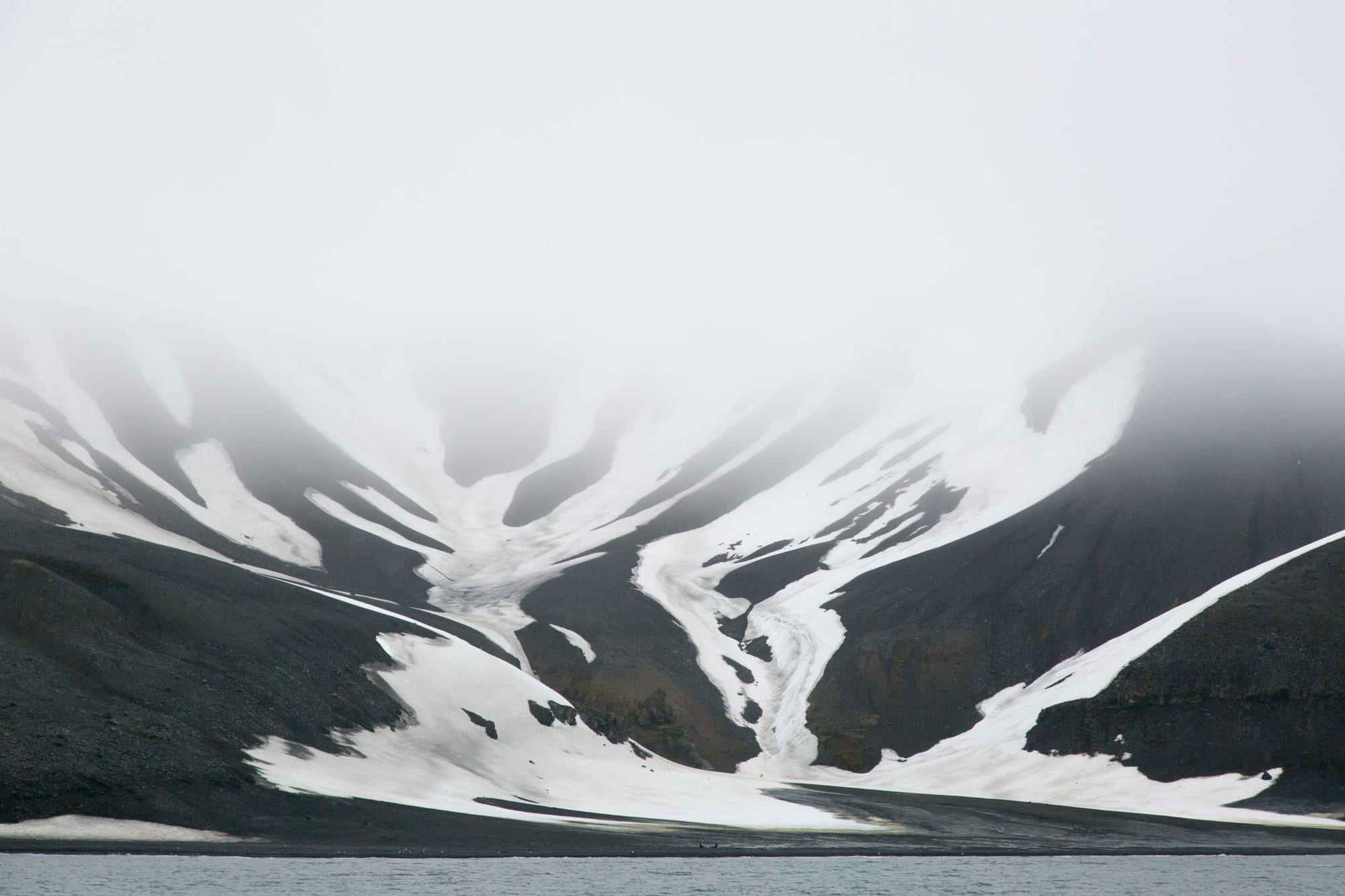
Context · Deception Island (Antarctica), the volcanic caldera where three bases reported lights in 1965
Deception Island (195760163).jpeg · Wikimedia Commons · CC BY-SA 3.0 · open original
The night in question
Deception Island, an active volcanic caldera in the South Shetland Islands, was during the Cold War a point of sovereign friction: Argentines, Chileans and British maintained scientific-military bases within short distance of one another, in an overlap of Antarctic claims. That context (three watchful, mutually distrustful detachments in a single enclave) is what makes the episode interesting. In the preceding weeks moving colored lights had been reported over the Antarctic sky; the British station received notice of sightings seen from the Argentine station on June 7 and 20 (a later study places the second on June 18 and from the Chilean base only).
On July 3, 1965, in the austral polar night, at about 19:20, the Chilean base Presidente Pedro Aguirre Cerda reported a light crossing the sky; according to its communiqué nine people saw it, and astronomer Erich Paul Heilmaier, of the Catholic University of Chile, advised treating the report with reserve because the observers were untrained. Two minutes after the Chilean observation ended, at 19:42, the weather observer of the Argentine naval base Decepción saw a light of solid appearance and lenticular shape, red and green with yellow, blue and white flashes, which advanced, stopped and changed course; it was followed with the naked eye, binoculars and a theodolite, using a star as reference. The Navy form speaks of 17 witnesses, but three were Chilean NCOs visiting the Argentine base, and the commander, Lieutenant Daniel Perissé, gave 62 minutes of observation, while the communiqué says 15 to 20. Meteorologist Jorge Stanich tried to photograph it without success, because the film was of low sensitivity, it was dark and the light looked distant; no photograph was ever published. The most cited instrumental component is not Deception's but that of the naval detachment in the South Orkneys, on Laurie Island, almost 900 km away: that day, at 17:03, two meteorologists saw a round bluish-white body for 15 seconds and two variometers registered a disturbance of the magnetic field. The Condon Report examined the Orkney magnetograms on microfilm and concluded that the deviation was small, 'an order of magnitude lower' than those of a magnetic storm and within normal daily fluctuations; on Deception there was also talk of magnetic variations (astronomer Heilmaier said the Argentine station's magnetometers had recorded them), but Captain José María Cohen, of the Argentine Navy, reported that the variations registered on the Deception Island instruments were not outside the limits of normal variation. A Navy publication also acknowledges that geomagnetic measurements at the Orkneys could not be made from February to June 1965 because of instrument failures.
The Argentine Navy Secretariat released on July 6 a communiqué titled 'Sighting of unidentified flying objects in Argentine Antarctica' and later a second one on the photographic attempt and the Orkneys, an official acknowledgment uncommon for the era. On the British side, the base commander, C. D. Walter, told the Condon Report investigators that the only sighting by his party was made by the cook and was looked upon 'as rather a joke', that no scientific personnel on the island observed anything, that the Chileans placed the phenomenon above the Argentine base and the Argentines above the Chilean one, and that practical jokes on the Argentine commander were suspected. The British Antarctic Survey dated that cook's observation, by Bernard Chappel, to the night of July 2, although Chappel said decades later it was the same night as the Argentines'. Walter added that in early July, at British Base F in the Argentine Islands, a nacreous cloud coincided with a fault in the magnetic instruments, and that misinterpreted radio reports may have fed the idea of magnetic effects. The La Plata Astronomical Observatory told the press, after the Reuters dispatch of 7 July, that it had no theory on the objects, although it pointed out that the sightings occurred when the Echo II satellite was orbiting over the Antarctic zone, according to a U.S. Embassy airgram from Buenos Aires dated 4 September. FOTOCAT Report no. 3 also records a calculation by the observatory published on 31 July: Echo II, a 41 m metallized balloon that to the naked eye looked brighter than the brightest stars, could have been seen from Deception from 19:21 until shortly after 19:30, before entering the Earth's shadow. FOTOCAT found that calculation's times and directions correct but not its elevations, and ruled the satellite out for the Argentine base's light, which barely moved for an hour; commander Perissé had already said his object did not match Echo II, and, according to Roberto Banchs as quoted in the same report, after talking with the Navy the observatory's head of astrometry ended up acknowledging his "hasty opinion". The often-cited CIA document is a digest by the FBIS press-monitoring service reproducing an ANSA agency wire of July 6, not an intelligence report. FOTOCAT Report no. 3, by Vicente-Juan Ballester Olmos and three other researchers, gathered the Navy forms, the cables and the declassified British files, interviewed witnesses and concluded that the three key sightings of July 3 were most probably a meteor, Echo II and celestial bodies such as Mars, Spica or Arcturus; civil engineer Pablo Justo, who was at the Argentine base, maintains he saw only a twinkling star.
Why it matters
It is an early example of a navy officially releasing a sighting by its own personnel, in an enclave where three rival states had bases a few kilometers apart. That structure is what the case's legend exploits: three nations, photography and a magnetic record. Read against the primary record, each pillar weakens: there are no photos, the most cited magnetic disturbance happened at another base, almost 900 km away, and was normal, the variations mentioned on Deception were also within normal limits according to the Navy, and the observations from the three bases are neither independent nor simultaneous, with Chilean witnesses inside the Argentine base and a British report dated to another night.
The official communiqué exists, the witnesses at the Argentine base were numerous and described advances and stops, and the study proposing prosaic explanations presents them as the most probable, not as proven. But the Antarctic latitude and the long night of mid-austral winter favor exactly the stimuli that study identifies (low stars twinkling and seeming to change color through turbulence, the passage of Echo II, a meteor), the autokinetic effect explains well a light that seems to move without references, and the 1965 instrumentation (theodolite and low-sensitivity film) cannot discriminate. The case serves as a lesson in how an official communiqué and press coverage turned scattered lights into a 'tri-national sighting' with photos and magnetic effects that the record does not contain. It keeps its historical and institutional weight, with the mass concentrated in astronomical misidentification.
What's left on paper
Documented evidence
- Sightings on July 3, 1965 at the Chilean base Aguirre Cerda (19:20, nine witnesses per its communiqué) and at the Argentine naval base Decepción (19:42, 17 witnesses, three of them visiting Chileans; 62 minutes per the Navy form, 15 to 20 per the communiqué)
- Failed attempt to photograph the light because of low-sensitivity film, distance and darkness; no photo was ever published
- At the Argentine base in the South Orkneys, almost 900 km away, a bluish-white body seen for 15 seconds coincided with a disturbance on two variometers; the Condon Report found it 'an order of magnitude lower' than a magnetic storm and within normal daily variation
- Official communiqués from the Argentine Navy Secretariat (July 6, 1965) and the Chilean Air Force
- Only British observation: the base cook's, dated July 2 and looked upon 'as rather a joke' by the base commander; no scientist on the island saw anything (Condon Report)
Show 2 more items
- The La Plata Observatory said it had no theory but pointed out that Echo II was then orbiting over Antarctica (U.S. Embassy airgram, 4 Sep 1965), and according to FOTOCAT calculated it could have been seen from Deception between 19:21 and about 19:33, before the Argentine observation; FOTOCAT Report no. 3 attributes the three key sightings to a meteor, Echo II and celestial bodies such as Mars, Spica or Arcturus
- The CIA document is an FBIS press digest reproducing an ANSA wire of July 6, 1965
Sources
- Informe Condon — Scientific Study of Unidentified Flying Objects, vol. 1 (DTIC AD0680975), sección III, cap. 4 «Indirect Physical Evidence» (Roy Craig), pp. 148-149 — Orkney magnetograms examined on microfilm: deviation within normal daily fluctuations; testimony of the British base commander (the cook, 'a joke', no scientist saw anything), astronomer Heilmaier and Captain Cohen.
- CIA / FBIS — resumen de prensa argentina de julio de 1965, «Antarctic flying saucers» (DOC_0000015255) — archive.org copy of the CIA reading-room document: an FBIS monitoring digest reproducing an ANSA agency wire of July 6, 1965, not an intelligence report.
- U.S. Embassy Buenos Aires, airgram A-208 to the Department of State, “Celestial Body Observed over Antarctica”, 4 Sep 1965 (NSA UFO collection) — The La Plata Observatory had no theory on the objects but pointed out that Echo II was then orbiting over Antarctica; the Navy would have no more data until the summer exchange of personnel.
- Ballester Olmos, Borraz, Janosch y Victorio Uranga — Informe FOTOCAT n.º 3, «Avistamientos OVNI en la Antártida en 1965» (análisis secundario con documentos primarios) — Study gathering the Argentine Navy forms, the base cables, declassified British correspondence (AIR 2/17982) and witness interviews; attributes the three key sightings to a meteor, the Echo II satellite and celestial bodies.
- CEFORA — transcripción del comunicado de la Secretaría de Marina del 6 de julio de 1965 (fuente secundaria) — Secondary source transcribing the official Argentine communiqué and summarizing the failed attempt to photograph the light.
Related cases
same object · same period
Edwards AFB · The 1965 Tapes
1965 · Tier A
same object · same period
Minot AFB B-52
1968 · Tier S
same object · same period
Puente Almuhey · the light in the southwest and the disc that split in three
1968 · Tier B
same object · same period
Flight IB-435 Palma–Madrid · the light that was Venus (1969)
1969 · Tier A