1968·Minot AFB, North Dakota
United States.Minot AFB B-52
Before dawn on 24 October 1968, sixteen maintenance and security personnel in the Minuteman missile field around Minot AFB, North Dakota, reported for hours a large light that changed from white to green and amber, sometimes with a jet-engine sound.
Read the rest of the summary
At about 3:40 a.m. the radar of a B-52H picked up an echo that stayed off its left wing for some 20 miles while both its UHF radios stopped transmitting; the crew filmed the scope. Later the pilot saw an orange light on or near the ground, and later the intrusion alarm at the Oscar-7 silo went off. Blue Book attributed it to Sirius, the B-52 itself and a 'possible plasma'.
Tier S · SolidWhat do they mean? →
Strong evidence: a contemporary instrumental record (radar, sensor, film or photo of known provenance) that corroborates several independent witnesses.
What it was
62%no known cause
The evidence is not enough to decide between the explanations
See the split across the six explanations
No known cause
Natural or human cause
Primary documents
Project Blue Book · record card and memo of 24 October 1968 (extract)
Three pages of the Project Blue Book file on Minot (NARA). The record card concludes: ground-visual sightings, "probable aircraft (B-52)" and "probable astro (Sirius)"; radar and air-visual, "possible plasma", commenting that the radar contact and the temporary loss of UHF transmission could be attributed to plasma "similar to ball lightning". The memo for the record of 24 October summarises the call with Lt Col Werlich: a target on the B-52 radar that covered 2.5 miles in 3 seconds and held off the left wing for about 20 miles while both transmitters failed, scope photographs, fourteen other witnesses and a security alarm at one of the sites.
Project Blue Book, expediente «24 Oct 68, Minot AFB, North Dakota» (NARA), espejo en archive.org · pp. 1, 3 y 4 · Public domain · US Government work · open original
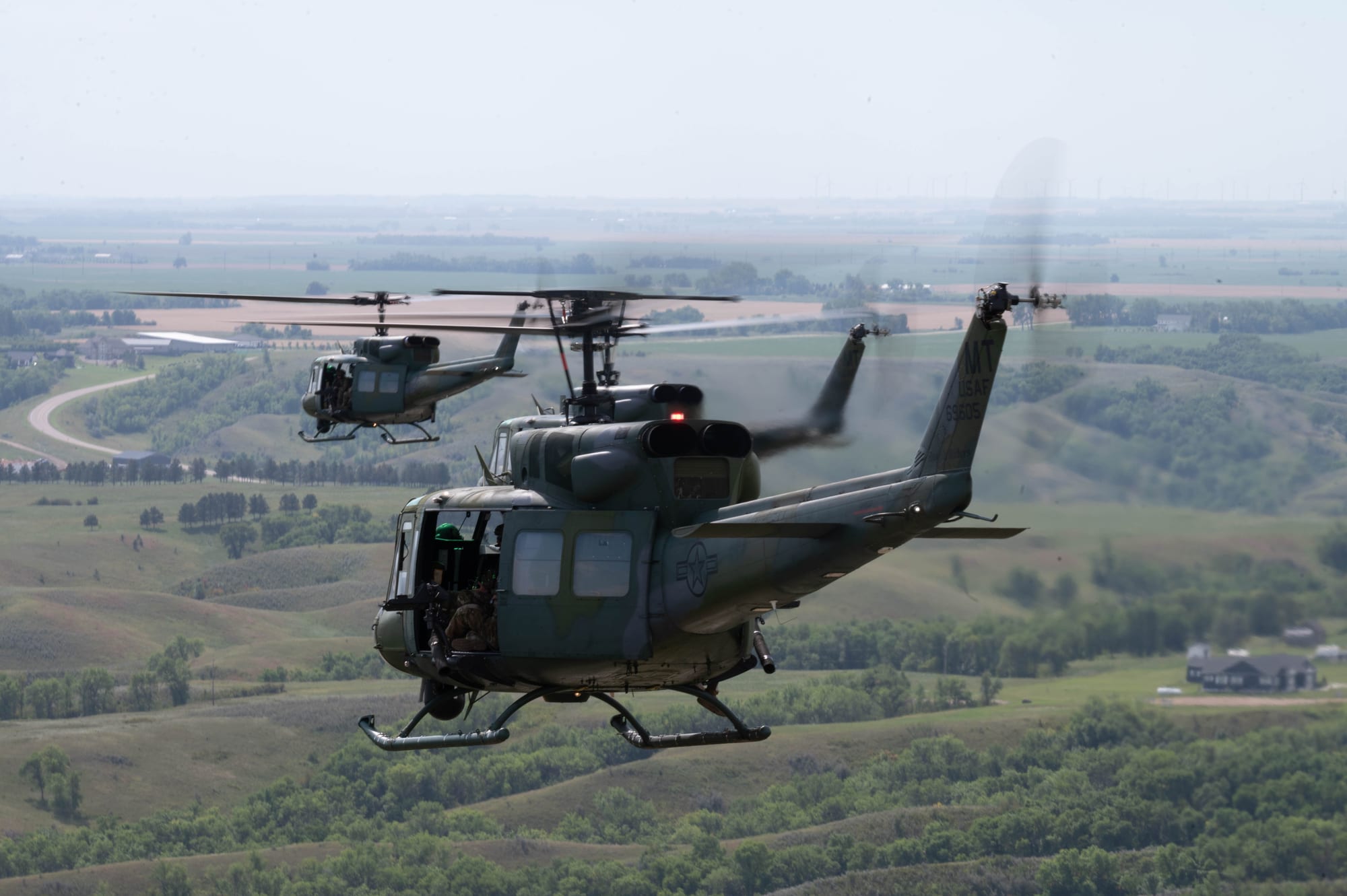
Context · Minot Air Force Base (North Dakota)
Three UH-1N Iroquois fly in formation at Minot Air Force Base, North Dakota, August 21, 2025.jpg · Wikimedia Commons · Public domain · open original
The night in question
In the pre-dawn hours of 24 October 1968, between 2:30 and 5:30 a.m. local time, a sequence of events at Minot AFB, North Dakota, involved three elements: a B-52H Stratofortress bomber returning to base from a training mission, several Minuteman launch facilities of the 91st Strategic Missile Wing, and the security and maintenance teams deployed across the silo field.
The initial phase was on the ground. A maintenance team, airmen O'Connor and Isley, reported a light to the east while driving to the November-7 (N-7) launch facility; the base operations dispatcher opened a line with them and with radar approach control (RAPCON) and kept a log. The Blue Book file lists sixteen witnesses at five points in the field, including security teams at Oscar-6, November-1, Oscar-1, Mike-1 and Juliett-1. They describe a "very large" reddish-orange object with flashing green and white lights; the log places it hovering about 600 feet over N-7 and notes several times that jet engines could be heard. The November-1 flight security controller said the light, "as the sun", came near his site's antenna and sent his alert team after it; they followed it to within half a mile of where it appeared to land, and there it went out. At Oscar-1, Sergeant Smith saw it separate into two parts that moved apart and crossed back past each other.
The B-52 (callsign JAG-31) was returning to Minot when RAPCON asked it to look for "orange glows" because "somebody is seeing flying saucers again". According to Blue Book's first memo, written from the data of the base investigator, Lt. Col. Werlich, the onboard radar picked up a target that initially covered about 2.5 miles in 3 seconds, about 3,000 miles per hour, passed from right to left and took up a position off the left wing, where it stayed for some 20 miles before breaking off. RAPCON said the weather radar was also painting it, but the SAGE site to the south did not remember any unidentified paints. While the target was close, neither of the two UHF transmitters worked: the copilot was cut off in the middle of a word, the crew could receive and answered with the identification squawk, and transmission returned when the echo moved away. Werlich's view was that it could not be a malfunction because the radios worked before and after. The navigator filmed the scope: thirteen consecutive frames, numbered 771 to 783 and 3 seconds apart, plus an unnumbered fourteenth.
The B-52 then flew a missed approach and was vectored toward the sighting area. Between 4:30 and 4:35, according to his form, the pilot, Major James Partin, saw to the west-northwest, about 15 miles away, a bright orange ball of light on or just above the ground; he turned one mile south of it, above it, and the light did not move. The copilot, Bradford Runyon, described in 2000 a large oval object of a dull red color; that account came more than 30 years later, and Blue Book never interviewed the crew. The aircraft landed at about 4:40. At 4:49 the outer- and inner-zone alarms went off at the Oscar-7 facility: the outer door was open and the combination lock on the inner hatch had been moved. Werlich told Blue Book that in the previous two or three years there had been about three such intrusions, all traced to air policemen with access to the keys, and that the next day a lieutenant found no car tracks or footprints.
The skeptical reading must be presented fairly, because part of the case admits a conventional explanation. Project Blue Book's final record card splits the case into three conclusions: the ground-visual sightings, "probable aircraft" (the B-52 itself) and "probable astronomical" (the star Sirius); the B-52's radar contact and the temporary loss of UHF transmission, "possible plasma", "similar to ball lightning"; and what the pilot saw, the star Vega, which was on the horizon, a light on the ground or "possibly a plasma". Blue Book's analysis notes that the B-52 arrived in the area at the time of the first ground sighting, maneuvered with its landing lights on and flew a penetration whose engine noise matches several reports, that there was haze and a temperature inversion, and that the initial claim of a simultaneous ground and air sighting at 3:35 does not hold, because the pilot dated his to 4:35. Our computation confirms that Sirius was in the southeast, where most witnesses placed the light, although about 12 degrees high rather than the 28 given in Blue Book's table; and that Vega, at 4:35, was on the horizon to the north-northwest, some 50 degrees from where the pilot saw the light. The "plasma" was suggested over the phone by a division radar specialist, without any analysis. Quintanilla himself suspected an internal radar malfunction or the temperature inversion, but, according to his memo of the call with Colonel Pullen of SAC, Werlich "wasn't able to have them pull a quick inspection of the set" on the B-52. Radar analyst Martin Shough examined the B-52 radarscope frames in detail, tested anomalous propagation against the weather soundings, second-trip terrain echoes, interference and other hypotheses, and concluded that none was convincing, while cautioning that the radar alone does not prove the presence of an extraordinary object.
Why it matters
The file joins two critical patterns: interference with an aircraft's communications and anomalous activity over nuclear weapons facilities, the same pattern as Malmstrom 1967 ↗. The B-52's radarscope reel is a contemporaneous physical record, not dependent on witness memory, and the contemporaneous papers (Blue Book's memo of the same day, the dispatcher's log and the RAPCON transcript) tie the loss of transmission to the moment of the contact.
The robust must be separated from the debatable. The ground personnel's visual observations are the most vulnerable: Sirius was low in the southeast, the B-52 itself was flying through the area with its lights on and much of the jet noise fits it; the copilot's account came 30 years later, and the Oscar-7 intrusion has a known human precedent. But the official explanation is weak where it matters most: the 'plasma' is a label without analysis, Vega was not where the pilot saw the light, and none of the three conclusions explains a radar echo that stayed beside the aircraft for some 20 miles while both its radios stopped transmitting. That leaves unexplained the radarscope sequence and the communications loss, which Shough could not reduce to any known mechanism.
What's left on paper
Documented evidence
- Radarscope film of B-52H JAG-31: thirteen consecutive frames (771-783) 3 seconds apart plus an unnumbered fourteenth
- Blue Book memo of 24 October: a target at about 3,000 mph that took position off the left wing for some 20 miles; both UHF transmitters failed while it was close
- RAPCON transcript and base operations dispatcher's log with the timeline of the sightings over N-7
- Sixteen security and maintenance witnesses at five points in the missile field; seven AF-117 forms, six from ground witnesses and the pilot's
- Form of the pilot, Major Partin: orange ball of light on or near the ground between 4:30 and 4:35
Show 2 more items
- Intrusion alarms at Oscar-7 at 4:49: outer door open and combination lock moved; earlier intrusions attributed to air policemen
- Blue Book final card: Sirius and the B-52 itself for the ground visuals, 'possible plasma' for the radar and the UHF loss
Sources
- Project Blue Book — file "24 Oct 68, Minot AFB, North Dakota" (record card and 24 October memo), NARA, archive.org mirror — Primary source (107 pp.): card, telephone memos with Werlich, witness list and log, RAPCON transcript, AF-117 forms, Blue Book analysis and astronomical table
- Klotz, Tulien et al. — The Minot AFB UFO case, 24 October 1968 (Sign Oral History Project) — Reconstruction with the scanned documents, crew and witness interviews, maps and the fourteen radarscope frames
- Martin Shough — Anomalous Echoes Captured by a B-52 Airborne Radarscope Camera (2006) — Technical analysis of the radar frames: rejects the conventional explanations one by one, without claiming the radar proves an extraordinary object
- NARA — Unidentified Flying Objects (Project Blue Book), collection guide — Guide from the archive holding the Blue Book originals (Record Group 341)
- Hastings, Robert — UFOs and Nukes (2008) — Secondary source: compilation of testimony about UFOs at nuclear bases
- Salas, Robert — Faded Giant (2005) — Secondary source: focused on Malmstrom 1967; context for the nuclear pattern
Referenced by 1 case
Related cases
same object · same country · same period
Edwards AFB · The 1965 Tapes
1965 · Tier A
same object · same country · same period
Redmond, Oregon · police, FAA and six F-102s
1959 · Tier A
same object · same country
Ellsworth AFB · Blue Book's 'best report'
1953 · Tier S
same object · same country
Great Airship Wave · U.S.
1896 · Tier B
Associated actors (1)