1967·Malmstrom AFB, Montana
United States.Malmstrom ICBM shutdown
On 16 March 1967, at 08:45, all ten Minuteman missiles of Malmstrom AFB's Echo squadron (Montana) dropped off alert within 10 to 40 seconds. The 341st Wing's declassified history says investigators found no logical cause, that the shutdown was reproduced with an electrical pulse, and that UFO rumours were 'disproven'. Captain Robert Salas's account of a red object over another launch centre was published in 1996 and has no documentary support.
Tier A · AcceptableWhat do they mean? →
Institutional evidence: several identified independent witnesses, or contemporary official documentation, without an instrumental record to corroborate them.
What it was
61%natural or human cause
Most likely explanation: equipment failure
See the split across the six explanations
Natural or human cause
No known cause
Primary documents
341st Strategic Missile Wing history, January–March 1967 (extract) and 2001 FOIA response
Ten pages: Malmstrom's 14 June 2001 response to John Greenewald's FOIA request, which releases excerpts of the unit histories and says it has no tapes or documents of any personnel injured, and the pages of the January–March 1967 history that narrate the Echo incident. On 16 March at 08:45 all ten sites went "No-Go" with channel 9 and 12 indications; the investigation team ruled out weather and communications, and the history states that rumours of UFOs around Echo "were disproven", relying on a mobile strike team that had checked November Flight.
341st Strategic Missile Wing History, 1 Jan–31 Mar 1967 (excerpts), desclasificada por Malmstrom AFB (FOIA, 2001), copia en The Black Vault · pp. 3, 5, 7, 9–15 del PDF · Public domain · US Government work · open original
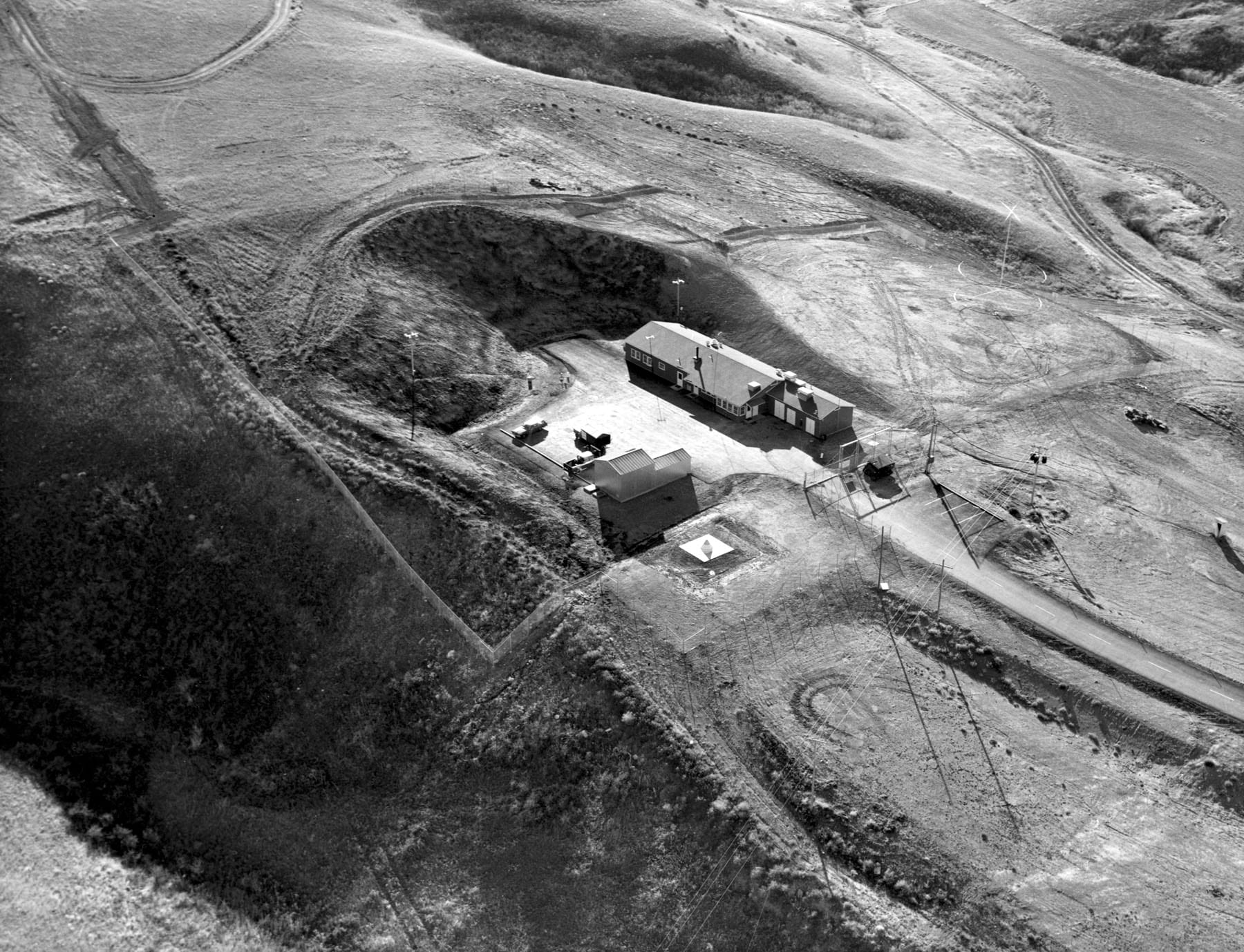
Context · Malmstrom Air Force Base (Montana), site of the Minuteman missile shutdown
Launch Control Facility after construction at Malmstrom AFB, Montana.jpg · Wikimedia Commons · Public domain · open original
The night in question
On the morning of 16 March 1967, at 08:45 local time, all ten launch facilities of the 341st Strategic Missile Wing's Echo squadron (E-Flight) at Malmstrom AFB (Montana) went to 'No-Go' status almost at once, with channel 9 and 12 indications on the reporting panel (guidance and logic-coupler No-Go). It is a documented fact: it is recorded in the unit history for January-March 1967, classified secret and released by the Air Force in 2001 in answer to a FOIA request, which cites the 'Report of Engineering Investigation of Echo Flight Incident' (23 March 1967) and a SAC message of the 17th titled 'Loss of Strategic Alert Echo Flight'. According to the crew, the loss of alert happened within 10 to 40 seconds, with no pattern or sequence; the deputy commander had turned away from the console to brief the commander, who had just been woken. All ten sites returned to alert without any equipment being replaced.
That same day SAC called in the Ogden logistics centre (OOAMA) for a full analysis, and it formed a team with Boeing, Autonetics and the 15th Air Force. They ruled out weather, communications, the alerting system and a guidance-computer fault, and the 801st Radar Squadron reported no interference. A transformer failure on the line feeding the area occurred at 14:53, six hours later, and power-switching tests were negative. The interim conclusion was that the teams at Malmstrom 'were unable to determine a logical cause'. In Seattle, Boeing did reproduce the failure signature: a 30-microsecond pulse injected on the self-test command line of the C-53P coupler produced the same shutdown in 60% of applications. What was never identified was the source of the real pulse: the sensitive-information-network line hypothesis was proved wrong, and the transformer-failure simulation came out negative. OOAMA attributed the problem to electromagnetic-pulse (EMP) or electrostatic noise peculiar to the Wing I configuration, and the episode led to an EMP test programme with Boeing at the Sierra-39 site from 28 September 1967 and to hardening modifications. The same history records a partial precedent: on 19 December 1966, three sites of Alpha squadron shut down in a similar way.
On UFOs, the unit history says that 'rumors of Unidentified Flying Objects (UFO) around the area of Echo Flight during the time of fault were disproven', and it rests this on a mobile team that had checked November squadron's sites that morning and stated it observed nothing unusual. The basis for that denial is weak (it questioned people who were in another squadron, not Echo's security) but it is all the 1967 record says on the matter. The UFO account was published in 1996 by Captain Robert Salas and researcher Jim Klotz: Salas, then a deputy crew commander, says a guard phoned him to report a red-glowing object by the gate of his launch centre, that a guard was injured, and that his missiles shut down as they spoke. That account has changed: in 1996 he placed his incident at November squadron, on the same day as Echo, with 'four or five' missiles affected; later at Oscar squadron, with 'six to eight'; and researcher Robert Hastings proposed moving it to the night of 24-25 March, a date Salas came to accept. The unit history mentions no shutdown at Oscar, Malmstrom's reply to the 2001 FOIA request says it holds no records of anyone injured, and among the 111 March 1967 files in the digitised Blue Book collection there is none from Montana. Salas testified at the National Press Club (2010) and at the Citizen Hearing on Disclosure (2013) and published 'Faded Giant' with Klotz; Hastings gathers in 'UFOs and Nukes' more than a hundred testimonies of alleged interference at nuclear installations.
In June 2025, The Wall Street Journal (Joel Schectman, 'The Pentagon Disinformation That Fueled America's UFO Mythology', 6 June) attributed to AARO investigators under Sean Kirkpatrick a terrestrial explanation: a large electromagnetic-pulse generator mounted on 60-foot posts near the Oscar-1 facility, whose discharges produced lightning-like flashes and disrupted the missiles' guidance. AARO has published no document to support it, and for Echo the 1967 record does not back it: the unit history places Boeing's EMP tests after the incident and as a consequence of it. Salas answered with a fourteen-point rebuttal. The same article placed the provenance of the account: according to the paper, Salas did not link it to a UFO until 1994, after reading a book by Timothy Good, went public in 1996 in the Great Falls Tribune, the red-object report reached him second-hand by phone, and over the years he came to hold that 'intergalactic' forces intervened to avert nuclear war and that he himself was abducted in 1985. None of this refutes Echo's technical failure, which is real and documented, but it bears on the testimonial layer that connects it to an unidentified phenomenon.
Why it matters
A full squadron of ten ICBMs dropped off alert within seconds, and the Air Force and its contractor could not identify the source of the pulse that caused it: that alone makes the case operationally critical, with or without a UFO. The episode forced the hardening of Minuteman against electromagnetic pulses, and that fact is documented in the 341st Wing's history independently of any interpretation.
Calibration requires separating three layers that popular coverage fuses. The first, the Echo failure, is solid and dated. The second, the technical attribution, is partial but concrete: the failure signature was reproduced with a 30-microsecond electrical pulse, which shows that no exotic agent is needed to produce it, although the source of the real pulse was never found. The third, the luminous object, has no support in the 1967 record, which mentions the rumours only to dismiss them, and rests on testimony published twenty-nine years later whose squadron, date and number of missiles have varied. That the official denial rested on a team that was in another squadron is a real weakness of the file, and if documentation on Oscar existed, it has not been released.
The explanation that The Wall Street Journal attributed to AARO in 2025 (an in-house EMP simulator) cannot be treated as fact: there is no published document and, for Echo, it clashes with the chronology of the unit history itself. The explanations left standing are an internal technical fault (electrical or electrostatic noise, the engineers' working conclusion) and an undocumented in-house test or activity, and much of the case remains indeterminate. The hardware anomaly is genuine; the link to an unidentified phenomenon is possible, but the primary record does not sustain it.
What's left on paper
Documented evidence
- 341st Strategic Missile Wing history (Jan-Mar 1967), declassified in 2001: all ten Echo sites drop off alert at 08:45 on 16 Mar 1967 within 10 to 40 seconds; the teams 'were unable to determine a logical cause'
- Boeing tests (Apr-Jun 1967): a 30-microsecond pulse on the C-53P coupler reproduces the shutdown in 60% of applications; the source of the real pulse was not identified; OOAMA attributes it to EMP or electrostatic noise
- The same history: UFO rumours around Echo 'were disproven', based on a team that checked November squadron's sites; 801st Radar Squadron reports no interference
- Robert Salas's testimony (Klotz and Salas, 1996; National Press Club, 2010; Citizen Hearing, 2013): red object by his launch centre, in versions that vary in squadron (November, later Oscar), number of missiles and date
- The Wall Street Journal (6 Jun 2025): attributes to AARO investigators the hypothesis of an EMP generator near Oscar-1; no published document supports it
Sources
- 341st Strategic Missile Wing — unit history excerpts, Jan 1967-Mar 1968 (declassified by Malmstrom AFB in answer to J. Greenewald's FOIA request, 2001), The Black Vault — Primary source: 88 pp. with the account of the Echo incident, the Boeing tests and the EMP programme, citing the engineering report and the SAC and OOAMA messages.
- Klotz, J. and Salas, R. — 'The Malmstrom AFB UFO/Missile Incident' (1996), copy at NICAP — First published version of Salas's testimony, which places his incident at November squadron.
- NICAP — Salas's Oscar-Flight account with R. Hastings's note on the date (2006) — Later version: Oscar squadron, 'six to eight' missiles and a proposed date of 24-25 March.
- Salas, R. — réplica al Wall Street Journal (Ojai Valley News, 2025) — Quotes the description of the EMP generator the WSJ attributed to AARO and rebuts it in fourteen points.
- Hastings, R. — UFOs and Nukes (2008) — Secondary source: compilation of military testimonies; 150+ alleged cases
- Salas, R. — Faded Giant (2005) — Operational autobiography
- National Press Club UFO Disclosure (Sept 27, 2010) — 7 military officers including Salas
- Schectman, J. — 'The Pentagon Disinformation That Fueled America's UFO Mythology' (Wall Street Journal, 6 jun 2025) — Attributes to AARO investigators the EMP-generator hypothesis; no AARO document has been published
Referenced by 3 cases
Related cases
same explanation · same country · same period
Apollo 17 · VM6 triangular formation (PURSUE)
1972 · Tier A
same explanation · same country
STEREO and SOHO · the “UFOs” beside the Sun
2011 · Tier S
same explanation · same country
When the sensor itself explains why the object flickers
2019 · Tier A
same explanation · same country
Colorado 2023 · the orb a police officer filmed
2023 · Tier A
Associated actors (2)