1966·Westall, Melbourne
Australia.Westall Australia
In mid-morning on 6 April 1966, students and at least one teacher at Westall High School in Melbourne saw a silver object pass over the sports ground and descend behind a nearby pine plantation, where a circle of flattened grass was later found. Local press at the time reported that several light aircraft followed it and that the school prevented interviews with witnesses; no official file on the case has been located.
Tier B · IndicativeWhat do they mean? →
Limited evidence: a single witness, testimony gathered years later, or an account without contemporary primary documentation.
What it was
54%natural or human cause
Most likely explanation: balloon
See the split across the six explanations
Natural or human cause
No known cause
Primary documents
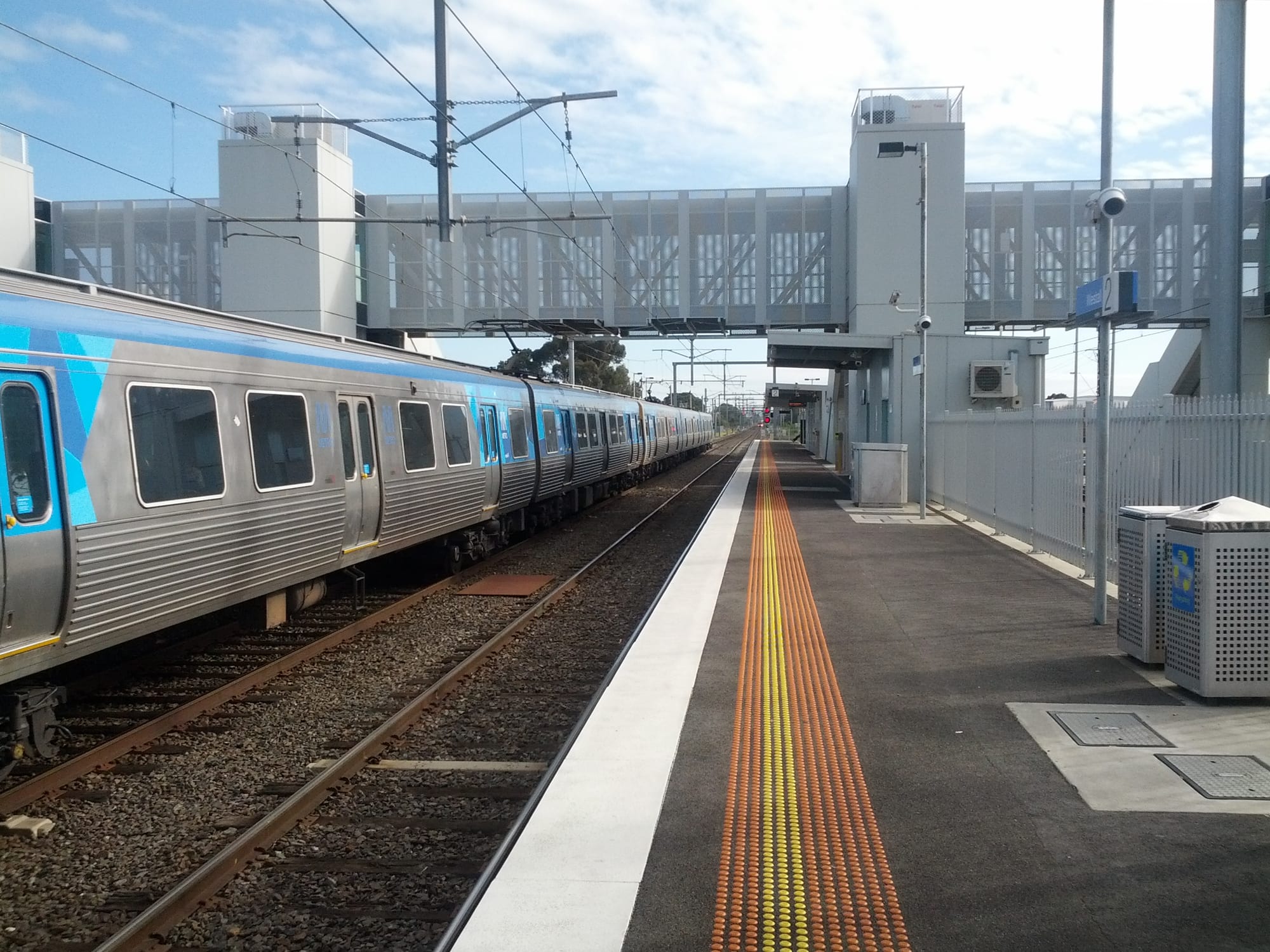
Context · Westall (Melbourne, Australia), where hundreds of schoolchildren saw the object
WestallPlatform2.jpg · Wikimedia Commons · CC BY-SA 3.0 · open original
Australian Flying Saucer Review no. 5 (Victorian Flying Saucer Research Society, July 1966), pp. 13-14: 'Scoop! Flying saucer over Westall'
The written account closest to the events: the magazine reproduces the page of the Clayton Calendar, the newsletter produced by pupils of grades 6C and 5C of state school 4747 in Clayton, in which an anonymous Westall High student says he saw from the yard, at morning recess, 'a dazzling, silvery object' circle some pines, descend behind them and rise again to the level of several light aircraft, 'as long as one of the Cessnas, but very thin', before moving away; and that after school he and two friends found a circle of flattened grass 25 to 30 feet across. Judith Magee's note dates the event to 6 April and says that, according to the headmaster, several organisations had investigated it, from the Air Force to the VFSRS. A private 1966 publication of uncertain copyright, so it is given as a link.
Victorian Flying Saucer Research Society · Internet Archive · view source
The night in question
On the morning of April 6, 1966, shortly before the mid-morning recess, students at Westall High School in Clayton South (a south-eastern suburb of Melbourne, Australia) who were on the oval during a sport class observed a greyish or silver object, described by most as a flattened disc or saucer, descending toward an open area known as The Grange, beyond a pine plantation bordering the school. The press at the time gave no witness count; the estimates of one hundred to more than two hundred, and up to nearly three hundred across two schools, neighbors and staff, come from reconstructions made decades later from interviews with former students. The written account closest to the events, by a Westall student, published in the Clayton Calendar, a Clayton school newsletter, and reprinted by the Australian Flying Saucer Review in July 1966, describes 'a dazzling, silvery object' flying around the pines, as long as one of the Cessnas but very thin; on April 21, The Dandenong Journal spoke of 'an object or objects of inexplicable origin'.
The object descended behind the pines, briefly remained out of sight, then ascended and moved off at high speed to the north-west. Several witnesses described up to five light aircraft (possibly Cessnas) that seemed to circle or follow the object; that perception is the origin of the popular 'pursuit' account. The point bears precision, because it is where the case is usually exaggerated: these were not jet fighters. Moorabbin Airport, one of Melbourne's busiest, was about four kilometers away. On 21 April, The Dandenong Journal ran the front-page headline "Who were 5 pilots?" and stated that the object was "almost certainly" observed by the pilots of several light aircraft that flew close to it and chased it for some time; those pilots were never identified. The only staff member who spoke to the press at the time was science teacher Andrew Greenwood, whose detailed description, according to the same paper, ruled out a weather balloon, an aircraft or a flock of birds; he maintained his account for decades, and in 1967 repeated it to U.S. physicist James McDonald.
Several students who went to the site reported a circular area of flattened or scorched grass at The Grange. The school's silence is on record in a document of the time: on 14 April, The Dandenong Journal led its front page with "Flying saucer mystery: school silent" and reported that its inquiries were hampered by the "reluctance of school authorities to permit interviews" with students and staff. The rest comes from later accounts: Greenwood said the headmaster threatened students with punishment and staff with losing their jobs if they talked, and several former students recall men in dark suits or uniforms at the school and at The Grange. That pressure is the core of the case's "suppression" component. On its official side beyond the school there is a contemporary note: Judith Magee, of the Victorian Flying Saucer Research Society (VFSRS), wrote in the July 1966 Australian Flying Saucer Review that the headmaster had stated several organisations had investigated the sighting, 'from the Air Force to the Victorian Flying Saucer Research Society', and that some children were detained after school for having spoken to the press; no file documenting it has been found.
Prosaic explanations exist, but none has documentary support. The first appeared the next day: The Age of 7 April suggested the object could be a balloon the Weather Bureau had released at Laverton at 8:30 a.m., carried into the area by the westerly wind. The most elaborate is researcher Keith Basterfield's: a high-altitude balloon from the HIBAL program, run by the Department of Supply and the U.S. Atomic Energy Commission, launched from Mildura to measure radiation, whose payload of about 200 kg came down under a 12 m parachute and was followed by a chase aircraft. Flight 292 was scheduled for 5 April, but Basterfield himself acknowledged in 2014 that he cannot test it: the program's file series (MP1472/25) was destroyed by Defence in 1996, the chase pilot's logbook skips from flight 291 to 293, and no document proves flight 292 ever took off. A HIBAL balloon would also be a state program, not a natural phenomenon. A towed target was proposed as well. No document on Westall has been found in the Australian government's UFO files: researcher Bill Chalker went through them in 1984 without finding anything, and no official file on the case has been made public since. The documentary 'Westall '66: A Suburban UFO Mystery' (Rosie Jones, SBS, 2010) compiled dozens of testimonies from adults who had been child witnesses, with notable narrative consistency four decades later.
Why it matters
Westall has witnesses in a school setting, a reported physical trace and a refusal by the school to let witnesses speak that is on record in the following week's press. There was no 'jet-fighter pursuit' (they were light aircraft) and there is no closed identification of the object. Unrefuted prosaic explanations exist (a weather balloon, a HIBAL balloon, a towed target) that prevent treating it as proof of anomalous technology, although none has a document behind it and the only adult witness who spoke at the time ruled out a balloon.
Two facts remain: first, that an event perceived by dozens or hundreds of people in broad daylight left no trace in any known official file, while the school prevented discussion of it (a data point about institutional behavior, independent of the object's nature); second, the persistence and coherence of the collective testimony across four decades, recorded in 2010-2014.
What's left on paper
Documented evidence
- The Dandenong Journal, 14 Apr 1966, front page: "Flying saucer mystery: school silent"; school authorities would not permit interviews with students or staff
- The Dandenong Journal, 21 Apr 1966, front page: "Who were 5 pilots?"; several light aircraft flew close to the object and chased it; teacher Greenwood ruled out a balloon, aircraft or birds
- Australian Flying Saucer Review no. 5 (VFSRS, July 1966): a student's account in the Clayton Calendar ('a dazzling, silvery object', as long as a Cessna but very thin) and a note by Judith Magee: according to the headmaster, several organisations investigated, 'from the Air Force to the Victorian Flying Saucer Research Society', and children were detained for speaking to the press
- The Age, 7 Apr 1966: the Weather Bureau had released a balloon at Laverton at 8:30 a.m.
- Circle of flattened grass at The Grange, seen by students and neighbors; photos from the time have not been located
Show 3 more items
- HIBAL hypothesis (flight 292): the program's files were destroyed in 1996 and there is no proof the flight took off
- No document on Westall in any known Australian government UFO file
- Testimony of former students gathered since 2005 and the documentary Westall '66 (SBS, 2010)
Sources
- The Dandenong Journal, 14 abr 1966, p. 1 — «Flying saucer mystery: school silent» (reproducción de la State Library Victoria) — Primary source: contemporaneous press; the school prevented interviews with witnesses.
- The Dandenong Journal, 21 abr 1966, p. 1 — «Who were 5 pilots?» (reproducción de la State Library Victoria) — Primary source: contemporaneous press on the light aircraft and Greenwood's testimony.
- Australian Flying Saucer Review no. 5 (Victorian Flying Saucer Research Society, July 1966), pp. 12-13 — 'The Clayton Calendar' and note by Judith Magee (archive.org) — Primary source: a student's written account and a note by the VFSRS investigator, both from 1966.
- State Library Victoria — «Strange lights in the sky: the Westall UFO event, 1966» — Secondary source reproducing and citing the 1966 press, including The Age of 7 Apr 1966, p. 6.
- Basterfield, K. — «Project HIBAL - the answer to Westall? - files destroyed» (2014) — Secondary source: the author of the HIBAL hypothesis acknowledges he cannot test it.
- Ryan, S. — «An Ongoing Mystery: The Westall Flying Saucer Incident» (Kingston Local History) — Secondary source: reconstruction based on witness interviews decades later.
- Westall '66: A Suburban UFO Mystery (documental, 2010) — Director Rosie Jones, SBS
- Chalker, B. — UFO archives Australia — Secondary source.
Related cases
same object · same period
Montánchez · the object no aircraft could reach
1967 · Tier S
same object · same period
Cluj · the Emil Barnea photographs
1968 · Tier A
same object · same period
Burgos 1970 · the motionless object photographed from the FOAT light aircraft
1970 · Tier A
same object · same period
Panama Canal Zone · military radar and searchlights (1958)
1958 · Tier S
Associated actors (1)