1967·Falcon Lake, Manitoba
Canada.Falcon Lake
Prospector Stefan Michalak suffered hospital-documented geometric-pattern burns after touching an object that had landed near Falcon Lake, Manitoba; the RCMP and RCAF investigated, and the Condon Report gathered the inconsistencies in the account and showed that the radioactive material found later was commercial silver coated with uranium ore.
Tier A · AcceptableWhat do they mean? →
Institutional evidence: several identified independent witnesses, or contemporary official documentation, without an instrumental record to corroborate them.
What it was
51%no known cause
The evidence is not enough to decide between the explanations
See the split across the six explanations
No known cause
Natural or human cause
Primary documents
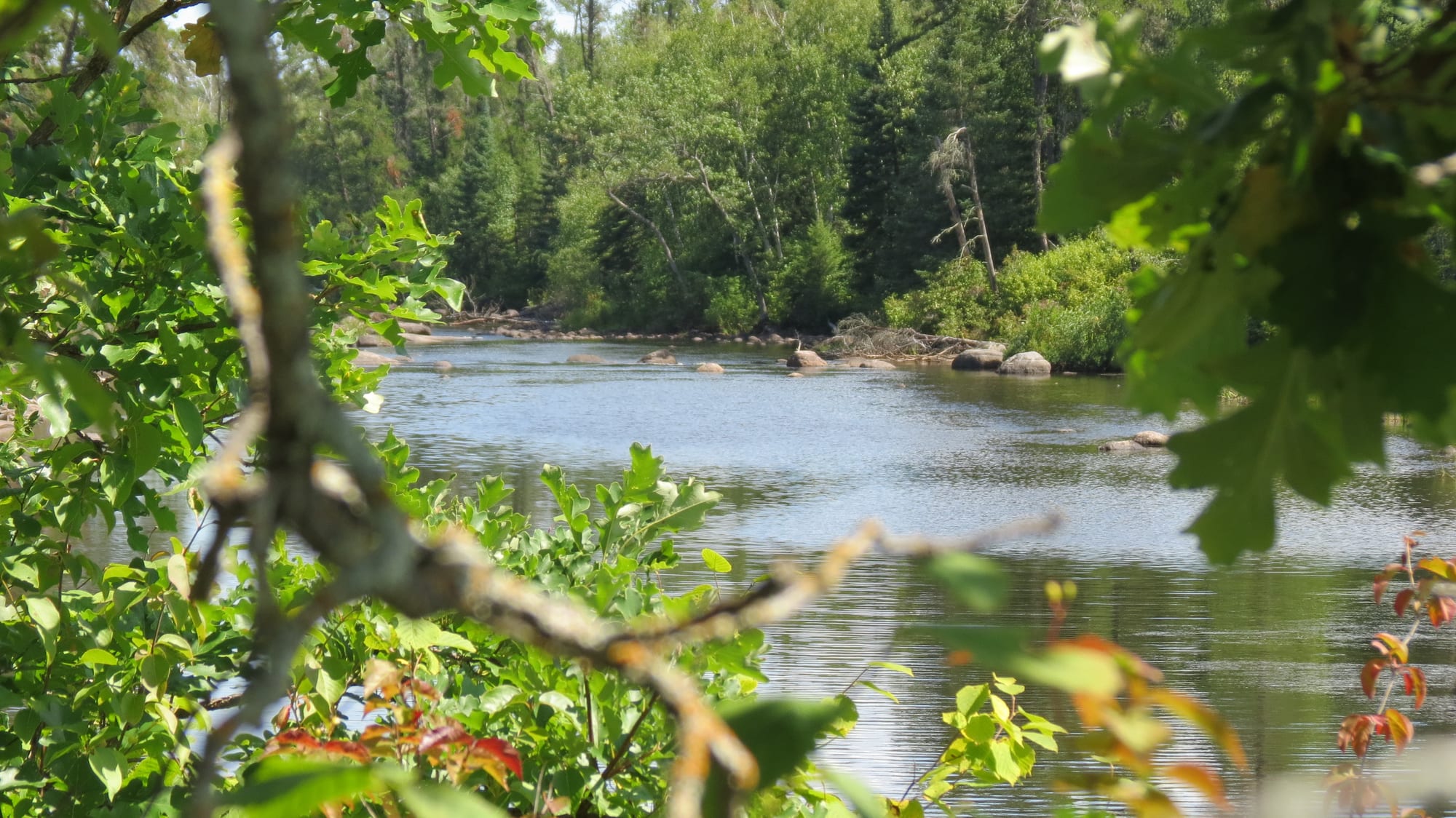
Context · Whiteshell Provincial Park (Manitoba, Canada), area of Stefan Michalak's encounter
Whiteshell River, Pine Point Trail, Whiteshell Provincial Park, Manitoba (492603) (9501380732).jpg · Wikimedia Commons · CC BY 2.0 · open original
Condon Report (1968), Case 22 "Claim of UFO Landing"
Chapter of the University of Colorado study for the Air Force that investigates the Falcon Lake case with the witness anonymized as "Mr. A". It summarizes his account (two discs, one landed 160 feet away, the blast that burned his abdomen), the hospital's finding that the burn was thermal with no radiation, and the search for the site with investigator Roy Craig, which struck him as "aimless". It also records that the fire towers were manned that day and that the rangers believed such a fire would have set the forest alight. The text carries the University of Colorado's copyright, so it is linked only; the RCMP and DND files are in Library and Archives Canada.
Condon, E. U. (dir.), «Scientific Study of Unidentified Flying Objects» (1968), transcripción de NCAS · view source
The night in question
On May 20, 1967, Stefan Michalak (an industrial mechanic of about 50 and a weekend prospector) was prospecting quartz and silver veins in Whiteshell Provincial Park, near Falcon Lake (Manitoba, Canada). Around noon, the agitated cackling of some geese made him look up and he observed two reddish disc-shaped objects descending; one moved off and the other settled on a rock formation about 45 meters away. Michalak sketched the object and watched it for about half an hour: he described a shifting glow, wafts of warm air, a smell of sulphur, a hissing sound, a hatch whose light was too bright to see inside, and humanlike voices within, which he addressed in English, Russian, German, Italian, French and Ukrainian without reply.
As he approached, he touched the hot surface with his glove, which melted on contact. The object then rotated, exposing what Michalak described as a grille of holes in the hull, and vented a blast of hot gas directly at his chest. The discharge set his shirt on fire and produced burns on his torso. The object rose and vanished.
Nauseated and vomiting, Michalak reached the highway and asked a passing RCMP constable for help, who thought he was drunk and did not assist; hours later he took a bus to Winnipeg, where his son took him to hospital. The abdominal burns were diagnosed as superficial. The day after he saw his own physician, he was examined by another hospital's nuclear medicine department: according to the Condon Report, the radiation pathologist found no radiation effects on the burned area, in his blood or on his clothing, and reported that the burn was thermal; a week later, a whole-body radiation counter at an atomic installation showed nothing above background. Michalak said he lost 22 pounds in seven days, a figure that could not be verified, and eleven days after the event a rash appeared on his neck and chest that the report attributes to black-fly bites during the search for the site.
The case was investigated by the Royal Canadian Mounted Police, the RCAF and the USAF-funded Condon project at the University of Colorado. The official ground and air searches did not find the site, and the one Michalak led with the Condon investigator struck the whole party as "aimless". The investigator also gathered the evidence against: forest rangers said the woods were dry and that the fire towers, manned from 9 a.m., would have seen smoke or the objects, and noticed nothing; on the golf course beneath the described flight path there were hundreds of golfers and none reported anything; three radar stations noticed nothing unusual; the compass effect developed from a question by the APRO interviewer; and the undershirt carried a burn with the same pattern on the back, where Michalak was not burned. In his favour, the same report records that his employer deemed him very reliable, that he convinced the RCMP, the RCAF and two of the physicians, and that his wife and son confirmed an unusual odour from his body.
More than a month later, Michalak and an associate said they had found the site, with no official representative present: a circle where the moss had been blown away. The soil, the shirt remnants and a measuring tape they brought back were radioactive, so much so that the Radiation Protection Division considered restricting entry to the area, and they had been removed despite an understanding with the RCMP that no evidence would be taken; the Health and Welfare inspector found only a contaminated smear of under 100 square inches in a crack in the rock, and the surroundings clean. A year later two W-shaped metal bars turned up in that crack: the National Research Council of Canada analysed them and found commercial sterling silver, twisted and partly melted, coated with quartz sand and a loose layer of crushed pitchblende, a uranium ore typical of the region's deposits. The Condon Report concluded that the case's inconsistencies meant it offered no probative information about unconventional craft; it never received the final soil analysis and left the origin of that material open. The Canadian file is held at Library and Archives Canada.
Why it matters
Falcon Lake left physical traces: real thermal burns treated in hospital, clothing burned in a pattern that, according to Michalak, reproduces the object's openings, and a file involving several institutions. But first-hand examination weakened each of those traces: no sign of radiation on the body or clothing, a patterned burn on the back of the undershirt matching no injury, a site found without official witnesses that did not match the original description, and radioactive material that turned out to be commercial silver with uranium ore from the area.
The case also forces several readings to be held in tension without collapsing them. The patterned burn, if the account is faithful, rules out a natural phenomenon (neither atmospheric plasma nor lightning leaves a regular grid), pushing toward something structured; if it is not, the case is a hoax, Menzel's reading. But structured does not imply non-human: 1967 was the height of the aerospace nuclear-program era, and an experimental prototype with a hot-gas exhaust is a hypothesis that half a century has neither confirmed nor fully closed. And the radiation itself has a banal geological explanation, pitchblende from the area's deposits, though no one explained how it reached the crack. It is a single witness, and no one else saw the objects on a clear day with fire towers manned and a full golf course. That is why Falcon Lake remains a case of open interpretation: real injuries, an uncorroborated account.
What's left on paper
Documented evidence
- Superficial abdominal burns treated at a Winnipeg hospital; the nuclear medicine department ruled them thermal and found no radiation in the body, blood or clothing
- Undershirt burned in a pattern, also on the back, where Michalak had no injury
- Radioactive material found by Michalak months later: commercial sterling silver coated with crushed pitchblende, according to the National Research Council of Canada analysis
- Fire towers, golfers and three radars with no observations that day (Condon Report, case 22)
- Investigation by the RCMP, the RCAF and the Condon project; file at Library and Archives Canada
Sources
- Department of National Defence Canada — Falcon Lake case file
- Michalak, S. & Rutkowski, C. — When They Appeared: Falcon Lake 1967 (2017) — Full documentary reconstruction
- Condon Report — Case 22 (Falcon Lake) — Primary source: Condon project field investigation, medical examinations, ranger testimony and the NRC analysis of the radioactive metal
- Rutkowski, C. — «Too Close an Encounter», citing Menzel and Taves, «The UFO Enigma» (1977), p. 104 (Patrick Gross's copy)
Related cases
Associated actors (1)
