1965·Santa Ana, Orange County, California
United States.Rex Heflin · Santa Ana
On 3 August 1965, around midday, Orange County Road Department traffic investigator Rex Heflin took three Polaroid photographs of a hat-shaped object over Myford Road in Santa Ana (California), and later a fourth of a smoke ring; his van's radio had cut out shortly before. On 22 September, one or two men claiming to be from NORAD took the three originals, which never resurfaced. The Air Force spoke of a photographic hoax, NICAP denied it, and the Condon Committee reproduced the first three photos with a model hung from a thread and found the evidence inconclusive and internally inconsistent.
Tier A · AcceptableWhat do they mean? →
Institutional evidence: several identified independent witnesses, or contemporary official documentation, without an instrumental record to corroborate them.
What it was
51%natural or human cause
Most likely explanation: possible hoax
See the split across the six explanations
Natural or human cause
No known cause
Read the full reasoning
The Condon Committee (case 52, William Hartmann) did not confirm it, but was 'able to simulate effectively the first three photographs by suspending a model by a thread attached to a rod resting on the roof of a truck', and found the evidence 'inconclusive and internally inconsistent'. NICAP rejected the hoax verdict. Against it, on 9 December 1965 Col. William E. Poe wrote to a congressman: 'We have not classified the photograph as a hoax'.Primary documents
Project Blue Book file · Santa Ana, 3 August 1965
Three-page extract from the Blue Book file. The record card (3 August 1965, 1835Z) closes the case as 'Other (HOAX)': photo analysis indicates the pictures did not represent the visual conditions of the sighting, and the three Polaroids place the object within 50 feet of the camera, with an estimated size of one to three feet. The Space Systems Division transmittal letter of 30 September says the original Polaroids were not available. Capt Charles F. Reichmuth's narrative report puts the sighting at about 1130 PDT on Myford Road and records that Heflin tried his radio just before seeing the object, not during it, and that it worked normally afterwards.
Project Blue Book · 1965-08-7461487-SantaAna-California, pp. 1, 3 y 14 (NARA, espejo en archive.org) · Public domain (US Government work) · open original
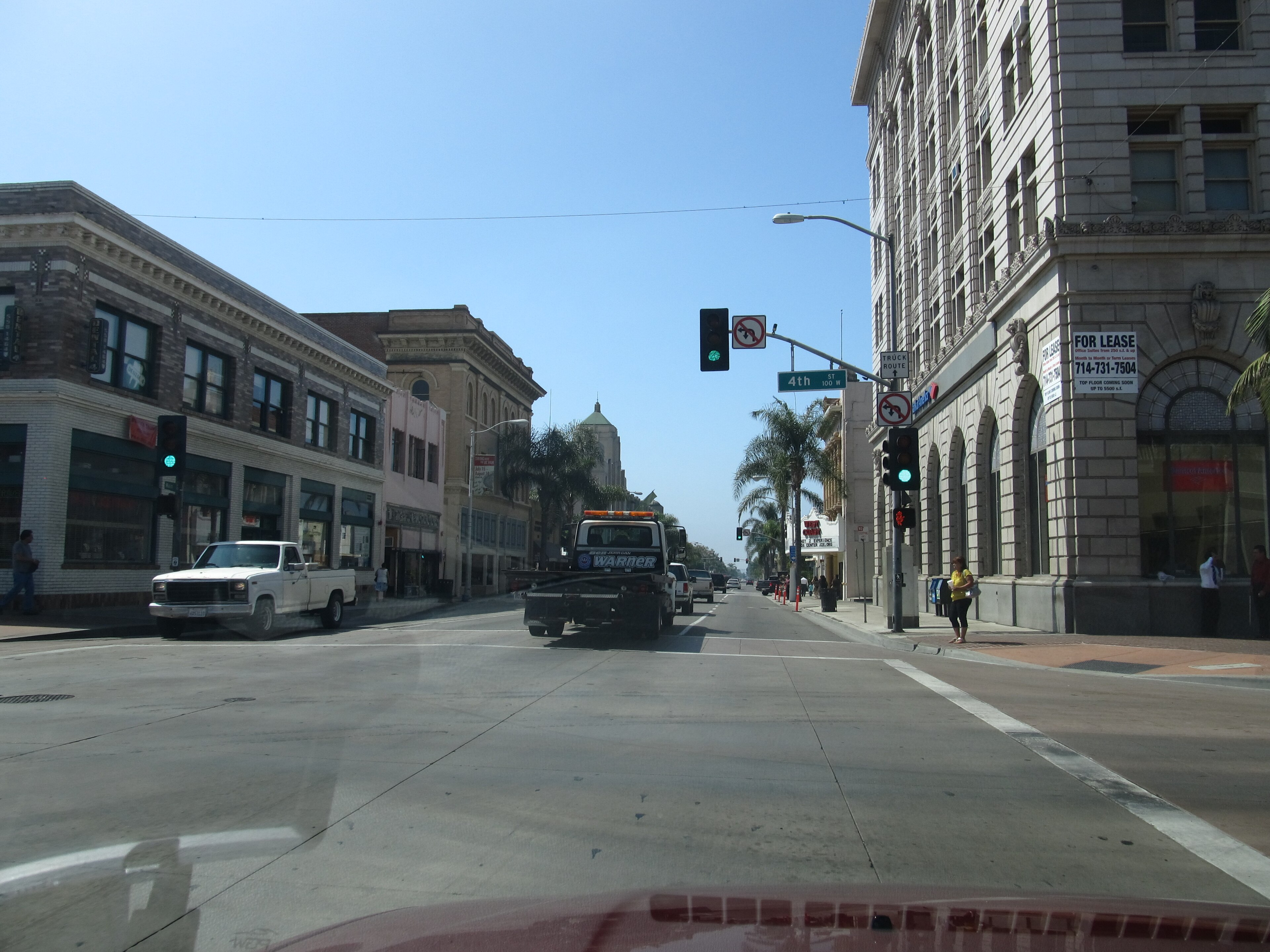
Context · Santa Ana (Orange County, California)
Downtown Santa Ana, California 4 (6020584618).jpg · Wikimedia Commons · CC BY-SA 2.0 · open original
The night in question
On 3 August 1965, around midday (11:30 according to the Air Force narrative report; other accounts give 12:30), Rex Heflin, a traffic investigator for the Orange County Road Department (California), was driving his official van slowly along Myford Road in Santa Ana, about 500 metres from the freeway and inside the flight pattern of the El Toro Marine Corps Air Station, checking roadside growth. He tried to call headquarters by radio and, by his account, the radio went dead after about three words; the Air Force investigator noted that, under detailed questioning, Heflin placed the failure before the sighting and not during it. His superintendent, one or two kilometres away, heard the transmission begin and a sudden, sharp cutoff unlike normal interference, and the Santa Ana FCC facility reported no interference that day. Heflin then saw an object he at first took for an aircraft: it crossed from left to right in front of the van and hovered for a moment. With the department's Polaroid Model 101, loaded with high-speed Type 107 film, he took one photo through the windshield and two more through the right window as the object moved off to the northeast; in the second he saw a beam of light rotating from the center of the underside. He described it as dull gray, about 30 feet across, about 150 feet up, wobbling like a gyroscope, until it accelerated and left a blue-black vapor ring. He drove about a mile down the road toward that ring, got out and photographed it: that is the fourth picture.
That afternoon he showed only the first three photos at the office. A friend tried to sell them to Life magazine, which returned them; copies circulated around Santa Ana and the Santa Ana Register published the first one on 20 September. That day Heflin lent the originals to a Marine intelligence investigator from El Toro, without checking credentials or asking for a receipt, and received calls from a self-styled NORAD colonel who asked him to refrain from further comment and from a Boeing engineer who suggested the same. On 22 September the Marines returned the originals with a receipt, and that same evening, according to Heflin, two men claiming to be from NORAD showed him identification cards similar to the Marines' and took the three photos, which were never returned. The Air Force report, based on its interview the next day, records a single visitor, and a NICAP report signed by Heflin on 25 September speaks of 'a man with a briefcase'; NORAD denied that anyone of theirs had visited him. James McDonald later learned that all military ID cards of the time carried a photograph, and the ones Heflin described did not. The fourth photo, which Heflin called his 'ace in the hole', was not mentioned to the Marines or the Air Force; Heflin said in 1967 that NICAP had advised him to withhold information from the Air Force. That fourth original was lent to a NICAP investigator and misplaced.
The Air Force studied copies of the originals and on 17 October 1965 stated that the object was as sharp as the road's center stripe and measured one to three feet, 15 to 20 feet above the ground; the internal report of its Foreign Technology Division added that a 9-inch vaporizing tray tossed in the air gave a 'surprising similarity'. On 27 October Maj. Hector Quintanilla of Blue Book told the Santa Ana Register it had been classified as a photographic hoax; NICAP's analyst Ralph Rankow supported authenticity and NICAP called the verdict an insult, and on 9 December Col. William E. Poe wrote to a congressman that the Air Force had not classified the photograph as a hoax. According to the reanalysis published in the Journal of Scientific Exploration, an early study by Robert Nathan of the Jet Propulsion Laboratory ruled out a model hung from a thread. William Hartmann, for the Condon Committee, visited the site, interviewed Heflin and the Marines, and effectively simulated the first three photos by hanging a model from a thread tied to a rod on a truck roof. He concluded the case had no probative value: the strongest arguments against it were the clouds in photo four, because Loren Crow's weather study had the sky inland of the freeway totally cloud-free at that hour, and the inconsistent early records about the NORAD visitors, and the photos contain no data that fix distance or size independently of the testimony. He added that the case remained of exceptional interest because it was so well documented.
Why it matters
Heflin matters for the rare combination of two features that seldom coincide in a photographic case: a quality image subjected to serious technical analysis, and a component of anomalous institutional behavior: the handover of the originals to men claiming to be from NORAD who never returned them, followed by the official denial of any involvement. That second element, connecting to the opaque-handling pattern (8m) and, together with the radio cutoff shortly before the sighting, to electromagnetic interference (8k), is what raises it above a simple disc photo: the case documents not only what Heflin saw, but what the official apparatus did with the evidence.
NICAP's analysts found no sign of trickery, but the file itself accumulates contradictions at the source: the NORAD visitor was one the next day and two later, the fourth photo was hidden from the official investigators, and its clouds do not match the clear sky the weather records give. Polaroids have no negative, so the loss of the three original prints, as in Calvine, precludes a definitive forensic verdict and is, ironically, what prevents closing the case in any direction. No analysis has demonstrated the trick, although William Hartmann, for the Condon Committee, effectively reproduced the first three photographs by suspending a model from a thread. Heflin is the photographic case that illustrates how the disappearance of the originals turns a good image into a permanently open question.
What's left on paper
Documented evidence
- Three Polaroid photographs of the object on Myford Road, Santa Ana (3 Aug 1965, around midday), and a fourth of the smoke ring taken a mile on, which Heflin did not show at first
- Van radio cutoff shortly before the sighting; the superintendent heard a sharp cutoff and the FCC recorded no interference
- Originals lent to El Toro Marine intelligence (20-22 Sep) and handed on 22 September to one or two alleged NORAD agents; never returned; NORAD denied the visit
- Air Force: object 1 to 3 feet across, 15-20 feet off the ground; test with a 9-inch vaporizing tray, 'surprising similarity'; Quintanilla spoke of a hoax (27 Oct 1965) and Col. Poe wrote that it had not been classified as a hoax (9 Dec 1965)
- NICAP: analyst Ralph Rankow supported authenticity; according to the Journal of Scientific Exploration reanalysis, Robert Nathan (JPL) ruled out a hanging model
- Condon Committee, case 52 (Hartmann, 1968): reproduced the first three photos with a hanging model; clouds in the fourth photo incompatible with the clear sky and inconsistencies about the visitors; evidence 'inconclusive and internally inconsistent'
Sources
- Patrick Gross / UFO-Logie — 'The Rex Heflin photographs case, Santa Ana, 1965'
- A. Druffel et al. — 'Reanalysis of the 1965 Heflin UFO Photos' (Journal of Scientific Exploration)
- UFO Evidence — 'Rex Heflin UFO Photographs - Santa Ana, California, August 3, 1965'
- Condon Report (1968) — caso 52, «Traffic Investigator Photographs» — Primary source: Hartmann's reconstruction from the Marine, Air Force and NICAP reports, interviews and Crow's weather study.
Related cases