1977·Big Lake Park, Council Bluffs, Iowa
United States.Council Bluffs (molten metal)
On the night of 17 December 1977 several witnesses in Council Bluffs (Iowa) saw a red luminous mass fall; 13.6 to 25 kg of still-burning molten metal was left in a frozen field. Garry Nolan and Jacques Vallée re-analyzed the trace decades later with isotopic techniques: the isotope ratios came out normal (terrestrial), but the metal mixture was unusual and poorly homogenized: a terrestrial industrial product whose origin and means of arrival remain unidentified, although one of the 1977 metallurgists described how to reproduce the sample with thermite.
Tier A · AcceptableWhat do they mean? →
Institutional evidence: several identified independent witnesses, or contemporary official documentation, without an instrumental record to corroborate them.
What it was
73%natural or human cause
Most likely explanation: possible hoax
See the split across the six explanations
Natural or human cause
No known cause
Primary documents
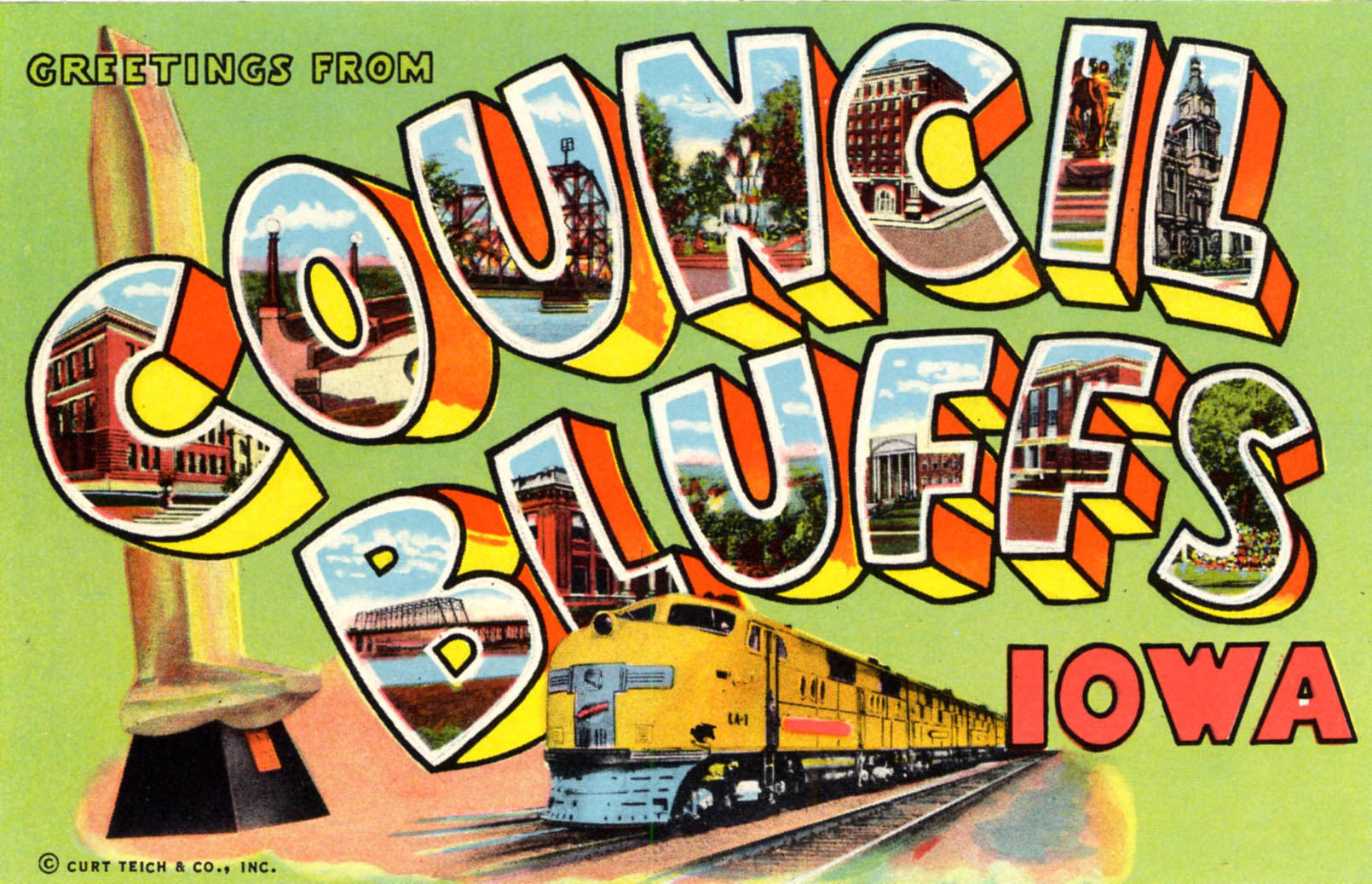
Context · Council Bluffs (Iowa)
Greetings from Council Bluffs Iowa (NBY 1601).jpg · Wikimedia Commons · Public domain · open original
"Mystery metal falls from sky", Daily Nonpareil (Council Bluffs), 18 Dec 1977, in UFO Newsclipping Service no. 103
Local newspaper story reproduced on p. 7 of the February 1978 clipping bulletin. Assistant Fire Chief Jack Moore says he answered a call around 8 p.m. to the Big Lake Park area; that Kenny Drake and "Randy James" reported seeing "something red fall out of the sky to the southeast, hit the ground and explode in flames"; that he found on a levee a four-by-six-foot patch covered in molten metal, "running, boiling", with the ground burned; that Eppley and Offutt contributed nothing, and that he and the police questioned the witnesses. Page 4 carries the Omaha World-Herald story quoting astronomer Robert Allen.
Daily Nonpareil (Council Bluffs, Iowa), reproducido por UFO Newsclipping Service (archive.org) · view source
The night in question
Around 7:30 pm on Saturday 17 December 1977, according to the press of the time, two Council Bluffs (Iowa) residents, Kenny Drake and Randy James, saw 'something red fall out of the sky to the southeast, hit the ground and explode in flames' near the northern city limits, around Big Lake Park, and called the fire department at about 8 pm. Assistant Fire Chief Jack Moore found on a levee by the lake a grassy area of about four by six feet covered by molten metal that 'was running, boiling, down the edges of the levee', with the centre too hot to touch for about an hour and the ground beneath it burned. Moore said he had questioned the witnesses closely, as had the police, and that they did not hesitate in their story. Later accounts, collected by Vallée, speak of about eleven witnesses, among them a couple who described a round object with red lights around the perimeter hovering below the treetops; the December 1977 reports consulted name only Drake and James. Later estimates of the metal recovered range from 30 to 55 lb (13.6 to 25 kg).
The material was collected and analyzed at the time by local and university laboratories. Moore said the metal was so hard that the grinding wheel he used on a fragment wore away rapidly, and checks with Eppley Airfield and Offutt Air Force Base contributed nothing. Amateur astronomer Robert Allen, who sent a sample to the Iowa State University metallurgical laboratory, said it 'definitely was not a meteorite', since meteorites do not arrive molten, and suggested it might be 'a piece of space junk'; he also considered a hoax all but ruled out because of the difficulty of melting such a mass. Early analyses identified a mix of iron and other metals, with three distinguishable components (solid metal, slag, and white-ash inclusions in the slag) with no obvious origin: there was no downed aircraft, no tower, no nearby industrial facility to explain a pour of molten metal falling from the sky on a winter night. According to Vallée's later summary, the investigators of the time ended up rejecting space debris, material shed from an aircraft, a meteorite and a deliberate hoax, which left the case open and made it one of the classic 'physical traces' of US UAP casework, cited for years by investigators such as Jacques Vallée.
Decades later, Vallée (who retained a portion of the original material) and Stanford immunologist Garry Nolan included the Council Bluffs sample in a program re-analyzing materials with modern techniques. Together with Sizun Jiang (Stanford) and Larry Lemke (NASA Ames), they applied secondary-ion mass spectrometry with a NanoSIMS instrument to measure isotope ratios, and published the results in the peer-reviewed literature (Progress in Aerospace Sciences, 2022). The result was deliberately sober: the iron, titanium and chromium isotope ratios were statistically consistent with normal terrestrial material (no exotic isotopic signature) except for a minor iron-57 deviation for which the authors themselves pointed to a conventional explanation. The authors concluded that the material 'would not be expected to form naturally', has an unusual inhomogeneity and shows 'no evidence suggesting it was engineered or designed'; the incomplete mixing points to an industrial process, but neither its source nor how it reached the field was identified. The published conclusion is terrestrial, not resolved: the paper quotes, without precise attribution, the conclusion of 'the investigators' of the time that it was not space debris, material fallen from an aircraft, a meteorite or a hoax. But the same paper quotes Professor Frank Kayser, who analyzed one of the samples in 1977-78, describing how to make it: 'One could prepare a rather similar sample' by collecting splatters from a carbon-steel casting or welding operation, taking them to the site and 'surround[ing] the metal with thermite powder' before igniting it. The critical review of the paper posted on Metabunk adds that a poured-metal hoax, 'though physically possible', might be very unlikely given the effort involved, and that those who claimed to see something fall 'did not directly observe an impact'.
Why it matters
Council Bluffs is a good case study of how materials science works on UAP casework: an event with witnesses, a preserved physical trace, and a peer-reviewed re-analysis decades later. It matters for its result, not in spite of it. When Garry Nolan and Jacques Vallée measured isotopes and composition, they found not an anomalous signature but signs of an incomplete industrial process. It is the disciplined counterpoint to the temptation to treat every unexplained molten metal as evidence of non-human technology: here a theorist of anomalous materials studied the sample and reported that it pointed to something terrestrial. It is also worth being precise about the scope of 'unresolved': according to Vallée's summary, the contemporary phase ruled out the most trivial explanations (meteorite, re-entry, hoax), although one of its metallurgists, Frank Kayser, described how to make a similar sample with thermite; the residue lacks an identified source that night, but 'unidentified source' does not equal 'non-terrestrial origin', and the isotopic re-analysis pushes hard toward the terrestrial. The case teaches one to hold both things at once (a real event with no known source, and a prosaic material conclusion) without collapsing them into an exotic claim.
What's left on paper
Documented evidence
- Witnesses saw 'something red' fall and explode in flames on the night of 17 Dec 1977 (the press of the time names two; later accounts speak of about eleven)
- Between 30 and 55 lb (13.6-25 kg depending on the estimate) of still-incandescent molten metal recovered in the field, with burnt grass
- Firemen found molten metal 'running, boiling' on a levee; Eppley and Offutt contributed nothing; an amateur astronomer ruled out a meteorite and suggested space junk
- Vallée & Nolan isotopic re-analysis (peer-reviewed): terrestrial isotopes, unusual and poorly homogenized metal mixture; material 'not expected to form naturally' and with no evidence of design
Sources
- Vallée, J. & Nolan, G. — 'Improved instrumental techniques, including isotopic analysis, applicable to the characterization of unusual materials...', Progress in Aerospace Sciences (2022)
- Daily Nonpareil (Council Bluffs), 'Mystery metal falls from sky', 18 Dec 1977, and Omaha World-Herald, 'Mystery Flaming Object "Definitely Not Meteorite"', Dec 1977 (reproduced in UFO Newsclipping Service no. 103, Feb 1978) — Primary source: contemporary reports with witnesses Kenny Drake and Randy James and Assistant Fire Chief Jack Moore.
- Hartmann, W. K. et al. — informe de campo del incidente de Council Bluffs (1977-78) — Contemporary documentation of witnesses and material recovery.
- Andrei Ol'khovatov — 'Some comments on events associated with falling terrestrial rocks and iron from the sky' (arXiv:2012.00686) — Summarizes the 1977 investigation: common manufactured carbon steel and four rejected hypotheses (poured hoax, thermite, aircraft, meteorite or space debris).
- Metabunk — '«Improved Instrumental Techniques...», Nolan, Vallee, Jiang, Lemke 2022: a useful paper?' (revisión de John J.) — Critical review of the paper: argues the 1977 investigations did not rigorously rule out slag, workshop waste or improvised thermite.
Related cases
same explanation · same country · same period
The Allagash Abductions
1976 · Tier B
same explanation · same country · same period
Travis Walton (Snowflake)
1975 · Tier A
same explanation · same country · same period
Gulf Breeze · Florida
1987 · Tier B
same explanation · same country
Bob Lazar · S-4 / Area 51
1989 · Tier B
Associated actors (1)