1989·S-4 / Groom Lake (Area 51), Nevada
United States.Bob Lazar · S-4 / Area 51
In 1989, Bob Lazar told journalist George Knapp (initially with his face hidden) that he had worked at S-4, a facility near Groom Lake (Area 51), where he said he saw nine intact flying saucers of extraterrestrial origin and was hired to reverse-engineer their propulsion, powered by 'element 115'. His academic and employment credentials could never be verified.
Tier B · IndicativeWhat do they mean? →
Limited evidence: a single witness, testimony gathered years later, or an account without contemporary primary documentation.
What it was
65%natural or human cause
Most likely explanation: possible hoax
See the split across the six explanations
Natural or human cause
No known cause
Primary documents
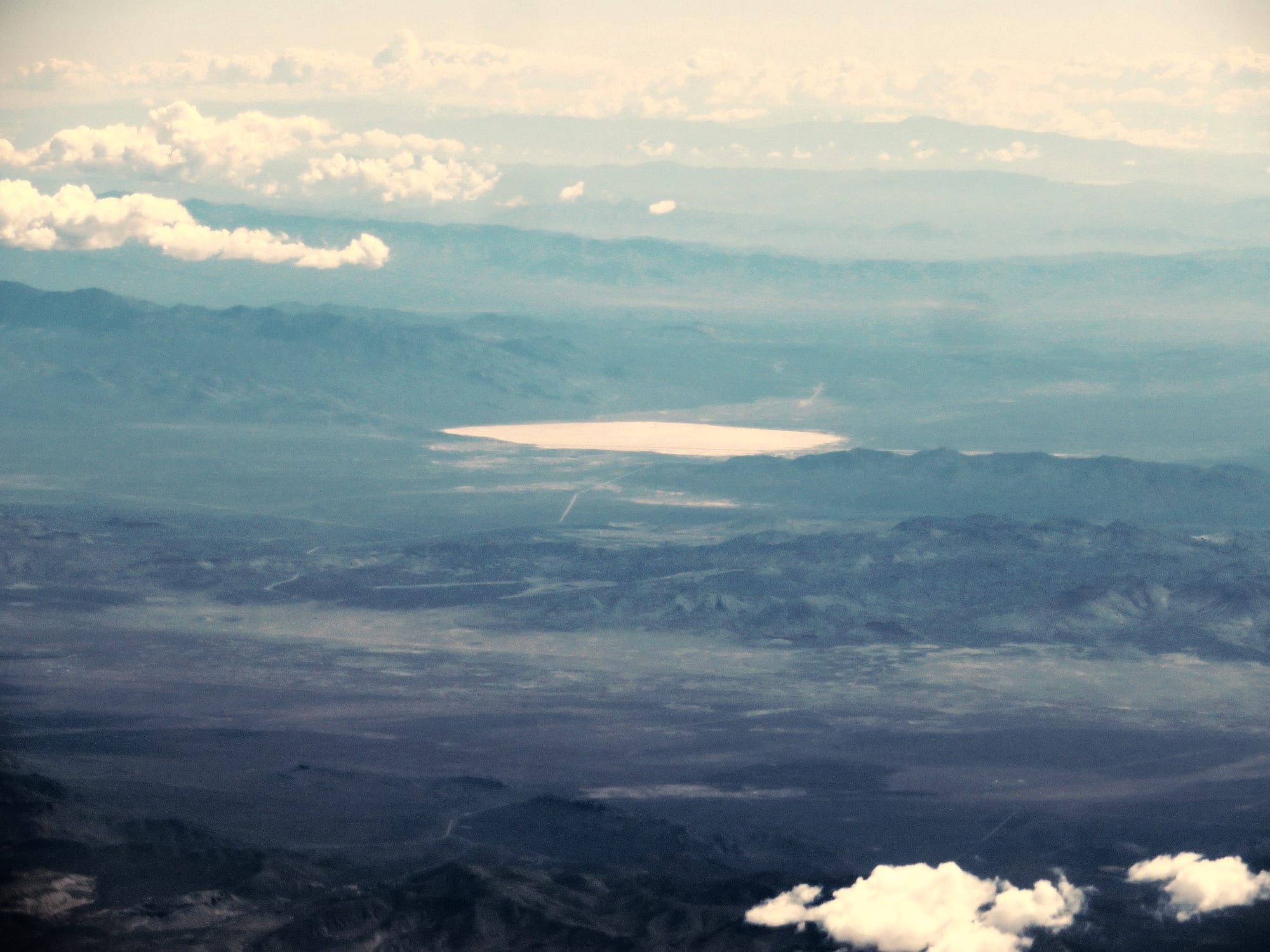
Context · Area 51 / Groom Lake (Nevada), near Bob Lazar's alleged S-4 site
Groom Lake, Area 51, North of Las Vegas, Nevada (17576998524).jpg · Wikimedia Commons · CC BY-SA 2.0 · open original
Lincoln County News, 30 Aug 1990 · Los Alamos 'could find no record' of Lazar (UFO Newsclipping Service no. 256)
Article by Kate MacGregor (Sunmount Syndicate) in the Lincoln County News of Carrizozo (New Mexico), August 30, 1990, reproduced in UFO Newsclipping Service no. 256. It summarizes Lazar's account: a Navy civilian transferred in 1984 to Area 51 to study the propulsion of alien craft, and KLAS-TV's nine-part series. It reports that Los Alamos personnel officers said they could find no record of his employment, but that a reporter found his name in an official 1982 laboratory phone directory and a 1982 article in the Los Alamos Monitor, 'apparently' about the same man. Issue 253 carries the pandering charge.
UFO Newsclipping Service n.º 256, noviembre de 1990 (archive.org) · view source
The night in question
In the spring of 1989, a man presenting himself under the pseudonym 'Dennis' and with his face darkened appeared on Las Vegas television, interviewed by investigative journalist George Knapp. Soon after he went public under his real name: Robert 'Bob' Lazar. His account reshaped the mythology of Area 51 forever. Lazar claimed to have been hired to work at a secret facility called S-4, located south of Groom Lake, in the Nevada desert, where, he said, nine complete flying saucers of non-human origin were kept, hidden from the public.
His testimony was technically detailed, which lent it force. Lazar described closely examining one of the craft, nicknamed the 'Sport Model' for its aerodynamic design, with a small-scale interior (as if designed for beings smaller than a human) and without conventional controls (buttons or dials). He maintained that the propulsion worked by gravity manipulation, generating a field from an exotic fuel: 'element 115', then nonexistent on the periodic table. He claimed to have studied at MIT and worked at Los Alamos.
From the start, verifying his story hit serious problems. George Knapp could not confirm that Lazar had studied at MIT, and Los Alamos responded that there was no record of his having worked there, though indirect indications appeared that his defenders cite as proof of a scrubbed record: in 1990 a check by the Sunmount Syndicate agency found his name in an official 1982 laboratory phone directory and in a 1982 article in the Los Alamos Monitor, while the Los Alamos personnel office told the agency there was no record he had worked there. That same year Las Vegas prosecutors charged him with pandering (police alleged he ran a brothel and outcall prostitution service in two apartments) and Lazar agreed to plead guilty to that charge. Element 115 offers the cleanest case study: in 2003 Russian scientists did synthesize element 115, today called moscovium, which his supporters celebrated as a confirmation; but real moscovium is a synthetic, fleeting and unstable radioactive element, with none of the gravity-generating properties or the stability Lazar ascribed to it. The skeptical consensus (recorded in analyses such as those in Skeptic magazine) holds that the whole points to a fabrication, while Lazar's testimony remains, three decades later, as persuasive as it is unverifiable.
Why it matters
Bob Lazar matters not as evidence of reverse engineering, but as the founding document of the nohumano_encubierto narrative in Area 51 culture: it was the account that installed in the public imagination the idea of a state that possesses, hides and studies non-human craft. Almost the entire later ecosystem of leaks, whistleblowers and 'recovery programs' (up to Grusch in 2023) dialogues, knowingly or not, with the mold Lazar set in 1989. Addressing it is mandatory for tracking that narrative; ignoring it would leave the hypothesis's cultural origin unanchored.
But the evidence points to fabrication. The chain of problems is serious and convergent: unverified academic and employment credentials (MIT, Los Alamos), and a description of element 115 that real chemistry contradicts: moscovium exists but is the opposite of what Lazar promised. His claim is, by definition, a narrative of non-human technology in state hands, and the case cannot be fully falsified: the genuine opacity of the Nevada facilities makes it impossible to prove an absolute negative, and some details (his knowledge of the terrain, the sightings he coordinated on the desert route) are not trivially explained, although neither those sightings nor his knowledge of the terrain substitutes for documentary proof that he worked at S-4. Lazar is the borderline case between whistleblower and fabulist: the proof that a narrative can be culturally decisive and epistemically weak at once, and that both must be held without collapsing one into the other.
What's left on paper
Documented evidence
- George Knapp interviews (KLAS-TV, Las Vegas, 1989), first with face hidden ('Dennis') and later under his real name
- Detailed account of nine saucers at S-4, a 'Sport Model' craft with small-scale interior and gravity-manipulation propulsion
- Claim of 'element 115' as fuel; moscovium (element 115) was synthesized in 2003 but is radioactive, unstable and lacks the described properties
- Inability to verify his credentials: MIT and Los Alamos did not confirm study/employment
- Skeptical analyses (e.g. Skeptic magazine) concluding probable fabrication
- Genuine opacity of S-4/Groom Lake that prevents proving an absolute negative
Sources
- Wikipedia — Bob Lazar
- Skeptic — 'The Strange Case of Bob Lazar'
- HowStuffWorks — 'Bob Lazar, UFO Hoaxster'
- UFO Newsclipping Service n.º 253, 254 y 256 (agosto, septiembre y noviembre de 1990) — prensa de Las Vegas y Nuevo México sobre Lazar (archive.org) — Contemporary press: the 1982 Los Alamos phone directory and Los Alamos Monitor article against the personnel office's denial (no. 256); the pandering charge and the plea agreement (Las Vegas Review-Journal, nos. 253 and 254).
- Radford, B. — «Area 51: Secrets, Yes; Aliens, No», Live Science (27 Sep 2012)
Related cases
same explanation · same country · same period
Linda Napolitano · Brooklyn Bridge
1989 · Tier B
same explanation · same country · same period
Gulf Breeze · Florida
1987 · Tier B
same explanation · same country
Council Bluffs (molten metal)
1977 · Tier A
same explanation · same country
The Allagash Abductions
1976 · Tier B