1933–1934·Northern Scandinavia (Sweden, Norway, Finland)
Sweden.Ghost Fliers · Scandinavia
Between 1933 and 1934, residents and authorities of northern Sweden, Norway and Finland reported grey unmarked aircraft, the 'ghost fliers' (spökflygare), flying at night and in bad weather, sometimes low and with searchlights, in conditions at the limit of the era's aviation in the Arctic; many of the lights turned out to be stars, planets or, in one case, a balloon. The militaries searched for them without finding either the craft or their base.
Tier B · IndicativeWhat do they mean? →
Limited evidence: a single witness, testimony gathered years later, or an account without contemporary primary documentation.
What it was
74%natural or human cause
Most likely explanation: planet or star
See the split across the six explanations
Natural or human cause
No known cause
Read the full reasoning
But General Reuterswärd held that 'aircraft have been observed by credible persons, military and civilian', and Svahn himself concludes that most evidence points to 'German spy flights from a catapult ship off the Norwegian coast, combined with a large dose of pure war psychosis': those flights are the adversary reading and fall outside the class, which covers only the lights.Primary documents
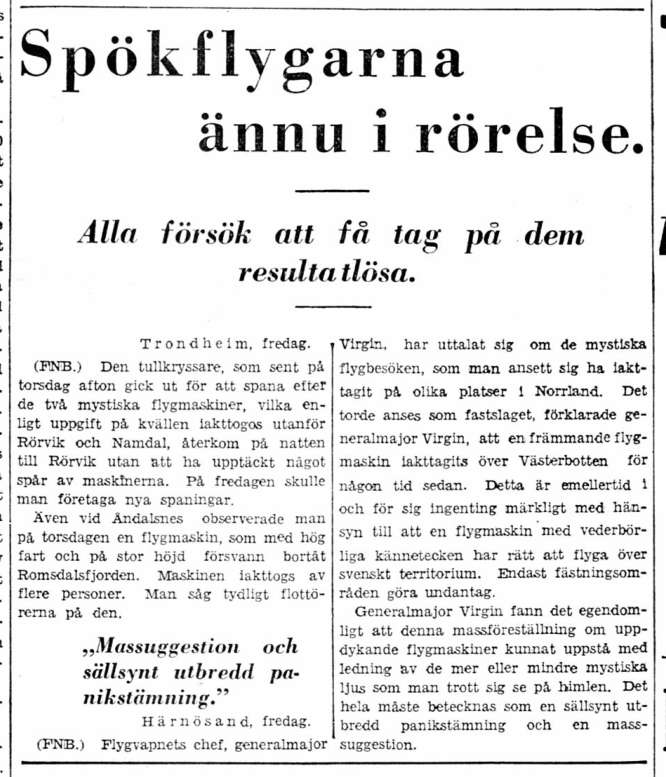
Hufvudstadsbladet, 13 January 1934, p. 3: 'Spökflygarna ännu i rörelse', with General Virgin's statement
Hufvudstadsbladet (Helsinki), Biblioteca Nacional de Finlandia (digi.kansalliskirjasto.fi) · Public domain · unsigned wire dispatch published in 1934 (over 70 years) · open original
The years in question
In the early 1930s, a strange wave swept the northern regions of Scandinavia. Between 1933 and 1934, many residents (and also police, military and civil authorities) of northern Sweden, Norway and Finland reported grey aircraft, without markings or registrations, overflying the region mostly at night and, strikingly, in the thick of snowstorms and at low altitude. They were dubbed spökflygare, the 'ghost fliers'. Many witnesses not only saw them but said they heard engine noise, and some described powerful searchlights sweeping the snowy terrain.
What turned the matter into a state mystery was the apparent technical difficulty: flying at night, in bad weather and over uninhabited terrain for weeks without a nearby base of operations was at the limit of 1933 aviation. The Swedish authorities took the phenomenon very seriously: the military organized active searches, mobilized aircraft and patrols to locate the intruders and, above all, the clandestine aerodrome from which they would have to be operating. According to Clas Svahn, who reviewed the material in the Archives for the Unexplained (AFU) in Norrköping, 24 Swedish army aircraft patrolled Norrland from December to February looking for depots and hidden bases; they found nothing, several crashed or had other mishaps, and on 5 March 1934 the military gave up. The Finnish army also sent aircraft up, without result.
The explanations weighed then and since span the whole spectrum. At the time there was talk of Soviet or Japanese spies, of alcohol smugglers bound for Norway, and of simple misperception and 'mass psychosis' amplified by the press. The head of the Swedish air force, General Eric Virgin, stated on 12 January 1934, according to the dispatch published by Helsinki's Hufvudstadsbladet the next day, that he considered it established that a foreign aircraft had flown over Västerbotten some time earlier, which in itself was nothing remarkable; what he found 'egendomligt' (strange) was that this 'massföreställning' of aircraft had arisen from more or less mysterious lights seen in the sky, and he called it 'panikstämning' and 'masssuggestion' (panic and mass suggestion). According to Svahn, he added that a smuggler or spy would not fly over populated areas with searchlights and navigation lights in full view. That same winter, a Communist member told the Riksdag the wave was a 'framkonstruerad spökflygare' (a fabricated ghost flier), invented to justify buying bombers. There were documented confusions: according to Svahn, in Sorsele the police chief put a light down to an aurora, and in Skellefteå a light that unsettled the town turned out to be a rubber balloon fitted with a battery and a bulb. Svahn concludes that many of the lights were Sirius, Venus and other bright stars, but that there were real airspace violations, probably 'German spy flights from a catapult ship off the Norwegian coast, combined with a large dose of pure war psychosis'; the sources consulted cite no archival document that proves it conclusively. The later identification with Heinkel He 60 seaplanes from the cruiser Leipzig does not fit the dates: that ship received its catapult in late 1934, after the wave. The case remained one of Scandinavia's enduring aviation enigmas and a direct precursor of the 'ghost rockets' the same region would experience in 1946.
Why it matters
The ghost fliers matter as an early, high-quality case of the foreign-state aerial surveillance narrative, documented by the institutional response itself: a phenomenon that mobilized real military searches and left a trace in government documents. Its analytical value lies in meeting the two conditions of pattern 8s (unattributed objects over strategic territory and an authority that pursues them without managing to identify them) three decades before the aerial Cold War, and in connecting to the Scandinavian lineage that continues in the 1946 ghost rockets.
The case is split among the adversarial hypothesis (surveillance or exercises by a foreign power over the Arctic), the mundane/misid narrative (misperception, social contagion and press in a dark, cold, isolated region where wind, lights and sounds easily deceive) and what remains unexplained, with nothing pointing to the non-human. The strength of the adversarial reading lies in the seriousness of the military reaction and in geopolitical coherence; its weakness, in the technical difficulty of sustaining such operations in 1933 without a detectable base and in the fact that the sources consulted cite no confirming document. The strength of the mundane reading lies in that the searches found no craft, runway or fuel, and in the confusions with stars, aurorae and balloons documented by the press; its limit, in that it does not cleanly explain the volume and consistency of the reports. The case is the interwar ancestor of the modern problem of 'drones over sensitive installations': objects treated as a real intrusion by the state, and still unresolved as to authorship.
What's left on paper
Documented evidence
- Numerous reports (1933-1934) of grey unmarked aircraft over northern Sweden, Norway and Finland, at night and in snowstorms
- Witnesses describing engine noise and searchlights sweeping the snowy terrain
- Active military searches: 24 Swedish army aircraft patrolled Norrland from December to February without finding the craft or a clandestine aerodrome, and gave up on 5 March 1934
- Statement by the head of the Swedish air force, Eric Virgin (12 Jan 1934, in the Hufvudstadsbladet of the 13th): a foreign aircraft had flown over Västerbotten, but the wave was 'panikstämning' and 'masssuggestion' from lights; according to Svahn, confusions with an aurora (Sorsele) and with a rubber balloon carrying a bulb (Skellefteå)
- Technical difficulty of operating night aviation in bad weather in the 1933 Arctic without a detectable base
- Adversarial hypothesis (unproven): according to Clas Svahn, German spy flights from a catapult ship off the Norwegian coast; Soviet flights were suggested earlier. The cruiser Leipzig, sometimes credited with them, had no catapult until late 1934
Sources
- UFOs in Wartime — 'Ghost Fliers'
- Airminded — 'Mystery aircraft, 1865-1946'
- Atlas Obscura — 'There's a Huge UFO Archive Hiding in These Swedish Apartment Cellars' (AFU, material de los ghost fliers)
- Clas Svahn — «Spökflygarens vinter» (UFO-Sverige) — Review based on the AFU archive and the Swedish press of 1933-1934: Eric Virgin's statement, military searches, confusions and the German-flights hypothesis.
- Wikipedia — «German cruiser Leipzig» — In late 1934 the ship went into drydock and had its seaplane catapult installed.
- Hufvudstadsbladet (Helsinki), «Spökflygarna ännu i rörelse» (13 ene 1934), p. 3, Biblioteca Nacional de Finlandia — FNB agency dispatches from Trondheim and Härnösand: fruitless Norwegian search and Virgin's statement.
- Riksdag, Andra kammaren, protocolo 1934 n.º 24 — A Communist member calls the wave a 'framkonstruerad spökflygare' used to justify rearmament.
Related cases