1909·East Anglia, Wales and across the United Kingdom
United Kingdom.British Scareships · 1909
In spring 1909, dozens of Britons (including a policeman in Peterborough) reported cigar- or torpedo-shaped 'airships' with powerful searchlights crossing the night sky, mostly over East Anglia and Wales. The press dubbed them 'scareships' and many assumed they were German Zeppelins spying, despite German aviation being unable to reach Britain in 1909; the press that same summer spoke of an advertising model and of a supposed inventor who turned out to be a hoax.
Tier B · IndicativeWhat do they mean? →
Limited evidence: a single witness, testimony gathered years later, or an account without contemporary primary documentation.
What it was
72%natural or human cause
Most likely explanation: aircraft
See the split across the six explanations
Natural or human cause
No known cause
Read the full reasoning
Historian Brett Holman (Airminded) adds: 'No archival evidence has ever emerged of anyone flying airships over Britain at this time'. But no cause covers every report: Holman leaves Cardiff unexplained, and the Venus explanation attributed to David Clarke does not fit 1909, as the planet was at superior conjunction on 28 April.Primary documents
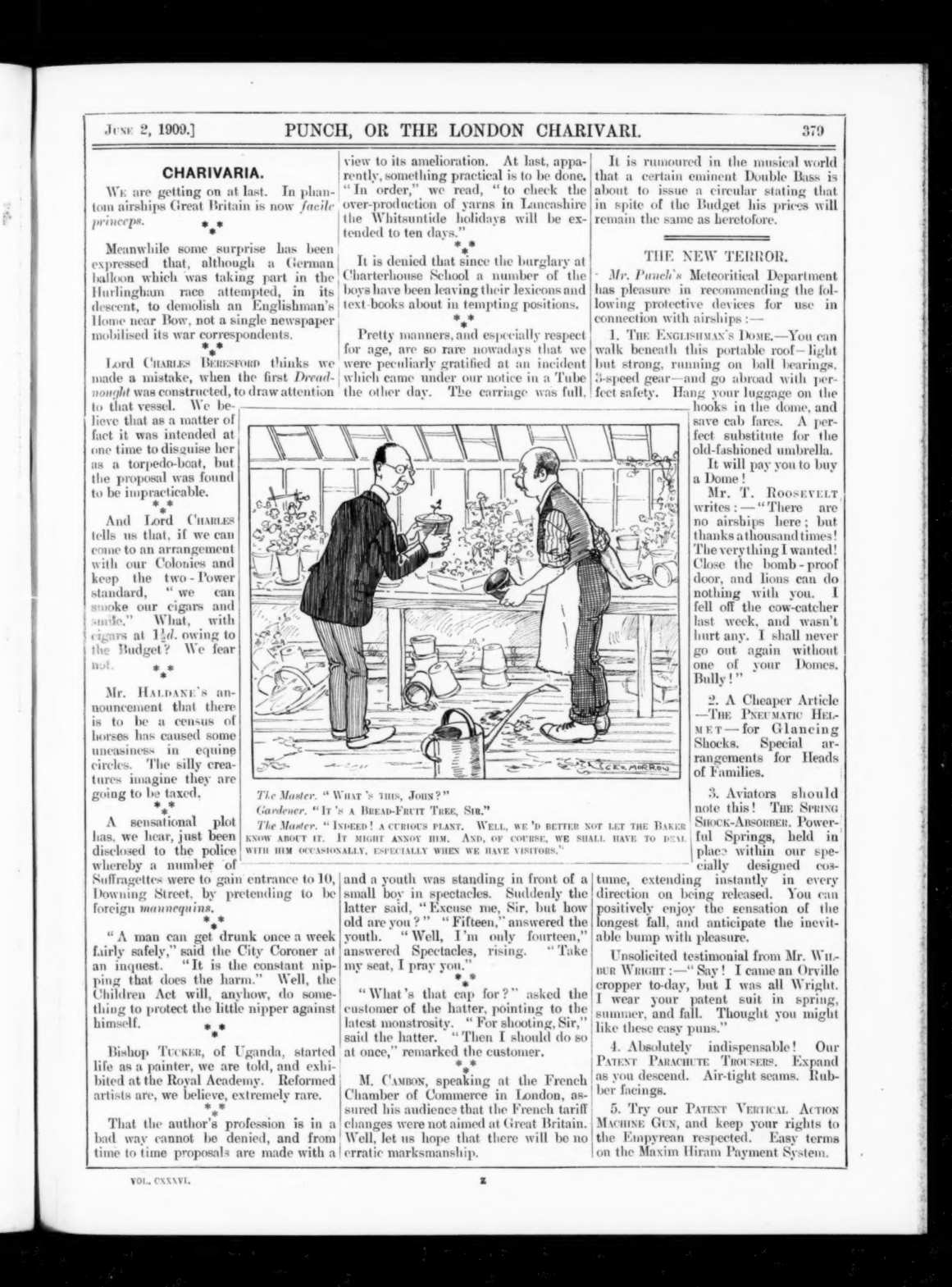
Punch, 2 June 1909, p. 379: "In phantom airships Great Britain is now facile princeps" (Charivaria) and the satire "The New Terror", with devices for protection against airships
Punch, or the London Charivari, vol. 136, vía archive.org · Public domain · published in 1909 · open original
The night in question
The 'scareship' panic was the British version (tinged with war anxiety) of the mystery-airship wave that had swept the United States in 1896-1897. It began with a notable sighting: at 5:10 on the morning of Tuesday 23 March 1909, half an hour before daylight, PC Kettle, on duty in Cromwell Road, Peterborough, heard what he took for a motor-car, looked up and saw 'what could not be anything else than an airship': oblong, a considerable distance up, with a very powerful light and a motor he heard distinctly, travelling at the rate of an express train toward the north-east; another policeman, in another part of the city, corroborated the description, according to the cable reproduced by the New Zealand press, and two nights later Mr Banyard and Mrs Day, of nearby March, separately saw something similar, according to historian Brett Holman. His account reached the press in May, when reports multiplied across eastern England (East Anglia) and South Wales; by later counts, London newspapers carried dozens of sightings that month. At 1:15 on the morning of 19 May, a signalman at King's Junction, Queen Alexandra Dock, Cardiff, saw 'a weird object' shaped like a boat or cigar, with two lights and a whizzing noise, moving at a great rate, and a pointsman, a traffic foreman, three coal tippers and the third mate of the steamer Arndale confirmed it.
The descriptions were remarkably uniform: as the London Standard noted in May, 'With few exceptions they all speak of a torpedo-shaped object, possessing two powerful searchlights, which comes out early at night.' One Egerton Free, of Clacton-on-Sea (Essex), reported seeing a long 'sausage-shaped' craft over the cliffs, and at Caerphilly a man said he had come upon a long tube on the ground beside two men in fur coats who jabbered in a strange tongue and rose into the air with it. The consistency of the accounts (cylinder or torpedo, searchlights, night flight) fed the sense that something real was crossing British skies.
The dominant interpretation in the press and public opinion was immediate and revealing of the historical moment: it was assumed the 'scareships' were German Zeppelins testing British defenses on the eve of the war many saw coming. Yet that explanation was technically impossible. In 1909 German airships were slow, with little range and power, and it would have been extraordinarily dangerous (indeed unfeasible) for them to cross the North Sea to Britain; in May, Berlin stated that, because of the east wind, no German airship had left its hall, and historian Brett Holman notes that no archival evidence of such flights has ever emerged. The period press itself deflated the story: by late May several papers put the apparition down to 'the plaything of some enterprising advertiser', and according to Holman a crashed airship turned up together with a claim that the motorcar firm Jarrott and Letts had been towing it around the Eastern Counties at night as an advertising stunt, and in July a so-called Dr Boyd claimed the Caerphilly, Cardiff and Northampton sightings for an airship of his own that had supposedly crossed the Irish Sea, until the Daily Chronicle reported, on Boyd's own authority, that the story was a fabrication. A second wave, even more charged with anti-German paranoia, would shake the United Kingdom again in 1912-1913, already studied by historians as a phenomenon of pre-war collective psychology rather than of aeronautics.
Why it matters
The 1909 scareships matter as the second great case (after the U.S. wave of 1896-1897) demonstrating how a sighting wave can be a robust, well-documented social phenomenon without any anomalous object involved. Its added value is that it cleanly isolates the variable of geopolitical anxiety: unlike the U.S. wave, driven by optimistic technological expectation, the British one is tinged with fear of a rival power, and that lets us see the same perceptual mechanism operating under a different emotion. For tracing the cultural-institutional dimension of the phenomenon, having both variants (hope and fear) is methodologically valuable.
The strongest explanation is a compound: misidentification of kites with lanterns, fire balloons and other lights, seeded by a first account and amplified by a press that sold on panic, all over a substrate of dread of a German attack that predisposed people to 'see' enemy Zeppelins. The Zeppelin hypothesis (the era's adversarial reading) is technically ruled out: 1909 German aviation could not do it, and the documents consulted do not record that it did. None of the proposed causes covers every report, such as Cardiff's, and witnesses from over a century ago cannot be audited. The scareships are the historical proof that attribution to an adversary can be as unfounded as attribution to the non-human: the reminder that the sky fills with what a society fears or desires.
What's left on paper
Documented evidence
- PC Kettle's account (Peterborough, 5:10 on Tuesday 23 Mar 1909): oblong object with a powerful light and motor noise, corroborated by another policeman
- Dozens of sightings carried by the British press in May 1909, mostly in East Anglia and South Wales
- Cardiff (1:15 on 19 May 1909): a signalman at Queen Alexandra Dock, a pointsman, a foreman, three coal tippers and the third mate of the steamer Arndale see a cigar-shaped object with two lights
- Period denials: Berlin stated that no German airship had left its hall; the press spoke of an advertising toy
- The 'Dr Boyd' hoax (July 1909): he claimed the sightings and then admitted the story was false
- Second panic wave in 1912-1913, studied as pre-war collective psychology
Sources
- Airminded — 'The Scareship Age'
- Smithsonian Air & Space — 'Fear of Floating'
- Mysterious Britain & Ireland — 'Scareships or Motherships: The British phantom airship scare 1909-1918'
- Holman, B. — «Post-blogging the 1909 scareships: thoughts and conclusions», Airminded (11 jun 2009) — The historian's conclusion: no archival evidence of airship flights over Britain in 1909 beyond the well-known ones.
- Mataura Ensign, «Spying out the land» (21 may 1909), Papers Past — Primary source: London cable with PC Kettle's statement reproduced from the English press.
- Nelson Evening Mail (10 jul 1909), Papers Past: extracto de prensa inglesa sobre Cardiff — Primary source: the Cardiff signalman's statement (19 May 1909) and list of witnesses.
- Evening Post, «All nerves» (2 jul 1909), carta del corresponsal en Londres del 21 de mayo, Papers Past — Primary source: the panic atmosphere, the 'Muller Fabrik Bremen' balloon, Caerphilly and the Berlin denial.
- Taranaki Daily News, «An airship hoax» (14 jul 1909), Papers Past — Primary source: London cable on the Dr Boyd hoax.
Related cases
same explanation · same country
Farnborough · test pilot Hubbard's discs
1950 · Tier B
same explanation · same country
Operation Mainbrace · NATO Fleet Wave
1952 · Tier A
same explanation · same country
Bonnybridge · Falkirk Triangle
1992 · Tier B
same explanation · same country
Howden Moor · rescue operation for a phantom object
1997 · Tier A